
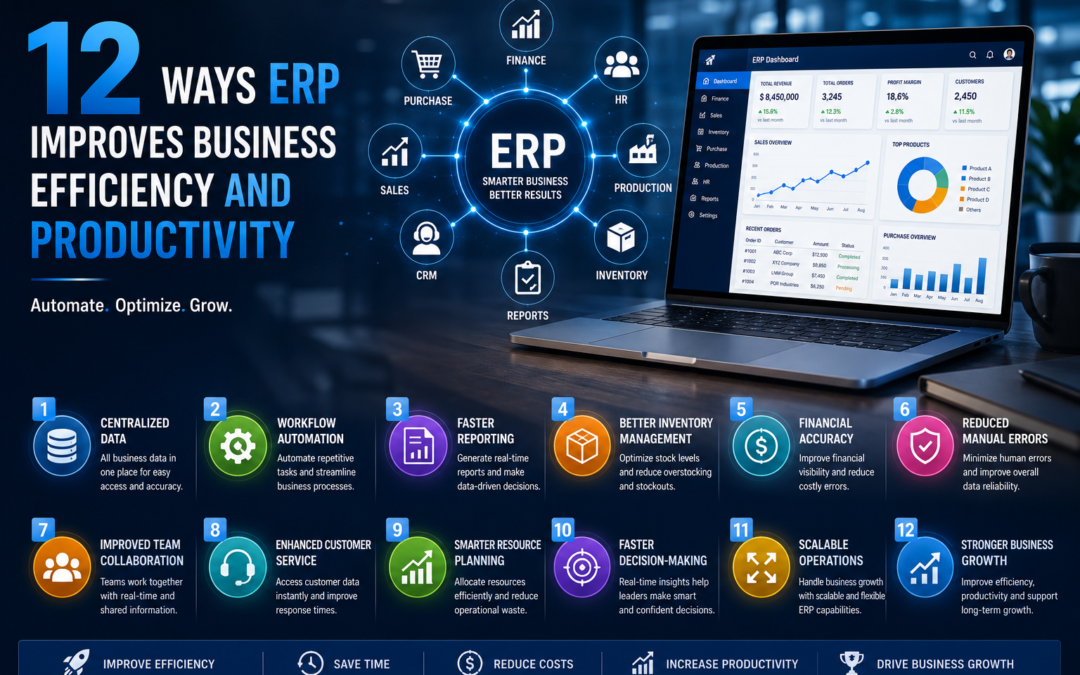
ERP Productivity: 12 Ways ERP Improves Business Efficiency and Productivity
ERP productivity has become a major priority for growing businesses that want to reduce manual work, improve operational control, and increase output without increasing unnecessary costs. As companies expand, disconnected tools and spreadsheet-based processes often slow teams down.
Modern ERP software helps businesses improve business efficiency by connecting departments, automating workflows, centralizing data, and providing real-time insights. With the right ERP system, teams can complete tasks faster, reduce errors, and make better decisions.
In this guide, we will explore 12 practical ways ERP improves productivity, supports workflow automation, and contributes to long-term business growth.
Table of Contents
- Why ERP Productivity Matters
- Centralized Business Data
- Automated Daily Workflows
- Faster Reporting
- Better Inventory Control
- Improved Financial Accuracy
- Reduced Manual Errors
- Improved Team Collaboration
- Better Customer Service
- Smarter Resource Planning
- Faster Decision-Making
- Scalable Operations
- Stronger Business Growth
- Common ERP Productivity Mistakes
- Frequently Asked Questions
Why ERP Productivity Matters for Business Efficiency
Productivity is not only about working faster. It is about using better systems, reducing repetitive tasks, improving coordination, and allowing teams to focus on high-value work.
An ERP system creates a single platform for business operations, making it easier for departments to work together and access accurate information.
ERP productivity improvements can help businesses achieve:
- Faster workflows
- Reduced manual work
- Improved reporting accuracy
- Better resource utilization
- Stronger team coordination
- Higher operational efficiency
- Sustainable business growth
12 Ways ERP Improves Business Efficiency and Productivity
1. ERP Productivity Starts With Centralized Business Data
ERP software brings important business data into one centralized platform. This eliminates the need to search through multiple spreadsheets, emails, or disconnected tools.
- Sales data
- Customer records
- Inventory details
- Finance reports
- Purchase information
- HR records
Centralized data improves accuracy and saves time across departments.
2. Workflow Automation Reduces Repetitive Tasks
Workflow automation is one of the biggest advantages of ERP software. It reduces manual work and allows employees to focus on strategic responsibilities.
- Automatic invoice generation
- Purchase approval workflows
- Inventory update alerts
- Order processing automation
- Payroll workflows
3. ERP Software Speeds Up Reporting
Manual reporting takes time and often leads to errors. ERP systems provide real-time reports and dashboards that help teams access accurate information quickly.
Faster reporting improves planning, reviews, and management decisions.
4. Improves Inventory and Stock Control
ERP software helps businesses track inventory levels, stock movement, demand trends, and reorder points more effectively.
This reduces stock shortages, overstocking, and unnecessary inventory costs.
5. Strengthens Financial Accuracy
Finance teams benefit from ERP systems because transactions, billing, expenses, and reports are managed in one place.
- Better cash flow visibility
- Accurate invoicing
- Expense control
- Tax-ready reporting
- Budget monitoring
6. Reduces Manual Errors
Manual data entry can create costly mistakes. ERP software reduces errors by automating processes and maintaining consistent data across departments.
This improves operational reliability and business efficiency.
7. Improves Team Collaboration
When all teams use the same ERP system, communication becomes faster and more accurate.
Sales, finance, operations, inventory, and management teams can work with shared real-time data instead of outdated information.
8. Enhances Customer Service
ERP systems help teams access customer orders, payment status, delivery updates, and service history quickly.
This enables faster response times and better customer experiences.
9. Supports Smarter Resource Planning
ERP software helps businesses plan manpower, inventory, budgets, production capacity, and purchasing needs more effectively.
Better resource planning improves productivity and reduces waste.
10. Enables Faster Decision-Making
ERP dashboards provide leaders with real-time performance insights. This helps decision-makers identify trends, risks, and opportunities faster.
You can learn more about enterprise software trends from Gartner IT Research.
11. Supports Scalable Operations
As businesses grow, operations become more complex. ERP systems provide scalable processes that can support more users, departments, locations, and transactions.
12. Drives Long-Term Business Growth
ERP productivity improvements directly support business growth by improving efficiency, reducing costs, and helping teams perform better.
A productive ERP-driven business can scale faster with stronger control and visibility.
Common ERP Productivity Mistakes Businesses Should Avoid
- Using ERP without clear process mapping
- Not training employees properly
- Failing to automate repetitive workflows
- Ignoring data quality
- Not customizing reports for decision-makers
- Using ERP only as a data entry tool
- Not reviewing productivity KPIs
Frequently Asked Questions
What is ERP productivity?
ERP productivity refers to how ERP software improves efficiency, reduces manual work, speeds up workflows, and helps teams complete tasks more effectively.
How does ERP improve business efficiency?
ERP improves business efficiency by centralizing data, automating workflows, reducing errors, improving reporting, and connecting departments.
What is workflow automation in ERP?
Workflow automation in ERP uses software rules to automate repetitive tasks such as approvals, invoice generation, order updates, and reporting.
Can ERP software support business growth?
Yes. ERP software supports business growth by improving scalability, productivity, operational visibility, and resource planning.
Is ERP suitable for growing companies?
Yes. ERP is highly useful for growing companies that need better control over finance, inventory, sales, operations, and reporting.
Internal Linking Opportunities
- ERP Solutions
- Business Automation Services
- Workflow Automation Services
- Enterprise Software Development
- Digital Transformation Solutions
Conclusion
ERP productivity plays a major role in improving business efficiency and operational performance.
By using ERP software for centralized data, workflow automation, real-time reporting, inventory control, financial accuracy, collaboration, and resource planning, businesses can become more productive and scalable.
For companies focused on business growth, ERP is a strategic investment that improves both daily operations and long-term performance.
Ready to Improve Productivity With ERP?
Our ERP experts help businesses implement ERP software solutions that improve workflow automation, business efficiency, and scalable growth.
Get a Free ERP Consultation