
Call Logicraftz Professionals +912231982472 to upgrade ERP software, business technology, digital transformation, and enterprise software solutions for 2026 growth.
ERP Trends: 11 Powerful Changes Shaping 2026
A practical guide to modern ERP software, business technology, digital transformation, automation, analytics, and scalable enterprise software.
Introduction
ERP trends are changing how modern businesses manage finance, inventory, sales, HR, procurement, customer service, operations, and decision-making. In 2026, businesses are no longer looking for basic systems that only store data. They need intelligent, connected, scalable, secure, and automation-ready platforms.
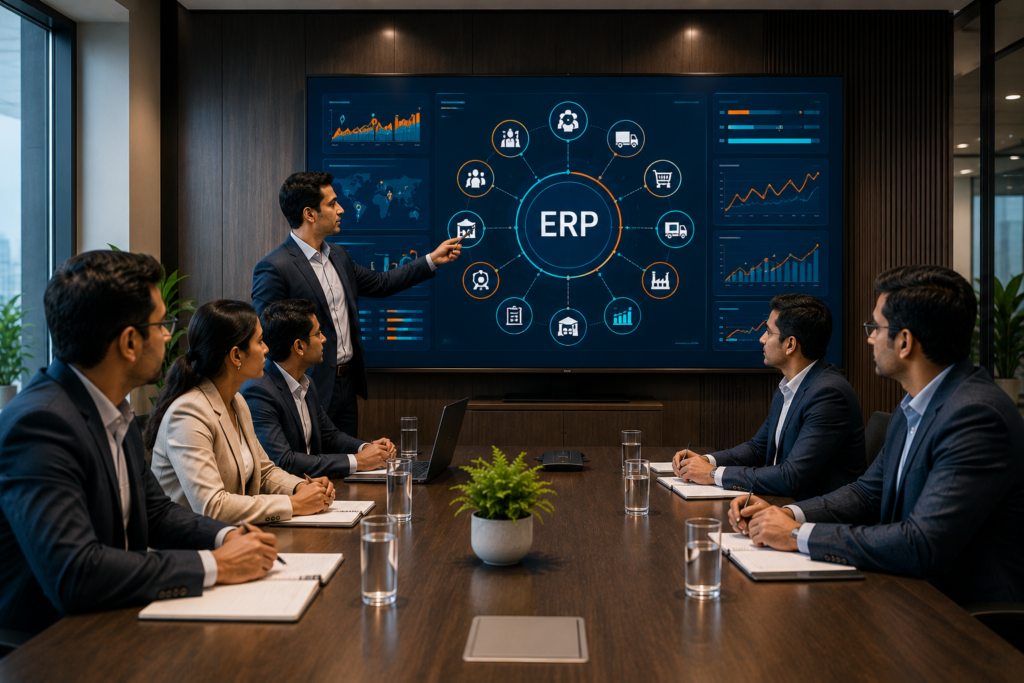
Modern ERP software is becoming a central part of business technology. It helps organizations reduce manual work, improve control, connect departments, and make faster decisions using real-time insights.
As companies focus on digital transformation, ERP systems are evolving into powerful enterprise software platforms that support automation, analytics, mobility, cybersecurity, and long-term business growth.

Table of Contents
- Why ERP Trends Matter in 2026
- 1. Cloud ERP Adoption
- 2. AI-Powered ERP
- 3. Workflow Automation
- 4. Real-Time Analytics
- 5. Mobile ERP Access
- 6. Industry-Specific ERP
- 7. ERP and CRM Integration
- 8. Stronger ERP Cybersecurity
- 9. Low-Code ERP Customization
- 10. IoT and ERP Connectivity
- 11. Scalable Enterprise Software
- Traditional ERP vs Modern ERP
- Common ERP Technology Mistakes
- Frequently Asked Questions
Why ERP Trends Matter for Business Management in 2026
Business management is becoming more data-driven, automated, and technology-focused. Companies need systems that provide visibility, flexibility, security, and integration across multiple departments.
ERP trends matter because they show where enterprise software is heading and how businesses can prepare for future operational needs. Organizations that upgrade at the right time can improve productivity, reduce data silos, and make better decisions.
Routine approvals, reports, and workflows can be automated.
Leaders get clearer access to real-time business data.
Modern systems include stronger access control and protection.
Cloud, mobile, AI, and integrations support future growth.
1. Cloud ERP Adoption
Cloud ERP is one of the biggest movements in modern enterprise software. Businesses are shifting from traditional on-premise systems to cloud-based platforms because they need flexibility, faster deployment, remote access, and easier scalability.
Benefits of Cloud ERP
- Remote access for teams and decision-makers
- Lower infrastructure dependency
- Automatic updates and easier maintenance
- Better scalability for growing businesses
- Faster deployment compared with traditional systems
Cloud-based systems are especially useful for companies with multiple locations, hybrid teams, and growing transaction volumes.
2. AI-Powered ERP Software
Artificial intelligence is making ERP software smarter. AI can help businesses analyze patterns, predict demand, automate recommendations, and detect possible risks before they become serious problems.
AI ERP Use Cases
- Predictive analytics
- Demand forecasting
- Smart inventory planning
- Automated insights
- Risk detection
- Finance and cash-flow forecasting
AI-driven insights help business leaders move from reactive decisions to proactive planning.
3. Advanced Workflow Automation
ERP systems are becoming stronger workflow automation platforms. Businesses can automate approvals, invoicing, reporting, order updates, inventory alerts, and task assignments.
This reduces manual work and improves process consistency across departments. Automation also helps managers identify delays and bottlenecks faster.
Processes That Can Be Automated
- Purchase approvals
- Invoice processing
- Inventory notifications
- Order updates
- HR requests
- Finance reporting
4. Real-Time Analytics and Business Intelligence
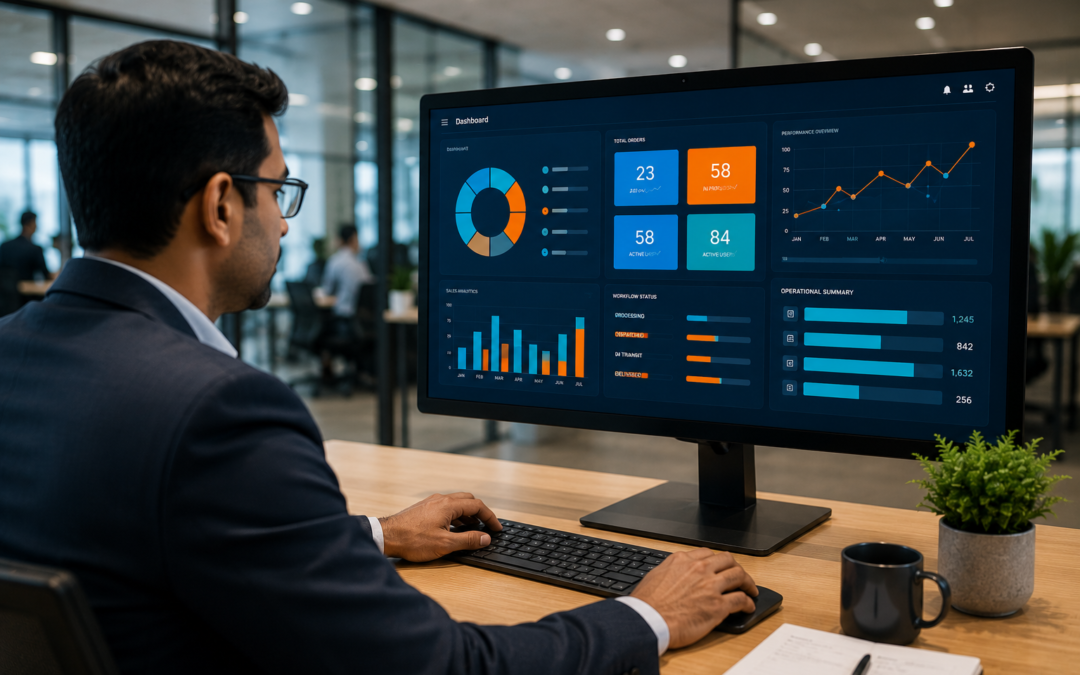
Real-time analytics is now essential for business management. ERP dashboards help leaders monitor finance, inventory, sales, HR, procurement, and operations instantly.
Better analytics supports faster and more confident decision-making because leaders do not have to wait for manually prepared reports.
Analytics Can Help Track
- Sales performance
- Inventory movement
- Procurement status
- Cash flow
- Operational costs
- Department performance
5. Mobile ERP Access
Business leaders and teams need access to ERP data from anywhere. Mobile ERP allows users to approve workflows, view reports, manage tasks, and track operations from smartphones or tablets.
This trend supports remote teams, field employees, traveling executives, and hybrid work environments. Mobile access also helps teams respond faster to urgent business activities.
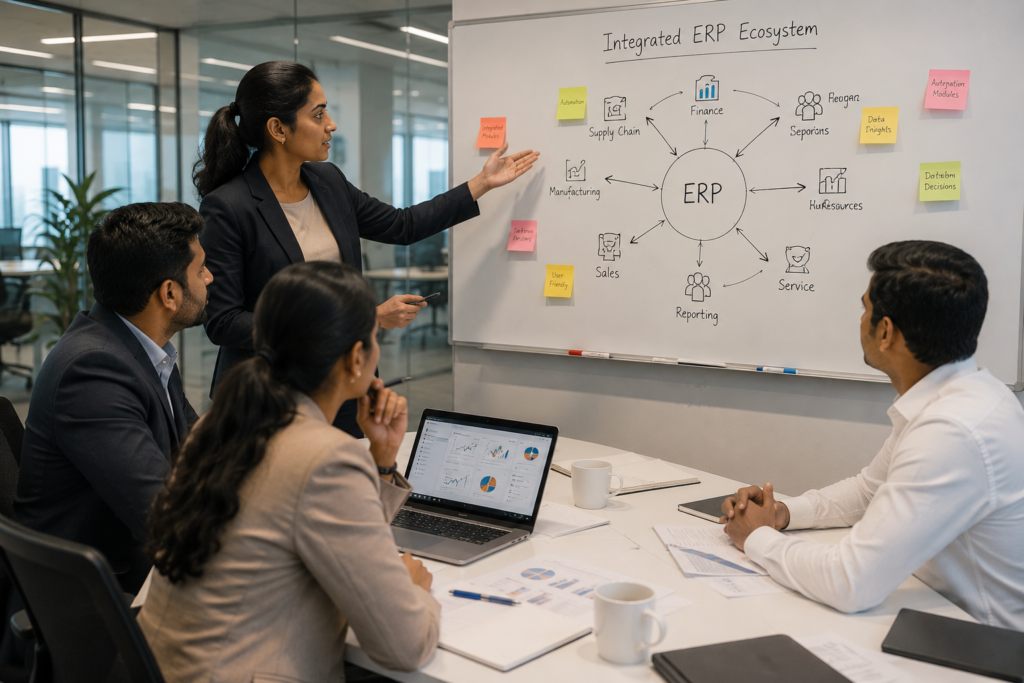
Mobile ERP access helps teams manage approvals and reports from anywhere
6. Industry-Specific ERP Solutions
Businesses increasingly prefer systems tailored to their industry requirements. A manufacturing company, healthcare organization, logistics firm, and retail business all need different workflows, reports, and compliance controls.
Industries Using Specialized ERP
- Manufacturing
- Retail
- Healthcare
- Construction
- Logistics
- Professional services
- Trading and distribution
Industry-focused platforms reduce unnecessary customization and help companies go live faster with relevant workflows.
7. ERP and CRM Integration
ERP and CRM integration is becoming more important for businesses that want a complete view of customers, sales, orders, billing, inventory, and service history.
When sales and operations are connected, teams can improve customer management, order fulfillment, invoicing, and sales efficiency.
Integration Helps Connect
- Customer records
- Sales orders
- Inventory availability
- Billing and invoices
- Service requests
- Delivery updates
8. Stronger ERP Cybersecurity
ERP platforms store sensitive financial, operational, employee, supplier, customer, and business data. This makes cybersecurity a major priority for modern organizations.
Important Security Features
- Role-based access
- Multi-factor authentication
- Data encryption
- Activity monitoring
- Regular backups
- Access logs
Strong security helps protect business information while maintaining compliance and user accountability.

9. Low-Code ERP Customization
Low-code customization allows businesses to adapt workflows, forms, reports, dashboards, and approval flows faster without heavy development work.
This makes enterprise software more flexible for changing business needs. Teams can adjust processes faster while reducing dependency on long development cycles.
10. IoT and ERP Connectivity
IoT integration is becoming valuable for industries that need machine data, warehouse visibility, production tracking, equipment monitoring, and asset management.
ERP connected with IoT devices can provide real-time operational updates. This is useful for manufacturing, logistics, utilities, smart warehouses, and asset-heavy businesses.
IoT Can Support
- Machine monitoring
- Production tracking
- Warehouse visibility
- Asset performance
- Predictive maintenance
- Inventory updates
11. Scalable Enterprise Software for Growth
Modern businesses need ERP systems that can scale with more users, departments, locations, transactions, reports, and integrations. A scalable platform supports expansion without forcing businesses to rebuild their technology foundation every few years.
Scalability is especially important for growing companies planning new branches, larger teams, more products, or stronger digital operations.
You can learn more about enterprise technology planning from Gartner IT Research and Oracle ERP Guide.
Traditional ERP vs Modern ERP System
| Area | Traditional ERP | Modern ERP |
|---|---|---|
| Deployment | Mostly on-premise | Cloud-ready and remote accessible |
| Automation | Limited workflow automation | Advanced approvals, alerts, and process automation |
| Analytics | Static reports | Real-time dashboards and business intelligence |
| Customization | Slow and developer-heavy | Flexible, low-code, and scalable |
| Security | Basic access control | Role-based access, encryption, monitoring, and backups |
Common ERP Technology Mistakes Businesses Should Avoid
Legacy systems can limit automation, reporting, and scalability.
Cloud readiness supports remote teams and faster updates.
Your platform should support users, locations, and transaction growth.
Security planning is critical because ERP systems store sensitive data.
Disconnected tools create duplicate work and data gaps.
Manual workflows reduce productivity and slow down decision-making.
Continue Reading
Frequently Asked Questions
Q: What are ERP trends?
ERP trends are developments in ERP software and enterprise technology that shape how businesses manage operations, automation, reporting, and growth.
Q: Why is ERP software important in 2026?
ERP software is important because it helps businesses centralize data, automate workflows, improve reporting, and support digital transformation.
Q: How does ERP support business technology?
ERP supports business technology by connecting departments, improving analytics, enabling automation, and integrating with other business tools.
Q: What role does ERP play in digital transformation?
ERP provides a foundation for digital transformation by improving data visibility, workflow automation, cloud access, and scalable operations.
Q: Is cloud ERP useful for growing businesses?
Yes. Cloud ERP is useful for growing businesses because it offers flexibility, remote access, faster updates, and easier scalability.
Ready to Upgrade With Modern ERP Software?
A future-ready ERP system helps businesses improve automation, analytics, digital transformation, reporting, and scalable operations.
Logicraftz Solutions LLP helps businesses implement enterprise software solutions for automation, business intelligence, cloud access, and long-term growth.
Introduction
In today's competitive business environment, organizations are under constant pressure to improve efficiency, reduce operational costs, and deliver better customer experiences. Managing finance, inventory, procurement, production, human resources, and customer service through disconnected systems often creates delays, duplicate work, and inconsistent reporting. To overcome these challenges, companies are increasingly investing in ERP software that connects every department through a single digital platform.
Modern enterprise software helps businesses streamline operations, improve collaboration, and gain complete visibility into organizational performance. Combined with innovative business technology, organizations can simplify complex workflows, eliminate manual processes, and make data-driven decisions that support long-term growth. As industries continue evolving, digital transformation has become an essential strategy for businesses seeking to remain competitive and adaptable.
Whether operating in manufacturing, healthcare, retail, logistics, education, construction, hospitality, or professional services, organizations benefit from centralized systems that improve productivity while creating a foundation for future expansion.
Understanding ERP Software
ERP software is an integrated management platform that combines multiple business functions into one centralized system. Instead of using separate applications for accounting, purchasing, inventory, production, sales, payroll, and reporting, employees work from a unified environment where information is updated automatically across departments.
This centralized approach reduces duplicate data entry, improves accuracy, and ensures everyone has access to reliable information. Business leaders gain greater visibility into operations, allowing them to monitor performance, identify bottlenecks, and respond quickly to changing market conditions.
A unified platform also supports better communication between teams, creating smoother workflows and improving overall operational efficiency.
Why Business Technology Matters
Modern organizations generate enormous amounts of operational data every day. Without the right systems, managing this information becomes increasingly difficult as the business grows.
Advanced business technology enables organizations to organize data, automate routine activities, and improve collaboration across departments. Employees spend less time performing repetitive administrative work and more time focusing on strategic initiatives that create value.
Some key advantages include:
- Faster communication
- Improved operational visibility
- Better reporting accuracy
- Reduced paperwork
- Enhanced collaboration
- Improved resource planning
- Better financial control
- Increased employee productivity
- Stronger decision-making
- Sustainable organizational growth
Technology is no longer simply a support function—it has become a core driver of operational excellence.
The Role of Digital Transformation
Businesses today operate in an environment where customer expectations, market conditions, and technology continue to evolve rapidly.
Digital transformation involves redesigning business processes using modern technology to improve efficiency, agility, and customer experience. Rather than digitizing existing paperwork, organizations rethink how departments collaborate and how information flows throughout the business.
Successful transformation initiatives often include:
- Process optimization
- Workflow automation
- Cloud adoption
- Data analytics
- Artificial intelligence
- Mobile accessibility
- Business intelligence
- Secure collaboration
- Integrated reporting
- Continuous improvement
Organizations that embrace these innovations position themselves for greater flexibility and long-term competitiveness.
Benefits of Enterprise Software
Modern enterprise software provides businesses with a connected operational environment that improves performance across every department.
Key benefits include:
- Centralized business information
- Improved operational consistency
- Better financial visibility
- Enhanced inventory management
- Faster reporting
- Increased transparency
- Better compliance support
- Simplified document management
- Improved collaboration
- Higher operational efficiency
Employees no longer need to switch between multiple applications or manually transfer information from one department to another.
Instead, data moves automatically throughout the organization, reducing delays and improving accuracy.
Improve Collaboration Across Every Department
Business success depends on effective communication between teams.
Integrated platforms connect finance, procurement, inventory, production, human resources, sales, customer support, and executive management using one centralized database.
When departments work with the same information, they can coordinate activities more efficiently, reduce misunderstandings, and improve service quality.
Managers gain complete visibility into business operations while employees can make faster decisions using accurate, real-time information.
This collaborative environment strengthens operational performance while supporting sustainable business growth.
Automating Business Processes for Greater Efficiency
Organizations perform hundreds of operational activities every day, many of which are repetitive and time-consuming. Manual approvals, purchase requests, invoice processing, document sharing, inventory updates, payroll preparation, and reporting consume valuable employee time that could be better spent on strategic work.
Automation simplifies these activities by creating predefined workflows that reduce human intervention and improve consistency. Routine tasks can move automatically from one department to another, ensuring every process follows standardized business rules.
Benefits of automation include:
- Faster approvals
- Reduced operational delays
- Improved document accuracy
- Better process visibility
- Lower administrative costs
- Increased employee productivity
- Consistent business procedures
- Fewer manual errors
- Improved accountability
- Better customer service
Employees can focus on innovation, planning, and customer relationships instead of repetitive administrative responsibilities.
Real-Time Data Improves Business Decisions
Business leaders require accurate information to make confident decisions. Waiting for manually prepared reports often delays important actions and limits organizational agility.
Modern reporting dashboards provide immediate access to operational information such as financial performance, purchasing activities, inventory movement, production output, employee productivity, and customer demand.
Having real-time visibility allows management teams to:
- Identify operational bottlenecks
- Monitor department performance
- Improve forecasting
- Allocate resources effectively
- Control operational expenses
- Track organizational objectives
- Measure productivity
- Evaluate financial performance
- Support strategic planning
- Respond quickly to market changes
Organizations that use reliable data consistently outperform businesses relying on assumptions or outdated information.
Cloud Computing Supports Business Growth
Cloud computing has changed the way organizations manage technology infrastructure.
Instead of maintaining expensive on-premise servers, businesses can securely access information from any location using internet-connected devices.
Cloud deployment offers several advantages:
- Lower infrastructure investment
- Automatic software updates
- Secure backups
- Remote accessibility
- Better scalability
- Business continuity
- Improved collaboration
- Simplified maintenance
- Faster implementation
- Enhanced security
These capabilities allow organizations to expand operations without significant technology investments.
Remote teams also benefit from instant access to business information regardless of their physical location.
Financial Management Made Simpler
Financial visibility plays an important role in organizational success.
Integrated financial modules simplify processes including:
- General ledger
- Accounts payable
- Accounts receivable
- Budget planning
- Expense tracking
- Cash flow management
- Asset monitoring
- Financial reporting
- Tax preparation
- Bank reconciliation
Centralized financial information enables organizations to monitor profitability while improving compliance and reducing accounting errors.
Management gains greater confidence when making investment and budgeting decisions.
Inventory and Supply Chain Optimization
Maintaining accurate inventory is essential for controlling operational costs and ensuring timely customer deliveries.
Organizations can improve inventory management by monitoring:
- Stock availability
- Warehouse movement
- Supplier performance
- Purchase orders
- Material consumption
- Product demand
- Delivery schedules
- Stock valuation
- Inventory turnover
- Reorder levels
Better inventory visibility reduces unnecessary purchases while minimizing stock shortages.
Supply chain coordination also becomes more efficient because procurement, warehousing, and production teams work with the same information.
Human Resource Efficiency
Employees remain one of the most valuable assets of any organization.
Modern workforce management solutions simplify administrative responsibilities while improving employee experiences.
Organizations can efficiently manage:
- Employee records
- Attendance
- Payroll
- Leave requests
- Performance reviews
- Recruitment
- Training
- Compliance documentation
- Workforce planning
- Employee reporting
Reducing administrative workload enables HR professionals to focus on employee development and organizational culture.
Manufacturing and Production Planning
Manufacturing organizations require precise coordination between purchasing, inventory, production, quality control, and distribution.
Integrated systems provide complete visibility into manufacturing operations by monitoring:
- Production schedules
- Material availability
- Work orders
- Machine utilization
- Product quality
- Manufacturing costs
- Finished goods
- Maintenance planning
- Production timelines
- Capacity utilization
These insights improve operational efficiency while reducing production delays and unnecessary waste.
Logicraftz: Your Digital Transformation Partner
Logicraftz helps businesses modernize operations by delivering customized solutions designed around real business requirements rather than generic templates. Every implementation begins with understanding existing workflows, identifying operational challenges, and creating practical solutions that improve efficiency across departments.
The company offers expertise in ERP implementation, AI-powered automation, cloud solutions, website development, mobile applications, system integration, reporting, and digital consulting. Businesses receive complete support throughout consultation, planning, customization, deployment, employee training, and ongoing technical assistance.
Logicraftz focuses on delivering scalable technology that adapts as organizations grow. Whether a business operates in manufacturing, healthcare, retail, logistics, education, hospitality, or professional services, every solution is developed to improve collaboration, streamline operations, and support long-term success.
With a strong commitment to innovation and customer satisfaction, Logicraftz enables organizations to simplify complex operations while improving productivity, transparency, and decision-making.
Preparing for the Future
Technology continues to evolve rapidly, creating new opportunities for organizations willing to embrace innovation. Artificial intelligence, predictive analytics, cloud computing, Internet of Things (IoT), machine learning, and advanced business intelligence are reshaping how companies operate and compete.
Organizations that continuously invest in operational improvement remain better prepared for future challenges while delivering greater value to customers and stakeholders.
Success is no longer determined only by products or services. It also depends on how effectively businesses manage information, optimize resources, improve collaboration, and adapt to changing market conditions.
By implementing connected operational platforms and continuously refining internal processes, organizations create a strong foundation for sustainable growth, improved efficiency, better decision-making, and long-term business excellence in an increasingly digital economy.