

Call Logicraftz Professionals +912231982472 to improve CRM best practices, sales CRM usage, sales management, customer relationship management, and lead tracking for your sales team.
CRM Best Practices: 9 Powerful Tips for Sales Teams
A practical sales team guide to improve sale CRM usage, sales management, customer relationship management, lead tracking, follow-ups, and revenue performance.
Introduction
CRM best practice help sales teams use CRM software in a more organized, consistent, and result-driven way. A CRM system can store leads, customer records, sales activities, follow-ups, reports, and communication history, but it only delivers real value when the sales team follows the right process every day.
Many businesses invest in a sale CRM, but the system becomes ineffective when data is incomplete, follow-ups are missed, pipelines are not updated, and reports are ignored. The goal is not only to use software, but to improve sales management, strengthen customer relationship management, and make lead tracking easier for every salesperson.
This guide explains 9 practical CRM best practice that sales teams can follow to improve productivity, response time, customer communication, sales visibility, and deal conversion.
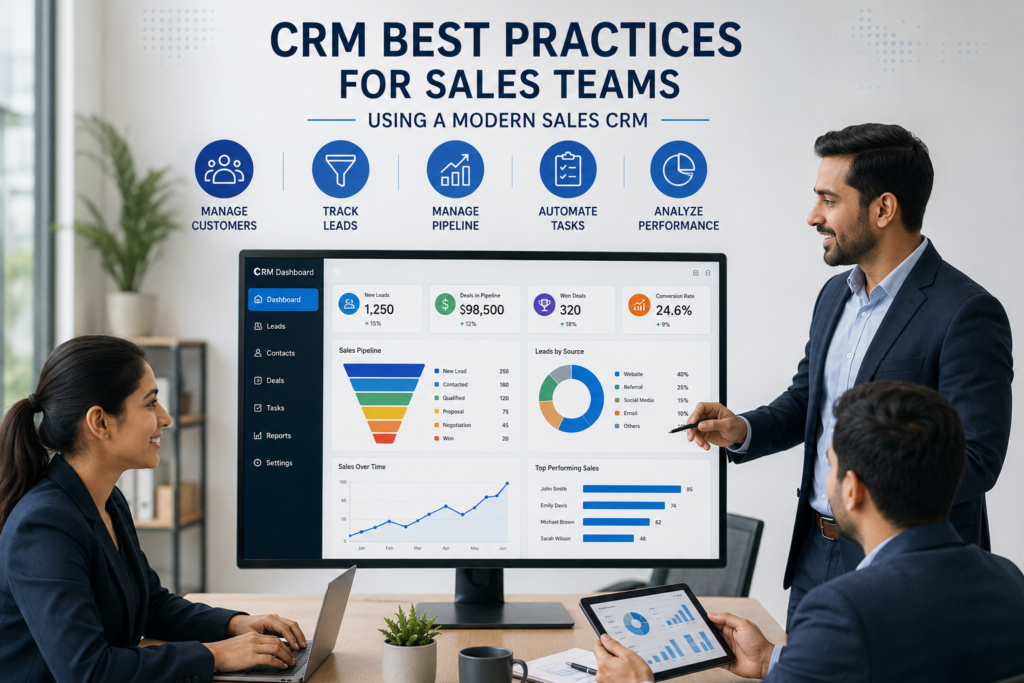
CRM best practice for sales teams using a modern sale CRM
Table of Contents
- What Are CRM Best Practice?
- Why CRM Best Practice Matter for Sales Teams
- Benefits of Using CRM Correctly
- 1. Keep CRM Data Clean and Updated
- 2. Define Clear Sales Pipeline Stages
- 3. Track Every Lead Properly
- 4. Set Follow-Up Reminders
- 5. Use Lead Scoring
- 6. Automate Repetitive Sales Tasks
- 7. Review CRM Reports Weekly
- 8. Improve Customer Communication
- 9. Train Sales Teams Regularly
- Manual Sales Process vs Sales CRM
- Common CRM Usage Mistakes
- FAQ: CRM Best Practices
What Are CRM Best Practices?
CRM best practice are proven methods sales teams use to manage customer data, track leads, organize pipelines, schedule follow-ups, and review sales performance through CRM software. These practices help teams avoid missed opportunities and create a more reliable sales process.
A CRM platform should not be used only as a contact list. It should support sales planning, customer communication, lead tracking, reporting, task reminders, deal management, and customer relationship management. When used correctly, CRM becomes a central system for sales growth.
A Strong CRM Process Includes
- Clean and updated customer data
- Clear sales pipeline stages
- Consistent lead tracking
- Follow-up reminders
- Sales automation workflows
- Weekly sales reports
- Customer communication history
- Regular sales team training
Why CRM Best Practices Matter for Sales Teams
Sales teams handle calls, emails, proposals, meetings, demos, follow-ups, negotiations, and customer questions every day. Without a structured CRM process, it becomes easy to forget leads, delay responses, lose customer history, and miss revenue opportunities.
CRM best practice create consistency. They help every salesperson follow the same process from new lead capture to deal closure. This improves visibility for managers and gives the sales team a clear path for customer relationship management.
Every enquiry is recorded, assigned, and followed up properly.
Managers can track pipeline movement, team activity, and conversion performance.
Teams can view customer history before every call or meeting.
Automation and reminders reduce repetitive manual work.
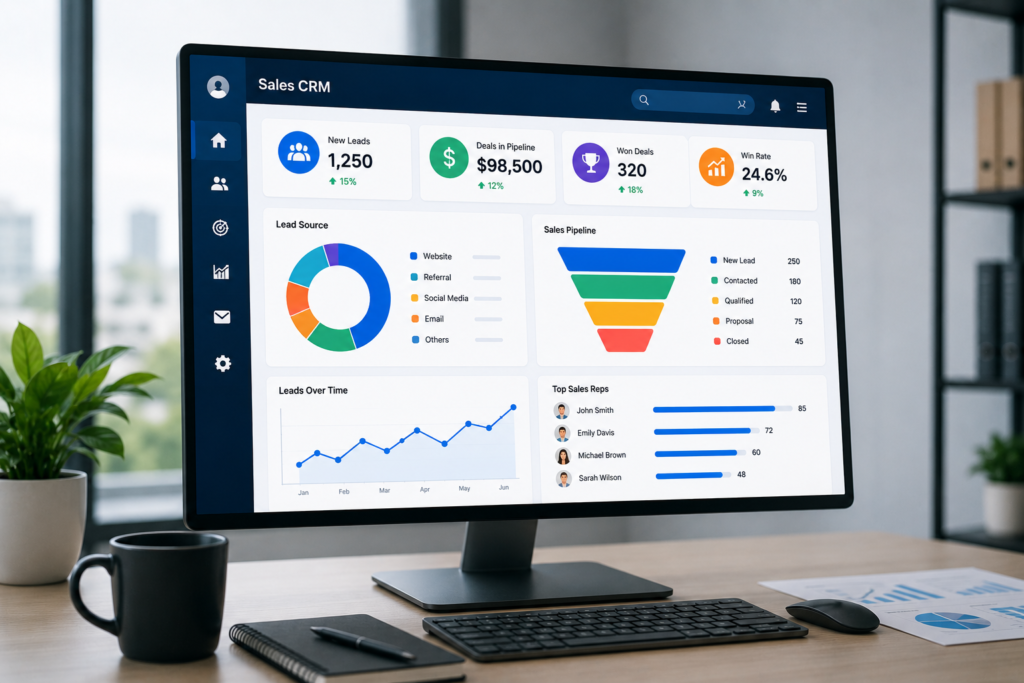
Sales CRM dashboard for lead tracking and sales management
Benefits of Using CRM Correctly
When sales teams follow the right CRM process, the system becomes a powerful sales management tool. It helps businesses reduce confusion, speed up follow-ups, improve customer conversations, and increase deal conversion.
1. Cleaner Customer Data
Accurate customer records help sales teams make better decisions and avoid duplicate follow-ups.
2. Better Sales Visibility
Managers can view lead status, pipeline value, deal stage, team activity, and sales performance.
3. Faster Follow-Ups
CRM reminders help sales teams connect with prospects at the right time.
4. Stronger Customer Communication
Teams can personalize communication using customer history and previous interactions.
5. Better Lead Tracking
Every lead can be tracked from enquiry to conversion, including source and deal status.
6. Improved Sales Growth
Consistent CRM usage helps teams close more deals and improve revenue predictability.
1. Keep CRM Data Clean and Updated
Clean data is one of the most important CRM best practice for sales teams. If contact details are wrong, lead status is outdated, or customer history is incomplete, the sale CRM becomes unreliable.
Sales Teams Should Regularly Update
- Customer name and contact details
- Email address and phone number
- Lead source
- Deal stage
- Follow-up date
- Customer notes
- Communication history
Pro Tip: Make CRM updates mandatory after every customer call, meeting, email, or proposal discussion.
2. Define Clear Sales Pipeline Stages
A sales pipeline helps teams understand where each opportunity stands. Clear pipeline stages make sales management easier and help managers forecast revenue more accurately.
Common Sales Pipeline Stages
- New lead
- Contacted
- Qualified
- Demo or meeting scheduled
- Proposal sent
- Negotiation
- Closed won
- Closed lost
Every stage should have a clear meaning. This avoids confusion and keeps lead tracking consistent across the sales team.
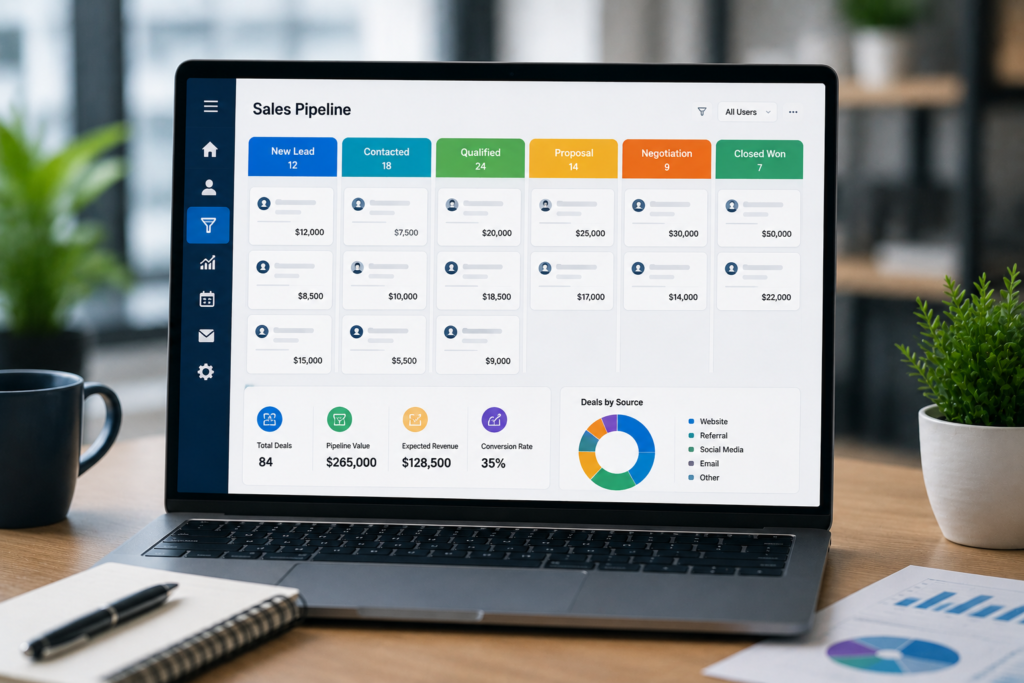
Sales pipeline management inside a modern sale CRM
3. Track Every Lead Properly
Lead tracking should start from the moment a customer enquiry enters the business. Whether the lead comes from a website form, phone call, referral, social media, email campaign, or paid ad, it should be added to the CRM immediately.
Lead Tracking Should Include
- Lead source
- Customer requirement
- Budget range
- Salesperson assigned
- Follow-up date
- Current stage
- Next action
This practice helps sales teams avoid missed opportunities and gives managers better insight into which marketing channels are generating quality leads.
4. Set Follow-Up Reminders
Many sales opportunities are lost because follow-ups are delayed or forgotten. CRM reminders help sales teams stay consistent with calls, emails, meetings, proposal follow-ups, and renewal conversations.
Useful CRM Follow-Up Reminders
- Call back reminders
- Proposal follow-ups
- Meeting reminders
- Payment follow-ups
- Renewal reminders
- Customer check-ins
Follow-up discipline is one of the simplest ways to improve customer relationship management and increase conversion rates.
5. Use Lead Scoring for Better Prioritization
Not every lead has the same value or urgency. Lead scoring helps sales teams identify which prospects are more likely to convert. This improves time management and helps teams focus on high-potential opportunities first.
Lead Scoring Can Consider
- Budget readiness
- Service requirement
- Decision timeline
- Customer engagement
- Company size
- Past interactions
- Fit with your services
A well-structured lead scoring process improves sales CRM efficiency and helps sales teams avoid wasting time on low-priority enquiries.
6. Automate Repetitive Sales Tasks
Sales automation helps teams save time and reduce manual effort. A good CRM system can automate repetitive actions while still allowing personalized customer communication.
Tasks You Can Automate
- New lead assignment
- Follow-up reminders
- Email sequences
- Task creation
- Pipeline notifications
- Lead status updates
- Weekly reports
Automation should support salespeople by reducing routine work. It should not make communication feel robotic or impersonal.
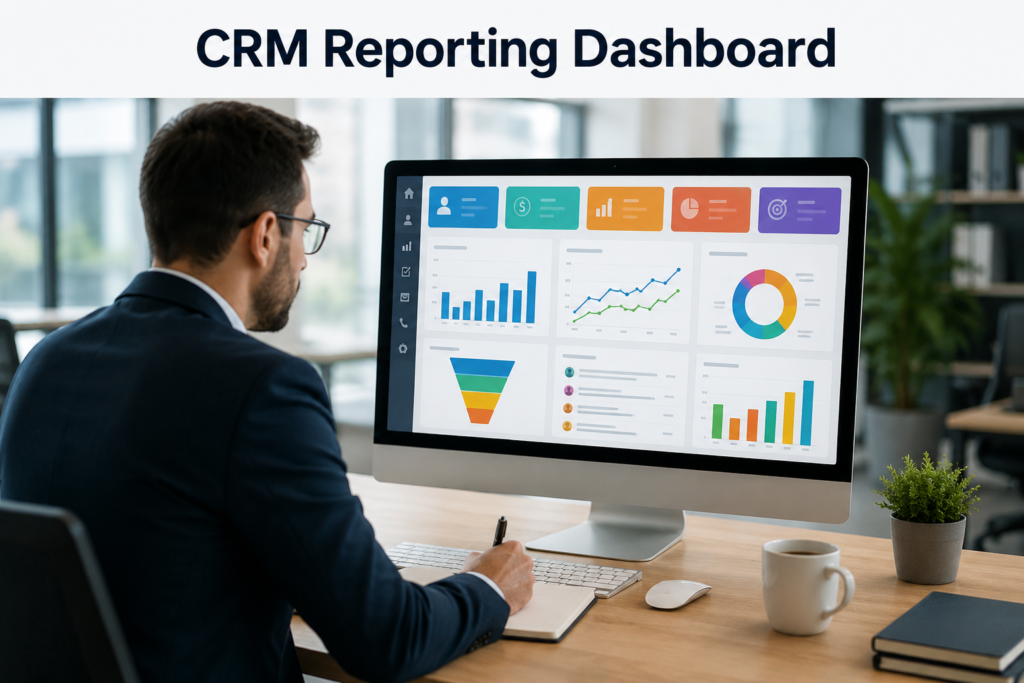
CRM reporting dashboard for sales management and performance tracking
7. Review CRM Reports Weekly
CRM reports help sales managers understand what is working and what needs improvement. Weekly reporting creates accountability and helps teams make decisions based on real data instead of assumptions.
Important CRM Reports
- Lead source report
- Pipeline value report
- Conversion rate report
- Sales activity report
- Follow-up completion report
- Lost deal reason report
- Revenue forecast report
You can learn more about CRM and sales performance from Salesforce CRM Guide and HubSpot CRM.
8. Improve Customer Communication
Customer communication becomes stronger when sales teams record every important conversation inside the CRM. This helps any team member understand customer needs, previous discussions, objections, and next steps.
CRM Should Record
- Call notes
- Email history
- Meeting summaries
- Customer objections
- Proposal details
- Support requests
- Follow-up commitments
Better communication improves customer relationship management and creates a more professional sales experience.
9. Train Sales Teams Regularly
CRM training should not happen only once during implementation. Sales teams need regular training to understand new features, reporting methods, pipeline changes, automation rules, and customer management processes.
Training Should Cover
- How to update leads
- How to manage customer records
- How to use pipeline stages
- How to schedule reminders
- How to use automation features
- How to review reports
- How to improve customer communication
Regular training improves user adoption and helps teams get more value from the sales CRM.

Manual Sales Process vs Sales CRM
| Sales Area | Manual Process | With Sales CRM |
|---|---|---|
| Lead Tracking | Leads stored in spreadsheets or emails | Every lead is captured, assigned, and tracked |
| Sales Management | Managers depend on manual updates | Managers view real-time pipeline and activity reports |
| Follow-Ups | Follow-ups may be forgotten | CRM reminders keep teams consistent |
| Customer Relationship Management | Customer history is scattered | Complete customer history is available in one place |
| Reporting | Reports take time to prepare | Live dashboards show sales performance |
Common CRM Usage Mistakes Sales Teams Should Avoid
Missing contact details and lead status reduce CRM accuracy.
Delayed follow-ups can reduce sales conversion.
Unclear stages make sales forecasting difficult.
Without reports, teams cannot identify improvement areas.
CRM should support sales management, automation, and customer communication.
Without training, users may avoid important CRM features.
Continue Reading
FAQ: CRM Best Practices
Q: What are CRM best practice?
CRM best practice are proven methods that help sales teams use CRM software properly for lead tracking, sales management, customer communication, reporting, and pipeline control.
Q: Why are CRM best practice important for sales teams?
They are important because they help sales teams stay organized, reduce missed follow-ups, improve customer relationship management, and increase sales conversion.
Q: How does a sale CRM help with lead tracking?
A sale CRM helps with lead tracking by recording every enquiry, assigning leads to team members, tracking deal stages, and showing follow-up status in one system.
Q: How does CRM improve sales management?
CRM improves sales management by giving managers visibility into pipeline stages, team activity, lead sources, conversion rates, and sales performance reports.
Q: What is customer relationship management in CRM?
Customer relationship management in CRM means storing customer history, communication records, preferences, follow-up details, and service information in one platform.
Q: How often should sales teams update CRM data?
Sales teams should update CRM data after every customer interaction, including calls, emails, meetings, proposals, follow-ups, and deal stage changes.
Q: Can CRM automation improve sales productivity?
Yes. CRM automation improves productivity by handling reminders, lead assignment, task creation, follow-up notifications, and reports so sales teams can focus on closing deals.

Customer relationship management results from better CRM usage
Need Help Improving CRM Usage?
CRM best practice help sales teams improve lead tracking, sales management, customer relationship management, reporting, and follow-up consistency. With the right sale CRM process, your team can close more deals and build stronger customer relationships.
Logicraftz Solutions LLP helps businesses implement CRM systems, automate sales workflows, train sales teams, and improve CRM adoption for measurable business growth.
Build Stronger Sales Processes with a Modern Sales CRM
Every growing business depends on an organized sales process to attract prospects, nurture opportunities, and convert them into loyal customers. A modern Sale CRM acts as the central hub where every interaction, enquiry, quotation, follow-up, and opportunity is managed efficiently. Instead of relying on spreadsheets, emails, and manual reminders, organizations can streamline operations through a single intelligent platform.
As businesses expand, maintaining consistent communication becomes increasingly challenging. Missed follow-ups, scattered customer information, duplicate records, and delayed responses often result in lost revenue. Implementing a structured CRM solution eliminates these obstacles while improving visibility across the entire sales cycle.
A well-designed platform empowers sales representatives, managers, and business owners to make informed decisions using real-time information rather than assumptions.
Simplify Daily Operations with Effective Sales Management
Successful sales management involves much more than assigning leads and monitoring revenue. It requires planning, forecasting, coaching, reporting, and continuous process improvement.
An organized management system enables leaders to:
- Assign enquiries automatically.
- Monitor opportunity progress.
- Track team activities.
- Measure individual performance.
- Forecast future revenue.
- Identify stalled opportunities.
- Review sales targets.
- Improve productivity.
- Reduce manual administration.
- Increase accountability.
Managers gain complete visibility into every stage of the pipeline without spending hours collecting reports from multiple departments.
Strengthen Customer Relationship Management Across Every Touchpoint
Modern customer relationship management focuses on creating meaningful, long-term business relationships rather than simply storing contact details.
Every customer interaction contributes to a complete profile, including:
- Phone conversations
- Email communication
- Meeting notes
- Product interests
- Purchase history
- Support requests
- Feedback records
- Renewal reminders
- Contract information
- Service history
Having this information available in one place allows employees to provide faster, more personalized assistance while improving customer satisfaction.
Organizations that consistently deliver positive experiences often benefit from stronger loyalty, repeat purchases, and valuable referrals.
Improve Efficiency Through Intelligent Lead Tracking
One of the biggest challenges businesses face is losing potential customers because enquiries are not followed up consistently.
Accurate lead tracking helps organizations monitor every opportunity from the first enquiry until conversion.
A structured process typically includes:
- Capturing enquiries from multiple channels.
- Assigning opportunities automatically.
- Recording every communication.
- Monitoring customer engagement.
- Scheduling reminders.
- Updating opportunity stages.
- Measuring conversion rates.
- Identifying inactive prospects.
- Prioritizing high-value opportunities.
- Generating performance reports.
With complete visibility into every opportunity, businesses reduce response times while increasing conversion potential.
Why Businesses Invest in CRM Technology
Digital transformation has changed customer expectations. Buyers expect quick responses, personalized communication, and consistent service regardless of how they contact a business.
CRM technology helps organizations deliver these experiences while reducing administrative work.
Key business advantages include:
- Better organization
- Improved collaboration
- Faster communication
- Centralized information
- Increased transparency
- Higher productivity
- Reduced operational errors
- Better forecasting
- Smarter decision-making
- Sustainable business growth
Instead of working with disconnected tools, teams collaborate using one centralized platform.
Automation Creates Faster Business Processes
Automation is one of the most valuable capabilities of today's CRM platforms.
Instead of manually performing repetitive activities, businesses can automate:
- Welcome emails
- Follow-up sequences
- Appointment reminders
- Task creation
- Opportunity assignment
- Status updates
- Internal notifications
- Quotation approvals
- Customer onboarding
- Renewal alerts
Automation reduces delays while maintaining consistency throughout the customer journey.
Employees spend more time building relationships and less time performing administrative work.
AI is Transforming Modern CRM Systems
Artificial Intelligence continues to reshape how organizations interact with customers.
Advanced CRM platforms now provide:
- Intelligent opportunity scoring
- Customer behavior analysis
- Predictive forecasting
- Automated recommendations
- Smart workflow optimization
- Revenue predictions
- Customer segmentation
- Personalized communication suggestions
- Performance insights
- Business intelligence dashboards
These capabilities enable businesses to identify opportunities earlier and make faster strategic decisions.
Better Visibility Across the Sales Pipeline
Understanding pipeline health is essential for predictable business growth.
A modern CRM provides complete visibility into:
- New enquiries
- Qualified opportunities
- Ongoing discussions
- Proposal submissions
- Negotiation stages
- Closed deals
- Lost opportunities
- Pending approvals
- Renewal schedules
- Customer retention metrics
Managers no longer depend on manual spreadsheets or verbal updates to understand business performance.
Interactive dashboards provide instant access to meaningful information.
Improve Team Collaboration
Customer information often becomes fragmented when departments operate independently.
CRM software brings together:
- Sales teams
- Marketing teams
- Customer support
- Finance departments
- Operations
- Management
Everyone works using the same customer information, reducing duplication while improving communication.
This collaboration creates a smoother customer experience throughout every stage of the relationship.
Data-Driven Decision Making
Successful organizations rely on accurate business data instead of assumptions.
CRM reporting provides valuable insights including:
- Revenue trends
- Conversion percentages
- Customer acquisition costs
- Sales cycle duration
- Team productivity
- Campaign effectiveness
- Customer retention
- Opportunity value
- Average response time
- Business performance indicators
These reports help management identify strengths while improving weaker areas.
Mobile Accessibility for Modern Businesses
Today's workforce is increasingly mobile.
Sales representatives require instant access to customer information regardless of location.
Mobile CRM applications enable employees to:
- Update opportunities
- Schedule meetings
- Access customer records
- Review quotations
- Record meeting notes
- Capture enquiries
- Check dashboards
- Monitor tasks
- Communicate with customers
- Manage activities while traveling
This flexibility improves responsiveness and productivity.
Cloud-Based CRM Advantages
Cloud deployment has become the preferred option for many organizations.
Benefits include:
- Lower infrastructure costs
- Automatic software updates
- Remote accessibility
- Enhanced collaboration
- Improved scalability
- Secure data storage
- Simplified maintenance
- Disaster recovery
- Business continuity
- Faster implementation
Cloud platforms enable organizations to grow without major technology investments.
CRM Integration Improves Business Operations
Modern CRM solutions integrate seamlessly with existing business applications.
Common integrations include:
- ERP software
- Accounting systems
- Email platforms
- Website enquiry forms
- Marketing automation
- WhatsApp communication
- Payment gateways
- Inventory systems
- Customer support tools
- Analytics platforms
These integrations eliminate duplicate data entry while improving operational efficiency.
Industries Successfully Using CRM
Organizations across numerous sectors use CRM platforms to improve customer engagement and operational performance.
Industries include:
- Manufacturing
- Healthcare
- Education
- Retail
- Hospitality
- Financial Services
- Logistics
- Information Technology
- Construction
- Professional Services
- Automotive
- Distribution
- Real Estate
- Consulting
- E-commerce
Every customer-focused organization can benefit from structured relationship management.
Why Logicraftz is Your Trusted CRM Technology Partner
Businesses looking for scalable and intelligent CRM solutions need a partner with both technical expertise and business understanding. Logicraftz develops customized CRM platforms designed to simplify operations, automate business processes, improve collaboration, and support long-term digital transformation.
Rather than offering generic software, Logicraftz builds solutions aligned with your workflow, helping organizations improve efficiency, enhance customer engagement, and accelerate business growth.
The platform supports automation, reporting, intelligent dashboards, workflow customization, cloud deployment, secure data management, and seamless integration with existing business applications.
Whether your objective is improving operational efficiency, increasing productivity, enhancing customer experiences, or supporting future expansion, Logicraftz delivers reliable technology backed by experienced implementation and ongoing support.
Organizations that invest in a modern CRM today are building a stronger foundation for tomorrow's business success. By combining structured processes, intelligent automation, real-time insights, and customer-focused strategies, companies can improve performance, strengthen relationships, and achieve sustainable growth in an increasingly competitive marketplace.