Call Logicraftz Professionals +912231982472 to improve online marketing, digital advertising, lead generation, and marketing campaign strategy.
Online Marketing: 4 Powerful Campaign Steps
A practical guide to building a marketing campaign with digital advertising, lead generation, strong messaging, and performance tracking.
Introduction
Online marketing is one of the most effective ways for businesses to reach the right audience, generate leads, and grow faster in a competitive digital marketplace. However, a successful campaign requires more than simply running ads or posting content online.
A strong marketing campaign needs clear goals, audience research, the right digital channels, persuasive messaging, and accurate performance tracking. When planned properly, digital advertising and lead generation strategies can help businesses attract quality prospects and convert them into customers.
In this guide, we will explain 4 practical steps to create a successful campaign that supports brand visibility, enquiries, conversions, and long-term business growth.

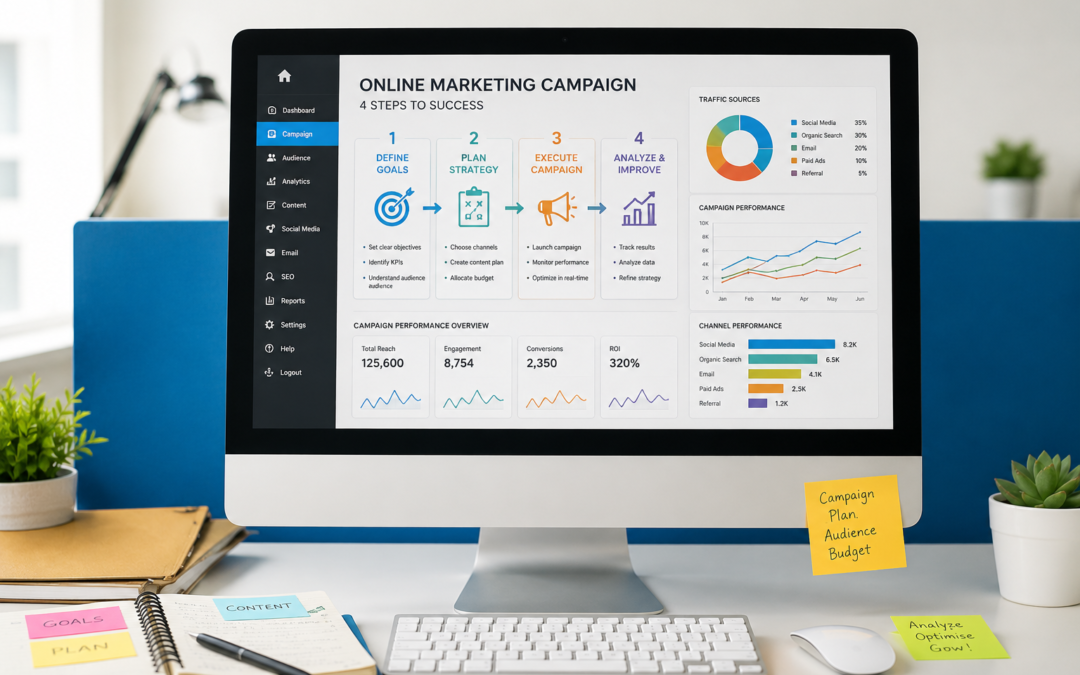
Marketing campaign dashboard for tracking ads, leads, and conversions
Table of Contents
- Why Online Marketing Campaigns Matter
- 1. Define Clear Goals and Target Audience
- 2. Choose the Right Digital Advertising Channels
- 3. Create Strong Messaging and Landing Pages
- 4. Track, Analyze, and Optimize Performance
- Random Promotion vs Strategic Campaign
- Common Campaign Mistakes
- Frequently Asked Questions
Why Online Marketing Campaigns Matter for Business Growth
Customers now discover, compare, and evaluate businesses online before making decisions. A well-planned campaign helps your business appear in front of the right people at the right time.
Instead of relying on random promotions, a structured marketing strategy creates a clear path from awareness to enquiry and conversion. This helps businesses improve visibility, reduce wasted spend, and attract better-quality leads.
Reach people who may need your products or services.
Drive relevant visitors to your website or landing page.
Convert interested users into enquiries and prospects.
Measure results and optimize budget based on performance.
1. Start With Clear Goals and Target Audience
Every successful online marketing campaign begins with clarity. Before creating ads, content, graphics, or landing pages, businesses must define what they want to achieve and who they want to reach.
Clear goals help you decide the right platform, campaign budget, ad message, landing page structure, and performance metrics.
Common Campaign Goals
- Generate qualified leads
- Increase website traffic
- Promote a service or offer
- Improve brand awareness
- Increase sales enquiries
- Grow local visibility
- Improve remarketing performance
Audience Research Should Include
- Customer location
- Age group and profession
- Business type or industry
- Main pain points
- Buying intent
- Preferred digital channels
- Decision-making stage
Understanding your audience helps create messaging that speaks directly to their needs, problems, and decision-making process.
2. Choose the Right Digital Advertising Channels
Different platforms serve different purposes. The right channel depends on your audience, goals, budget, competition, and industry.
For example, Google Ads can work well when users are actively searching for a service, while social media ads can help increase awareness and retarget interested audiences.
Useful Online Marketing Channels
- Google Ads for high-intent search traffic
- Social media ads for awareness and engagement
- LinkedIn Ads for B2B targeting
- Email marketing for lead nurturing
- SEO for long-term visibility
- Remarketing ads for warm audiences
- Content marketing for trust building
Choosing the right digital advertising channels helps reduce wasted spend and improve campaign results.

Digital advertising channels help businesses reach the right audience
3. Create Strong Messaging and Conversion-Focused Landing Pages
Your campaign message should clearly explain the value of your offer and guide users toward action. Weak messaging can reduce clicks, while poor landing pages can reduce conversions even if the ads are performing well.
A successful marketing campaign should send traffic to a dedicated landing page instead of a generic homepage. This helps users understand the offer quickly and take the next step.
Campaign Messaging Should Include
- A clear headline
- Customer-focused benefits
- Strong call-to-action
- Trust signals
- Relevant visuals
- Simple enquiry form
- Proof such as testimonials or case studies
Landing Page Best Practices
- Keep the page focused on one offer
- Use short paragraphs and strong headings
- Add visible contact options
- Use fast-loading images
- Keep forms simple
- Make CTAs clear and easy to click
Better landing pages improve lead generation and help turn campaign traffic into real enquiries.

A conversion-focused landing page improves enquiry and lead quality
4. Track, Analyze, and Optimize Your Marketing Strategy
Campaign success depends on continuous improvement. Businesses should track performance and make data-driven decisions instead of guessing what works.
Tracking helps identify which ads, keywords, audiences, visuals, landing pages, and offers are generating better results. This allows you to invest more in what works and improve weak areas.
Important Metrics to Track
- Click-through rate
- Cost per lead
- Conversion rate
- Landing page performance
- Lead quality
- Return on investment
- Cost per acquisition
- Form submission rate
Analytics help identify what is working, what needs improvement, and where your budget should be invested. You can learn more from Google Analytics Help and Google Ads Resources.

Campaign tracking helps improve ROI, conversions, and lead quality
Random Promotion vs Strategic Marketing Campaign
| Area | Random Promotion | Strategic Campaign |
|---|---|---|
| Goals | Unclear campaign purpose | Defined goals and measurable KPIs |
| Audience | Broad and unfocused targeting | Specific audience segments |
| Messaging | Generic offer or weak copy | Clear value proposition and CTA |
| Landing Page | Traffic goes to homepage | Dedicated conversion-focused landing page |
| Tracking | No clear conversion tracking | Performance tracked and optimized regularly |
Common Online Marketing Campaign Mistakes Businesses Should Avoid
Define what the campaign should achieve before spending money.
Poor targeting can waste budget and reduce lead quality.
Your message should clearly explain the value of your offer.
A slow or confusing page can reduce conversions.
Track enquiries, calls, forms, and sales actions.
Test creatives, CTAs, headlines, audiences, and offers.

Lead generation strategy helps campaigns produce better business enquiries
Continue Reading
Frequently Asked Questions
Q: What is online marketing?
Online marketing is the process of promoting a business through digital channels such as search engines, social media, email, websites, and paid advertising.
Q: What makes a marketing campaign successful?
A successful campaign has clear goals, defined audience targeting, strong messaging, optimized landing pages, and accurate performance tracking.
Q: How does digital advertising support lead generation?
Digital advertising helps businesses reach targeted audiences quickly and drive them to landing pages where they can submit enquiries or take action.
Q: Why is a marketing strategy important?
A marketing strategy ensures campaigns are planned, targeted, measurable, and aligned with business growth goals.
Q: How often should campaigns be optimized?
Campaigns should be reviewed regularly, often weekly or monthly, depending on budget, performance, and campaign goals.
Ready to Launch a Successful Online Marketing Campaign?
A well-planned campaign helps your business reach the right audience, improve digital advertising performance, generate leads, and grow with measurable results.
Logicraftz Solutions LLP creates result-driven marketing campaigns designed to improve lead generation, campaign performance, and business growth.
Introduction
In today's competitive digital marketplace, businesses need more than great products and services to succeed. They require a structured approach that helps them reach the right audience, communicate their value effectively, and convert prospects into loyal customers. Organizations that rely on inconsistent promotion or outdated marketing methods often struggle to achieve sustainable growth because they lack measurable processes and data-driven decision-making.
A successful marketing campaign combines creativity with analytics to deliver the right message through the right channels at the right time. When supported by an effective marketing strategy, intelligent digital advertising, and consistent lead generation, businesses can improve brand visibility, attract qualified prospects, and build long-term customer relationships.
Whether serving local customers or expanding into national and international markets, companies that invest in modern marketing practices gain a competitive advantage by reaching audiences more efficiently and measuring performance more accurately.
Why Every Business Needs a Marketing Strategy
A well-defined marketing strategy provides direction for every promotional activity. Rather than running isolated campaigns, businesses establish clear objectives, identify their target audience, allocate budgets wisely, and measure meaningful results.
An effective strategy helps organizations:
- Define business goals
- Understand customer needs
- Identify ideal customer segments
- Select the right marketing channels
- Allocate resources efficiently
- Maintain consistent brand messaging
- Improve campaign performance
- Measure return on investment
- Build long-term customer relationships
- Support sustainable business growth
Planning before execution reduces wasted effort and increases the likelihood of achieving measurable outcomes.
Understanding the Modern Marketing Campaign
Every successful marketing campaign begins with understanding customer behavior. Businesses need to know where their audience spends time, what challenges they face, and which type of content encourages engagement.
A campaign typically includes several coordinated activities, such as content creation, email communication, social media promotion, search engine visibility, paid promotions, and performance tracking.
Successful campaigns share common characteristics:
- Clear objectives
- Audience-focused messaging
- Consistent branding
- High-quality creative assets
- Strong calls to action
- Mobile-friendly experiences
- Landing page optimization
- Continuous performance monitoring
- Regular testing
- Ongoing improvement
Organizations that treat campaigns as an ongoing optimization process often achieve stronger long-term results than those relying on one-time promotional efforts.
The Role of Digital Advertising
Modern digital advertising enables businesses to reach highly targeted audiences across search engines, websites, social media platforms, and video channels.
Unlike traditional media, digital platforms allow advertisers to control budgets, target specific demographics, monitor performance in real time, and refine campaigns based on measurable results.
Key advantages include:
- Precise audience targeting
- Flexible campaign budgets
- Real-time performance reporting
- Geographic targeting
- Device-specific optimization
- Remarketing opportunities
- Faster campaign adjustments
- Better conversion tracking
- Improved brand visibility
- Scalable promotional efforts
These capabilities help businesses maximize their marketing investment while improving campaign efficiency.
Lead Generation Creates Sustainable Growth
Consistent lead generation is essential for maintaining a healthy sales pipeline. Every organization needs a predictable system for attracting potential customers, capturing their interest, and nurturing relationships until they are ready to make a purchasing decision.
High-performing businesses generate quality enquiries by offering valuable content, educational resources, webinars, product demonstrations, consultations, downloadable guides, and optimized landing pages.
Successful lead acquisition depends on understanding customer intent and delivering relevant information at each stage of the buying journey. Organizations that focus on providing value before selling often build stronger trust, improve engagement, and achieve higher conversion rates over time.
Content Marketing Builds Trust and Authority
Content is one of the most valuable assets in modern marketing because it educates, informs, and guides potential customers throughout the buying journey. Instead of focusing only on promotional messages, businesses should create valuable resources that answer common questions and solve real problems.
High-quality content can include:
- Educational blog articles
- Industry guides
- Case studies
- Customer success stories
- Whitepapers
- Infographics
- Videos
- Tutorials
- Frequently Asked Questions
- Product comparison pages
When businesses consistently publish useful information, they improve credibility, strengthen search visibility, and encourage visitors to spend more time exploring their services.
Content also supports every stage of the customer journey by helping prospects make informed purchasing decisions.
Search Engine Optimization Increases Organic Visibility
Search engines remain one of the largest sources of qualified website traffic. Businesses that optimize their websites for search engines gain greater visibility among users actively looking for products or services.
An effective SEO approach includes:
- High-quality content creation
- Keyword optimization
- Fast-loading pages
- Mobile-friendly design
- Internal linking
- Technical optimization
- Structured headings
- Image optimization
- Quality backlinks
- Regular content updates
SEO is not a one-time activity. Continuous optimization helps websites remain competitive while adapting to changing search algorithms and user expectations.
Organizations that invest consistently in search optimization often achieve sustainable long-term traffic without depending entirely on paid promotion.
Social Media Strengthens Customer Relationships
Social media has become an important communication channel for businesses of every size. It allows organizations to interact directly with customers, answer questions, showcase expertise, and build long-term relationships.
Businesses should focus on publishing valuable and engaging content rather than only promotional posts.
Effective social media activities include:
- Educational posts
- Industry updates
- Customer testimonials
- Product demonstrations
- Behind-the-scenes content
- Team highlights
- Success stories
- Polls and surveys
- Short educational videos
- Community engagement
Consistent communication improves brand recognition while encouraging customer interaction and loyalty.
Email Marketing Supports Customer Nurturing
Email remains one of the most cost-effective communication channels for maintaining customer relationships.
Well-planned email communication helps organizations:
- Welcome new subscribers
- Share educational resources
- Promote new products
- Announce company updates
- Deliver newsletters
- Send event invitations
- Follow up after enquiries
- Collect customer feedback
- Encourage repeat purchases
- Strengthen customer relationships
Personalized communication based on customer interests generally produces better engagement than generic mass emails.
Analytics Improve Marketing Performance
Every successful marketing initiative should be measured using reliable performance data.
Organizations should regularly evaluate important metrics such as:
- Website traffic
- Visitor behavior
- Conversion rates
- Customer acquisition costs
- Engagement levels
- Landing page performance
- Email performance
- Search visibility
- Content effectiveness
- Return on investment
Reviewing these insights enables businesses to identify strengths, correct weaknesses, and improve future marketing decisions.
Performance measurement transforms marketing from guesswork into a data-driven business function.
Marketing Automation Improves Productivity
As businesses grow, manually managing customer communication becomes increasingly difficult.
Automation allows organizations to deliver timely and consistent communication while reducing repetitive work.
Common automation activities include:
- Welcome email sequences
- Follow-up reminders
- Appointment confirmations
- Customer onboarding
- Newsletter distribution
- Lead nurturing sequences
- Customer satisfaction surveys
- Event reminders
- Internal notifications
- Reporting schedules
Automated communication ensures customers receive relevant information while allowing employees to focus on higher-value activities.
Artificial Intelligence Enhances Modern Marketing
Artificial intelligence continues to reshape the marketing landscape by helping businesses understand customer behavior and optimize performance.
AI-powered capabilities assist organizations with:
- Audience segmentation
- Content recommendations
- Predictive analysis
- Customer behavior insights
- Campaign optimization
- Performance forecasting
- Personalization
- Chatbot assistance
- Trend identification
- Marketing reporting
Rather than replacing marketing professionals, AI provides valuable insights that improve planning, creativity, and strategic decision-making.
Organizations that combine human expertise with intelligent technology often achieve stronger business outcomes.
Why Businesses Choose Logicraftz
Logicraftz helps businesses achieve measurable growth by combining creative marketing with advanced technology and data-driven strategies. Every client engagement begins with understanding business objectives, customer behavior, industry competition, and long-term growth goals.
The team develops customized solutions covering website optimization, search engine optimization, content creation, social media management, paid advertising, AI-powered automation, CRM integration, analytics, and performance reporting.
Instead of using generic marketing approaches, Logicraftz creates customized plans designed to increase visibility, improve customer engagement, and generate measurable business results.
Clients receive ongoing support through campaign monitoring, performance analysis, optimization, and continuous improvement to ensure long-term success.
With experience across multiple industries, Logicraftz delivers scalable marketing solutions that help businesses strengthen their online presence while improving customer acquisition and retention.
Future Trends in Digital Marketing
Marketing continues to evolve as customer expectations, search technologies, and digital platforms become more sophisticated.
Businesses that remain competitive will increasingly focus on:
- AI-powered personalization
- Voice search optimization
- Video-first communication
- Interactive content
- Predictive analytics
- Customer experience optimization
- Omnichannel engagement
- First-party data strategies
- Automation technologies
- Privacy-focused marketing
Organizations that embrace innovation while maintaining a strong customer focus will be better positioned to succeed in an increasingly competitive marketplace.
Conclusion
Long-term marketing success depends on combining strategic planning with continuous improvement. A carefully planned marketing strategy, supported by a well-executed marketing campaign, intelligent digital advertising, and consistent lead generation, helps businesses build stronger customer relationships while achieving sustainable growth.
Organizations that invest in valuable content, search optimization, performance analytics, marketing automation, and emerging technologies create a strong competitive advantage. By partnering with experienced professionals like Logicraftz, businesses can transform their marketing efforts into measurable results, increase brand visibility, improve customer engagement, and build a foundation for long-term success in the digital economy.
Organizations that embrace continuous innovation are better prepared to meet changing customer expectations and emerging market opportunities. A successful online presence should evolve alongside new technologies, customer behaviour, and industry standards rather than remaining unchanged after launch. Regular performance reviews, content improvements, enhanced security, and the adoption of modern digital capabilities help maintain a competitive advantage while improving the overall customer experience. Businesses that invest in scalability, operational efficiency, and long-term digital planning create platforms that continue to deliver measurable value year after year. By focusing on quality, reliability, accessibility, and ongoing improvement, organizations strengthen their brand reputation, build lasting customer relationships, and establish a solid digital foundation that supports sustainable business growth in an increasingly competitive online environment.