
Call Logicraftz Professionals +912231982472 to improve operations management, ERP project planning, ERP strategy, business software, and digital transformation.
5 Operations Management Mistakes in ERP Implementation
Learn how to avoid ERP project delays, improve business software planning, and build a stronger digital transformation roadmap.
Introduction
Operations management plays a major role in successful ERP implementation. When business workflows are not clearly planned, even advanced ERP software can create confusion, delays, and poor user adoption.
An ERP system affects finance, inventory, sales, HR, procurement, reporting, and daily business processes. That is why companies need a clear ERP strategy before selecting or launching any platfodigital transformationrm.
In this guide, we will cover 5 common ERP implementation mistakes and how better planning, clean data, employee training, and post-launch support can help businesses succeed.

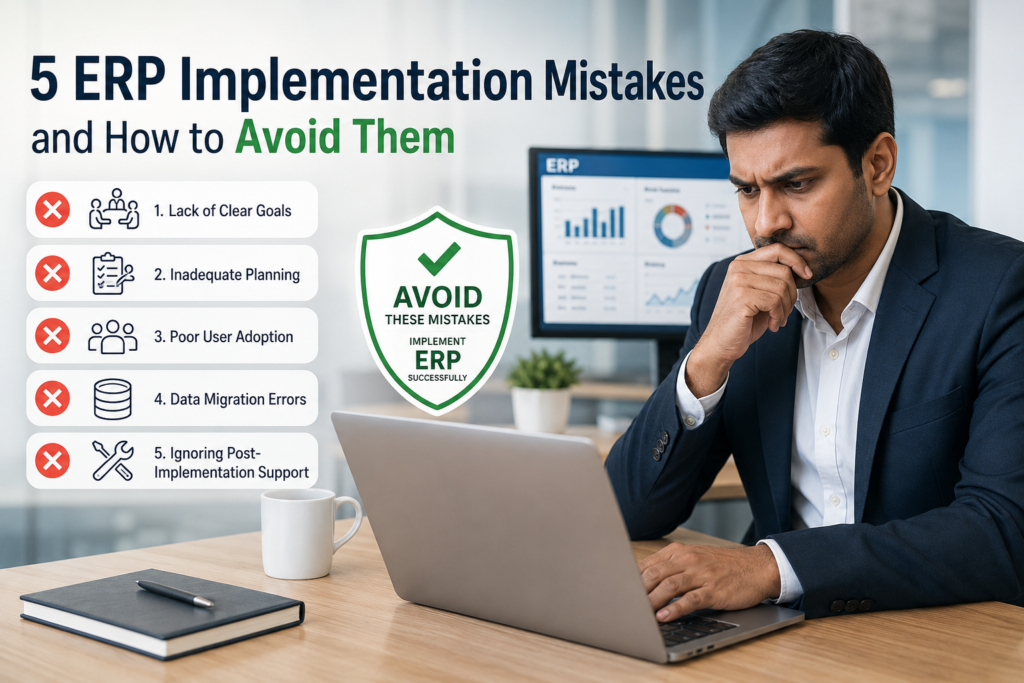
ERP dashboard for project planning, workflow visibility, and busines software implementation.
Table of Contents
Why Operations Management Matters in ERP Implementation
ERP implementation is not only a technical activity. It is a business improvement project that changes how teams work, share data, approve tasks, generate reports, and manage daily operations.
Strong operation management helps companies understand current workflow problems, define department goals, and create a practical implementation roadmap.
Proper Planning Helps Businesses:
- Define clear ERPs project goals
- Map department workflows
- Choose the right busines software
- Prepare clean data for migration
- Train users before launch
- Build a practical ERP strategy
- Support long-term digital transformation
5 ERP Implementation Mistakes and How to Avoid Them
1. Starting Without Clear Business Goals
Many companies start an ERP project because they know they need better control, but they do not clearly define what they want to improve.
This can lead to confusion during implementation. Teams may ask for unnecessary features while important workflows remain unclear.
How to Avoid It
- List current business problems
- Define department-wise goals
- Set measurable KPIs
- Identify automation priorities
- Assign internal project owners
2. Weak ERP Project Planning
Poor planning is one of the most common reasons ERP implementation becomes delayed or expensive. A successful rollout needs a clear timeline, responsibilities, testing process, and launch plan.
Operation management becomes stronger when every department knows what needs to happen, who is responsible, and how progress will be measured.
How to Avoid It
- Create an implementation roadmap
- Set realistic timelines
- Define user roles and responsibilities
- Plan data migration early
- Prepare testing and training schedules
3. Ignoring Data Migration and Cleanup
ERP systems depend on accurate data. If old records contain duplicate customers, wrong inventory numbers, outdated vendor details, or incomplete financial records, the new system will produce unreliable reports.
Data migration should be treated as a serious business software task, not just a copy-paste activity.
How to Avoid It
- Audit old data before migration
- Remove duplicate records
- Standardize naming formats
- Validate inventory and finance data
- Test migrated records before go-live
4. Not Training Employees Properly
Even the best ERP platform will fail if employees do not know how to use it. Poor training causes wrong entries, incomplete reports, low adoption, and continued dependency on spreadsheets.
Training should be role-based. Finance, sales, inventory, HR, and management teams need different workflows and dashboard access.
How to Avoid It
- Train users before launch
- Create department-wise training sessions
- Provide workflow documentation
- Teach reporting and dashboard usage
- Offer post-launch support
5. No Post-Launch Optimization
ERP implementation does not end after launch. Businesses need to review system usage, employee feedback, reporting accuracy, automation performance, and workflow gaps.
A strong ERP strategy includes continuous improvement after go-live. This helps the platform support digital transformation instead of becoming another unused system.
How to Avoid It
- Review user adoption
- Check workflow performance
- Track reporting accuracy
- Collect department feedback
- Improve processes every month
You can learn more about ERP planning from Oracle ERP Guide.
Poor ERP Planning vs Smart ERP Strategy
| Poor Planning | Smart ERP Strategy |
|---|---|
| No clear business goals | Defined goals and measurable KPIs |
| Unclear project ownership | Department-wise responsibilities |
| Duplicate and messy data | Clean and validated migration records |
| Weak employee training | Role-based training and support |
| No review after launch | Continuous workflow optimization |

Training and data migration improve ERP adoption and reporting accuracy.
Best Practices for ERP Success
Successful ERP implementation needs a balance of technology planning, business process review, employee involvement, and ongoing improvement.
- Start with clear business objectives
- Map existing workflows before configuration
- Choose business software based on actual needs
- Clean old data before migration
- Train employees department-wise
- Test workflows before go-live
- Use dashboards for performance tracking
- Review adoption after launch
- Improve processes through feedback
- Align ERP strategy with digital transformation goals
How Logicraftz Helps Businesses Implement ERP
Logicraftz Solutions LLP helps businesses plan ERPs projects with clear workflows, structured data migration, user training, and post-launch support.
Our team builds business software solutions that improve reporting, automation, collaboration, and operational visibility.
Our ERP Services Include:
- ERP requirement analysis
- Workflow mapping
- ERPs project planning
- Data migration support
- Employee training
- Business software customization
- ERP strategy consulting
- Digital transformation support

ERP-driven digital transformation improves control, visibility, and business performance.
Frequently Asked Questions
Why is operations management important in ERP implementation?
Operation management helps businesses map workflows, define goals, reduce process gaps, and ensure the ERP system supports real business needs.
What is an ERP project?
An ERPs project is the planned process of selecting, configuring, testing, launching, and improving ERP software for business operations.
Why do ERP implementations fail?
They often fail because of unclear goals, poor planning, messy data, weak training, unrealistic timelines, and no post-launch optimization.
How does ERP strategy support digital transformation?
ERP strategy supports digital transformation by centralizing data, automating workflows, connecting departments, and improving reporting.
How can businesses avoid ERP mistakes?
Businesses can avoid mistakes by setting clear goals, planning properly, cleaning data, training users, testing workflows, and reviewing the system after launch.
Continue Reading
Need Help With ERP Implementation?
A successful ERP system needs clear goals, proper planning, clean data, trained users, and continuous improvement after launch.
Logicraftz Solutions LLP helps businesses plan ERP projects, improve operation management, implement business software, and support digital transformation.
Introduction
Organizations today operate in an environment where speed, accuracy, and operational visibility are essential for long-term success. As companies expand, managing finance, procurement, inventory, production, sales, customer service, and human resources through disconnected systems often creates inefficiencies that slow growth and increase operating costs. Information becomes fragmented, manual work increases, and decision-making becomes more difficult.
A well-planned ERP project helps organizations overcome these challenges by creating a centralized operational platform that connects every department. Supported by reliable business software, a practical ERP strategy, and a long-term commitment to digital transformation, organizations can simplify operations, improve collaboration, and build a scalable foundation for future growth.
Whether an organization operates in manufacturing, healthcare, retail, logistics, education, hospitality, construction, or professional services, integrated business platforms help improve operational performance while delivering better experiences for employees, customers, and stakeholders.
Understanding an ERP Project
An ERP project is much more than installing new technology. It is a structured initiative that redesigns business processes, improves operational workflows, and creates a connected environment where departments share accurate information in real time.
Successful implementation begins with understanding current operations and identifying opportunities for improvement.
Typical project phases include:
- Business process analysis
- Requirement gathering
- Solution planning
- System configuration
- Data migration
- User testing
- Employee training
- Go-live preparation
- Performance monitoring
- Continuous optimization
Organizations that invest sufficient time in planning usually experience smoother implementation and higher employee adoption.
Why ERP Strategy Matters
Technology alone does not improve business performance. Organizations need a clear ERP strategy that aligns technology investments with operational objectives.
A successful strategy focuses on:
- Defining measurable business goals
- Standardizing operational processes
- Improving collaboration
- Eliminating duplicate activities
- Increasing data accuracy
- Supporting future expansion
- Reducing operational risks
- Improving reporting capabilities
- Strengthening compliance
- Encouraging continuous improvement
When business objectives and technology initiatives move in the same direction, organizations achieve stronger returns from their investment.
The Role of Business Software
Modern business software connects critical operational functions into one secure and centralized environment.
Instead of maintaining separate systems for accounting, purchasing, inventory, payroll, production, customer records, and reporting, employees access one integrated platform where information is automatically shared across departments.
Key advantages include:
- Centralized information
- Real-time reporting
- Improved collaboration
- Better financial visibility
- Faster communication
- Improved inventory accuracy
- Standardized operations
- Better resource planning
- Reduced administrative work
- Greater operational transparency
This connected approach enables employees to work more efficiently while providing management with reliable information for strategic decision-making.
Supporting Digital Transformation
Successful digital transformation involves improving the way an organization operates by combining technology with optimized business processes.
Rather than simply replacing paper-based activities, organizations redesign workflows to reduce delays, improve communication, and increase operational efficiency.
Common transformation initiatives include:
- Cloud adoption
- Process optimization
- Workflow standardization
- Data analytics
- Mobile accessibility
- Intelligent reporting
- Secure collaboration
- Automated approvals
- Employee self-service
- Continuous performance improvement
Organizations that embrace these improvements become more agile and better prepared to respond to changing customer expectations and market conditions.
Creating Better Collaboration
A connected operational platform enables finance, procurement, inventory, manufacturing, customer service, sales, human resources, and executive leadership to work with the same real-time information.
Improved collaboration reduces communication gaps, minimizes duplicate work, and enables faster decision-making. Employees gain confidence because they can access reliable information without searching through multiple systems, while managers receive complete visibility into business performance through interactive dashboards.
This shared environment creates stronger teamwork, improves accountability, and supports consistent operational excellence across the organization.
Real-Time Analytics Drive Better Decisions
Modern organizations generate valuable information through every transaction, customer interaction, purchase order, inventory movement, and financial activity. Transforming this data into meaningful insights enables leaders to make informed decisions instead of relying on assumptions.
Interactive dashboards provide immediate visibility into key performance indicators across every department. Management teams can evaluate operational trends, monitor productivity, review financial performance, and identify improvement opportunities without waiting for manually prepared reports.
Business intelligence helps organizations:
- Monitor operational performance
- Track departmental objectives
- Improve forecasting accuracy
- Measure resource utilization
- Identify cost-saving opportunities
- Evaluate financial health
- Review inventory movement
- Analyze procurement efficiency
- Improve customer service
- Support long-term planning
Access to reliable information allows organizations to respond quickly to changing market conditions while improving operational confidence.
Financial Management Becomes More Transparent
Strong financial control is essential for sustainable growth. Organizations need accurate accounting information, timely reporting, and complete visibility into revenue and expenses.
Integrated financial modules simplify activities including:
- General ledger
- Accounts payable
- Accounts receivable
- Budget planning
- Cash flow monitoring
- Asset management
- Tax compliance
- Expense tracking
- Financial reporting
- Bank reconciliation
Connecting financial information with procurement, inventory, operations, and payroll improves reporting accuracy while reducing duplicate work.
Decision-makers gain a complete picture of organizational performance, allowing them to allocate resources more effectively and support future investments.
Inventory and Supply Chain Optimization
Inventory directly affects operational continuity and customer satisfaction. Excess stock increases storage costs, while insufficient inventory can delay production and order fulfillment.
Integrated operational platforms provide real-time visibility into:
- Inventory availability
- Warehouse activities
- Supplier performance
- Purchase orders
- Material consumption
- Stock valuation
- Demand forecasts
- Distribution schedules
- Product movement
- Reorder planning
Better coordination between procurement, warehousing, production, and finance helps organizations reduce waste while improving inventory accuracy.
A connected supply chain supports timely deliveries, stronger supplier relationships, and more efficient resource utilization.
Manufacturing and Operations Excellence
Manufacturing businesses require accurate planning and continuous monitoring to maintain production efficiency.
Organizations benefit from centralized visibility into:
- Production schedules
- Work orders
- Material availability
- Machine utilization
- Product quality
- Maintenance planning
- Finished goods inventory
- Production costs
- Delivery timelines
- Capacity planning
Real-time operational information helps managers reduce downtime, improve productivity, and maintain consistent quality standards throughout the manufacturing process.
Human Resource Management Supports Organizational Success
Employees remain one of the most valuable resources within any organization.
Modern workforce management capabilities simplify administrative activities while improving employee engagement.
Organizations can efficiently manage:
- Employee records
- Attendance tracking
- Leave administration
- Payroll processing
- Recruitment activities
- Performance evaluations
- Learning programs
- Shift scheduling
- Compliance documentation
- Workforce reporting
Reducing administrative workload enables HR professionals to focus on employee development, leadership initiatives, and organizational culture.
Cloud Technology Enables Operational Flexibility
Cloud computing has transformed the way organizations access and manage business information.
Instead of depending on local infrastructure, businesses can securely access operational data from multiple offices, manufacturing facilities, warehouses, or remote work locations.
Cloud platforms provide several advantages:
- Automatic software updates
- Secure backups
- Lower infrastructure costs
- Remote accessibility
- Better scalability
- Faster deployment
- Improved collaboration
- Reliable disaster recovery
- Enhanced availability
- Simplified maintenance
These capabilities support organizational growth while reducing technology management complexity.
Security and Compliance Protect Business Information
Organizations manage sensitive financial, operational, employee, and customer information every day.
Protecting this information requires multiple layers of security.
Modern platforms include:
- Role-based permissions
- Multi-factor authentication
- Data encryption
- Audit logs
- Activity monitoring
- Backup management
- Disaster recovery
- Compliance reporting
- Secure cloud architecture
- Access control policies
Strong security practices reduce operational risk while increasing confidence among customers, employees, suppliers, and business partners.
Continuous Improvement Strengthens Competitive Advantage
Successful organizations continuously evaluate operational performance and refine internal processes.
Regular reviews help businesses identify opportunities to:
- Improve productivity
- Reduce operational costs
- Optimize resources
- Increase employee engagement
- Enhance service quality
- Strengthen collaboration
- Improve reporting accuracy
- Simplify internal procedures
- Support innovation
- Increase organizational resilience
Small improvements implemented consistently often create significant long-term benefits.
A culture focused on learning and optimization helps organizations remain competitive in rapidly changing industries.
Why Organizations Choose Logicraftz
Logicraftz partners with businesses seeking practical, scalable technology solutions that improve operational performance and simplify complex processes. Every engagement begins with understanding the client's existing workflows, operational challenges, and long-term objectives before recommending the most appropriate solution.
The company provides comprehensive services including business consulting, solution planning, customization, implementation, data migration, system integration, employee training, deployment, and ongoing technical support. This end-to-end approach minimizes disruption while ensuring technology investments deliver measurable business value.
With experience across manufacturing, healthcare, education, retail, logistics, hospitality, construction, financial services, and professional industries, Logicraftz develops flexible platforms designed to improve collaboration, operational visibility, reporting accuracy, and organizational productivity.
By combining technical expertise with industry knowledge, Logicraftz enables businesses to streamline operations, improve decision-making, strengthen internal communication, and prepare confidently for future expansion.
Looking Ahead
Organizations that embrace innovation today are better prepared for tomorrow's opportunities. Intelligent technologies, cloud platforms, predictive analytics, and connected operational systems continue to reshape the way businesses operate.
A carefully planned ERP project, supported by reliable business software, a clear ERP strategy, and a commitment to digital transformation, creates a resilient operational foundation capable of supporting sustainable growth. Businesses that invest in continuous improvement, employee development, and modern technology position themselves to improve efficiency, strengthen customer relationships, increase profitability, and remain competitive in an increasingly digital global economy.
The pace of technological change continues to accelerate, making adaptability one of the most valuable strengths an organization can develop. Businesses that regularly evaluate their operational processes, invest in employee development, and adopt scalable digital solutions are better equipped to respond to changing customer expectations and market demands. A connected business environment encourages collaboration, improves visibility across departments, and enables faster decision-making at every level of the organization. As new technologies such as artificial intelligence, predictive analytics, cloud computing, and intelligent automation continue to evolve, organizations that build flexible operational frameworks today will be better positioned to embrace future innovations with confidence.
By focusing on continuous improvement, process standardization, and data-driven planning, companies can reduce operational complexity, improve service quality, optimize resource utilization, and create a sustainable foundation for long-term success. Working with an experienced technology partner like Logicraftz further strengthens this journey by ensuring every solution is aligned with business objectives, scalable for future expansion, and capable of delivering measurable value across finance, operations, procurement, manufacturing, human resources, customer service, and executive management.