Call Logicraftz Professionals +912231982472 to choose the right ERP solution, ERP software, business automation, enterprise software, and business management system.
ERP Solution: 8 Clear Signs Your Business Needs One
A practical guide to business management, ERP software, enterprise software, automation, reporting, and scalable operational growth.
Introduction
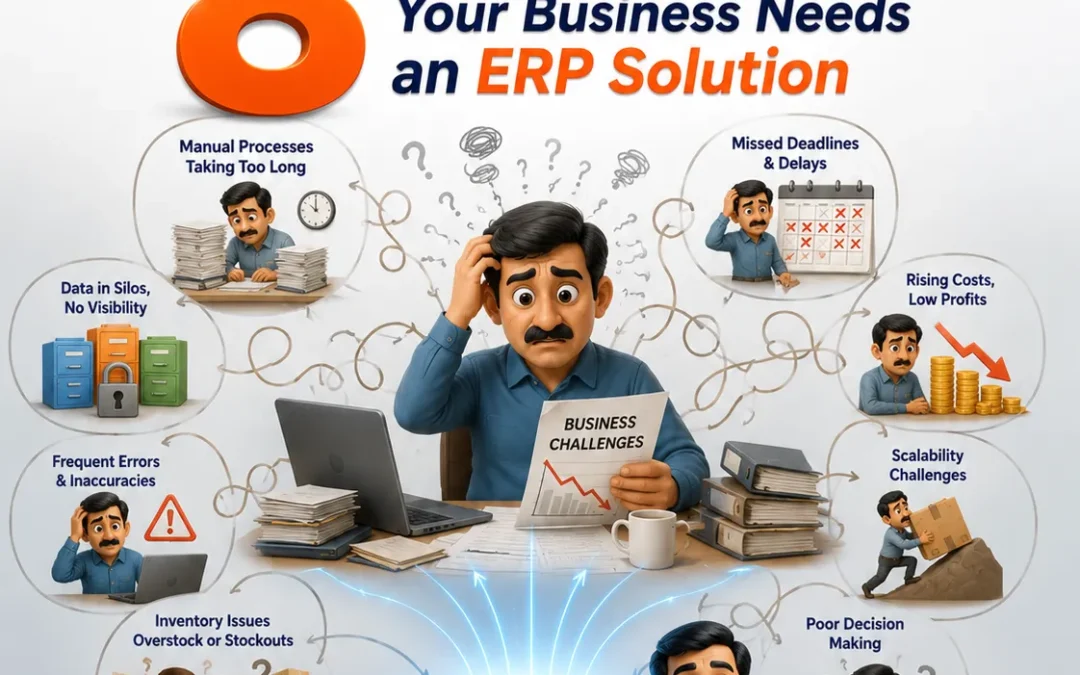
ERP solution adoption becomes important when a business starts facing operational delays, disconnected data, manual errors, and poor visibility across departments. As companies grow, managing finance, sales, inventory, HR, procurement, and reporting through separate tools becomes difficult.
Modern ERP software helps businesses improve business management by bringing major processes into one centralized platform. It also supports business automation, better reporting, stronger control, and scalable growth.
If your current systems are slowing down your business, it may be time to invest in professional enterprise software. In this guide, we will explore 8 clear signs that your business needs a more connected and scalable ERP system.

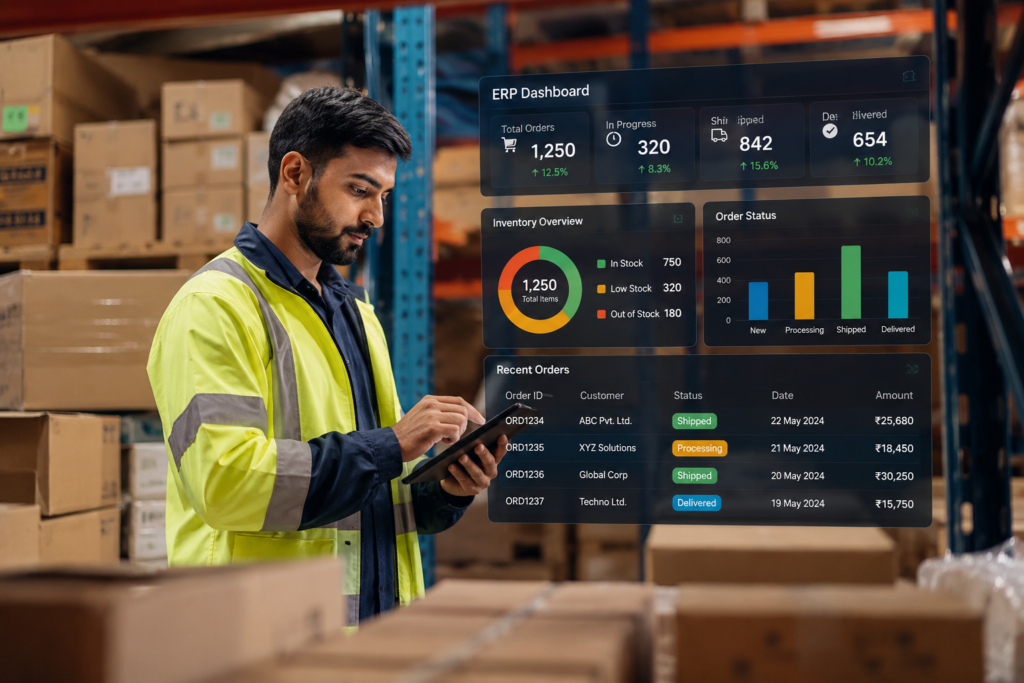
ERP dashboard for business visibility, automation, and operational control
Table of Contents
- Why ERP Solutions Matter
- 1. Disconnected Business Data
- 2. Too Much Manual Work
- 3. No Real-Time Reports
- 4. Inventory Management Problems
- 5. Slow Decision-Making
- 6. Weak Team Collaboration
- 7. Customer Service Delays
- 8. Difficulty Scaling Operations
- Separate Tools vs ERP System
- Common ERP Selection Mistakes
- Frequently Asked Questions
Why ERP Solutions Matter for Business Management
Growing businesses need systems that can handle increasing complexity. Separate spreadsheets, manual workflows, and disconnected software may work in the beginning, but they eventually create bottlenecks.
An ERP solution connects departments and provides a single source of truth. This helps teams work faster, reduce errors, improve reporting, and strengthen overall business management.
Leaders can track finance, sales, inventory, and operations from one platform.
Approvals, reports, orders, and repetitive workflows can be automated.
Real-time dashboards reduce dependency on manual reports.
Enterprise software supports more users, locations, products, and transactions.
1. Business Data Is Disconnected
If every department uses separate tools or spreadsheets, your business data becomes scattered. This creates confusion, duplicate records, conflicting reports, and slow data sharing.
A centralized system improves data accuracy by connecting department records in one place. Sales, finance, inventory, procurement, HR, and management teams can work with updated information instead of different versions of the truth.
Common Problems
- Duplicate records
- Outdated information
- Conflicting reports
- Slow data sharing
- Poor department visibility
- Manual data reconciliation
2. Your Team Is Spending Too Much Time on Manual Work
Manual data entry, repeated approvals, spreadsheet updates, invoice preparation, and follow-ups reduce productivity. As work increases, manual processes become slower and more error-prone.
ERP software supports business automation by reducing repetitive work and streamlining operational workflows.
Processes ERP Can Automate
- Invoice generation
- Inventory updates
- Purchase approvals
- Order processing
- Reports and dashboards
- Task notifications

3. You Cannot Access Real-Time Reports
If reports take days to prepare, your business may be operating with outdated information. Manual reporting also increases the chance of mistakes because data must be collected from different departments.
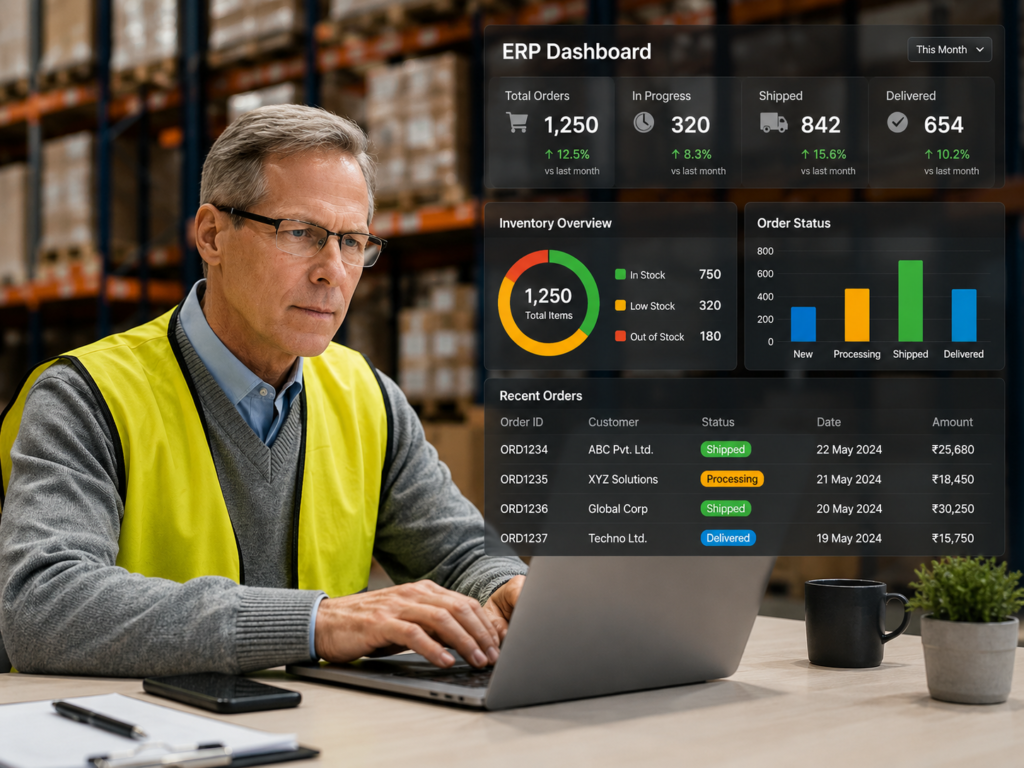
A modern ERP system provides real-time dashboards for finance, sales, inventory, HR, procurement, and operations. This helps management make faster and more accurate decisions.
Useful Reports Include
- Sales performance
- Inventory movement
- Financial reports
- Purchase tracking
- HR and payroll summaries
- Operational KPIs
4. Inventory and Stock Management Are Becoming Difficult
Inventory issues can directly affect sales, production, customer satisfaction, and cash flow. If stock data is not accurate, businesses may face delays, wrong commitments, or unnecessary purchases.
Warning Signs
- Frequent stockouts
- Overstocking
- Incorrect stock counts
- Delayed purchase planning
- Poor warehouse visibility
- Manual stock reconciliation
An ERP solution improves stock tracking, demand planning, purchase control, and inventory visibility.

Inventory and reporting dashboards help businesses manage operations faster
5. Decision-Making Is Slow
Business leaders need accurate data to make smart decisions. If your team spends too much time collecting information, checking spreadsheets, or confirming numbers with different departments, decisions get delayed.
Enterprise software gives managers instant access to key business insights and performance reports. This improves planning and allows leadership teams to respond faster to business changes.
6. Teams Are Not Collaborating Efficiently
When departments work in silos, communication gaps increase. Sales may not know stock availability, finance may not have billing updates, and operations may lack order information.
ERP software creates shared visibility and improves coordination between teams. This helps departments work from the same updated information instead of depending on repeated calls, emails, and manual confirmations.
Connected Teams Can Improve
- Sales and inventory coordination
- Finance and billing updates
- Procurement planning
- Operational reporting
- Order processing
- Customer service response
7. Customer Service Is Getting Delayed
Customers expect quick updates, accurate information, and smooth service. If your team struggles to access order status, payment details, stock availability, delivery updates, or service history, customer experience suffers.
An ERP system helps teams respond faster with accurate customer and order data. This can reduce delays and improve service quality.
Service Teams Can View
- Order status
- Payment details
- Delivery updates
- Stock availability
- Invoice history
- Customer transaction data
8. Your Business Is Struggling to Scale
Growth becomes difficult when existing systems cannot handle more users, departments, locations, products, orders, vendors, or transactions. Adding more spreadsheets or disconnected tools only increases complexity.
ERP software provides a scalable foundation for long-term growth and better business management. A connected system can support new branches, larger teams, increased transaction volume, and advanced reporting needs.
You can learn more about enterprise technology planning from Gartner IT Research and Oracle ERP Guide.
Separate Tools vs ERP System
| Business Area | Separate Tools | ERP System |
|---|---|---|
| Data | Scattered across departments | Centralized in one platform |
| Reports | Manual and delayed | Real-time dashboards |
| Automation | Limited workflow control | Automated approvals, alerts, and tasks |
| Collaboration | Departments work separately | Teams work with shared data |
| Scalability | Difficult to manage growth | Supports more users, locations, and transactions |
Common ERP Selection Mistakes Businesses Should Avoid
Document department-wise needs before selecting software.
Your system should support future growth and expansion.
Involve finance, sales, inventory, HR, and operations teams early.
Low price may lead to poor functionality or weak support.
Clean and organize data before implementation begins.
Support helps teams improve adoption and resolve workflow issues.
Continue Reading
Frequently Asked Questions
Q: What is an ERP solution?
An ERP solution is business software that connects departments such as finance, sales, inventory, HR, procurement, and operations into one centralized platform.
Q: How does ERP software improve business management?
ERP software improves business management by centralizing data, automating workflows, improving reporting, and helping teams work with accurate information.
Q: When should a business invest in ERP?
A business should consider ERP when manual work increases, reporting becomes difficult, data is disconnected, inventory is hard to manage, or operations become difficult to scale.
Q: What is the role of business automation in ERP?
Business automation reduces repetitive tasks such as approvals, invoicing, reporting, order updates, and inventory tracking.
Q: Is ERP useful for growing companies?
Yes. ERP is useful for growing companies that need better control, automation, reporting, and scalable enterprise software.
Need the Right ERP Solution for Your Business?
A modern ERP system can help your business centralize data, automate workflows, improve reporting, and create stronger operational control.
Logicraftz Solutions LLP helps businesses choose and implement ERP software that improves business automation, operational visibility, and enterprise growth.
Introduction
Running a successful organization requires more than excellent products or services. Companies must coordinate finance, procurement, inventory, production, human resources, customer service, and reporting while maintaining operational efficiency. As businesses grow, manual processes and disconnected applications often become barriers to productivity, creating delays, duplicate work, and communication challenges.
A modern ERP software platform helps organizations centralize operations by connecting departments through a single digital environment. Combined with intelligent enterprise software, structured business management, and effective business automation, companies can improve operational visibility, simplify workflows, and make better business decisions based on real-time information.
Organizations across manufacturing, healthcare, education, retail, logistics, hospitality, construction, and professional services are increasingly investing in integrated platforms that improve efficiency while supporting long-term growth.
Understanding Business Management
Effective business management is the process of planning, organizing, directing, and monitoring organizational resources to achieve strategic objectives. It requires coordination between departments, efficient resource allocation, accurate reporting, and continuous performance improvement.
Strong management practices enable organizations to:
- Improve operational efficiency
- Increase employee productivity
- Strengthen collaboration
- Reduce unnecessary costs
- Improve financial control
- Support better decision-making
- Enhance customer satisfaction
- Increase transparency
- Minimize operational risks
- Encourage sustainable growth
Businesses that establish structured processes are better equipped to respond quickly to changing market conditions.
Why ERP Software Matters
Modern ERP software integrates essential business functions into one centralized platform. Instead of maintaining separate systems for finance, inventory, purchasing, payroll, manufacturing, customer records, and reporting, organizations manage operations from a unified environment.
This integration provides significant advantages:
- Centralized business information
- Improved communication
- Better financial visibility
- Faster reporting
- Reduced duplicate records
- Improved inventory accuracy
- Stronger operational control
- Better compliance management
- Simplified collaboration
- Higher productivity
Employees gain access to accurate information without switching between multiple applications, improving efficiency throughout the organization.
Enterprise Software Connects Every Department
Successful organizations depend on effective communication across every department. Modern enterprise software enables finance, procurement, operations, warehousing, production, human resources, and executive management to work together using one shared database.
When departments share real-time information, businesses reduce communication gaps and improve coordination.
For example:
- Finance teams can monitor purchasing activities instantly.
- Warehouse teams receive accurate inventory updates.
- Production managers can review manufacturing schedules in real time.
- Human resources maintain employee information efficiently.
- Leadership teams monitor business performance through interactive dashboards.
This connected environment improves collaboration while supporting faster and more informed decision-making.
Business Automation Eliminates Repetitive Work
Administrative activities consume valuable employee time every day. Manual approvals, invoice processing, document routing, inventory updates, and internal notifications often create unnecessary delays.
Implementing business automation helps organizations streamline routine activities through predefined digital workflows.
Common automated processes include:
- Purchase approvals
- Invoice verification
- Employee onboarding
- Leave requests
- Inventory updates
- Internal notifications
- Task assignments
- Report generation
- Document approvals
- Workflow tracking
Reducing manual effort allows employees to focus on innovation, customer service, problem-solving, and strategic initiatives that create greater value for the organization.
Real-Time Reporting Improves Strategic Decision-Making
Business leaders require accurate and timely information to make confident decisions. Delayed reports and outdated spreadsheets often result in missed opportunities and slower responses to operational challenges.
An integrated platform provides interactive dashboards that display important business metrics in real time. Executives and department managers can monitor organizational performance without waiting for manually prepared reports.
Important business insights include:
- Revenue trends
- Department performance
- Procurement status
- Inventory availability
- Production efficiency
- Employee productivity
- Operational expenses
- Customer order status
- Resource utilization
- Financial performance
Access to reliable information allows organizations to identify bottlenecks early, optimize resources, and make proactive decisions that improve long-term performance.
Financial Management Becomes More Accurate
Financial accuracy is essential for maintaining profitability and supporting business expansion. A centralized operational platform helps organizations simplify accounting processes while improving transparency.
Finance departments can efficiently manage:
- General ledger
- Accounts payable
- Accounts receivable
- Budget planning
- Expense monitoring
- Cash flow
- Tax compliance
- Asset management
- Financial reporting
- Bank reconciliation
Having financial information connected with procurement, inventory, and operations improves reporting accuracy while reducing manual calculations and duplicate entries.
Leadership teams gain a complete financial overview that supports strategic investment decisions and better budget planning.
Inventory and Supply Chain Optimization
Inventory plays a critical role in maintaining operational continuity. Excess stock increases storage costs, while shortages may interrupt production or delay customer deliveries.
Organizations benefit from centralized inventory monitoring that provides visibility into:
- Stock movement
- Warehouse availability
- Purchase orders
- Material consumption
- Supplier performance
- Product demand
- Delivery schedules
- Stock valuation
- Reorder levels
- Distribution planning
Accurate inventory information helps purchasing teams make informed decisions while ensuring production departments have the materials needed to maintain efficient operations.
Improved supply chain coordination reduces waste, lowers operational costs, and enhances customer satisfaction.
Human Resource Management Supports Workforce Success
Employees remain one of the most valuable assets within any organization. Efficient workforce management helps improve productivity while supporting employee satisfaction and organizational compliance.
Integrated HR capabilities simplify activities such as:
- Employee records
- Attendance tracking
- Leave management
- Payroll administration
- Recruitment
- Performance evaluations
- Training programs
- Shift scheduling
- Compliance documentation
- Workforce reporting
Automating administrative responsibilities allows HR professionals to focus on employee engagement, leadership development, and organizational culture.
Cloud Technology Enables Flexible Operations
Cloud-based platforms have transformed the way organizations operate by providing secure access to operational information from virtually any location.
Employees can access business information using laptops, tablets, or smartphones while working remotely, visiting customers, or managing multiple business locations.
Cloud deployment provides several advantages:
- Automatic updates
- Secure backups
- Lower infrastructure costs
- Improved scalability
- Business continuity
- Enhanced collaboration
- Faster implementation
- Reliable disaster recovery
- Stronger data protection
- Flexible expansion
These capabilities help organizations adapt quickly to changing business requirements while reducing ongoing technology maintenance.
Mobile Accessibility Increases Productivity
Modern workplaces extend beyond traditional office environments. Managers, field staff, sales representatives, warehouse supervisors, and executives frequently require access to operational information while away from their desks.
Mobile access allows employees to:
- Review operational reports
- Approve requests
- Monitor inventory
- Access business documents
- Update activities
- Schedule meetings
- Capture field information
- Communicate with colleagues
- Review dashboards
- Respond to urgent business requirements
Instant access to business information improves responsiveness, supports collaboration, and helps employees remain productive regardless of their location.
Artificial Intelligence Enhances Operational Excellence
Artificial Intelligence is transforming the way organizations operate by helping leaders make faster and more informed decisions. Instead of relying solely on historical reports, intelligent systems analyze large volumes of operational data to identify trends, forecast future demand, and recommend practical improvements.
AI-powered capabilities support organizations by:
- Predicting inventory requirements
- Identifying operational bottlenecks
- Improving production planning
- Monitoring financial performance
- Optimizing workforce allocation
- Detecting unusual business patterns
- Supporting demand forecasting
- Improving procurement planning
- Enhancing reporting accuracy
- Assisting strategic decision-making
These intelligent insights enable organizations to become more proactive while improving operational efficiency across every department.
Strengthening Data Security and Compliance
As organizations continue their digital journey, protecting business information becomes increasingly important. Financial records, employee information, supplier contracts, and operational data must remain secure while being easily accessible to authorized users.
Modern digital platforms include multiple layers of security designed to protect valuable information.
Important security capabilities include:
- Role-based user permissions
- Multi-factor authentication
- Secure data encryption
- Automated backup processes
- Audit trails
- Activity monitoring
- Disaster recovery planning
- Compliance reporting
- Secure cloud infrastructure
- Access control management
Strong security practices reduce business risks while increasing confidence among employees, customers, suppliers, and stakeholders.
Continuous Improvement Builds Long-Term Success
Successful organizations understand that operational excellence is an ongoing process rather than a one-time achievement. Markets evolve, customer expectations change, and technology continues advancing.
Businesses should regularly evaluate operational performance by reviewing:
- Department efficiency
- Financial results
- Employee productivity
- Customer satisfaction
- Inventory accuracy
- Procurement performance
- Resource utilization
- Process effectiveness
- Service quality
- Organizational objectives
Regular performance reviews help identify opportunities for optimization while supporting continuous innovation.
Organizations that encourage learning and process improvement remain more competitive in rapidly changing industries.
Why Businesses Choose Logicraftz
Logicraftz helps organizations simplify complex operations through intelligent digital solutions designed around real business requirements. Every implementation begins with understanding existing processes, identifying operational challenges, and recommending practical improvements that support long-term organizational goals.
The company provides comprehensive services including business consultation, solution planning, customization, implementation, data migration, system integration, employee training, deployment, and ongoing technical support. This structured approach ensures every solution delivers measurable value while remaining scalable for future growth.
With extensive experience across manufacturing, healthcare, education, retail, logistics, hospitality, construction, financial services, and professional industries, Logicraftz develops customized platforms that improve collaboration, operational visibility, reporting, and resource utilization.
The company's customer-focused approach emphasizes simplicity, reliability, security, and long-term performance. Organizations receive technology that adapts as operational requirements evolve, ensuring continued value long after implementation.
The Future of Intelligent Business Operations
Modern organizations are entering an era where data, automation, artificial intelligence, and cloud computing work together to create more agile and efficient businesses. Companies that embrace these innovations gain greater visibility into daily operations while improving collaboration across departments.
Future-ready organizations focus on building flexible operational frameworks capable of adapting to new technologies, changing customer expectations, and evolving market conditions. Continuous investment in employee development, process optimization, and digital innovation creates stronger organizations prepared for sustainable growth.
Businesses that modernize their operations today position themselves for greater efficiency, stronger financial performance, improved customer experiences, and long-term competitiveness. By combining effective business management, advanced ERP software, intelligent enterprise software, and strategic business automation, organizations build a resilient operational foundation capable of supporting future success in an increasingly digital economy.