Call Logicraftz Professionals +912231982472 to improve CRM software usage, customer management, sales automation, and CRM strategy for better business results.
CRM Mistakes: 5 Costly Errors Businesses Should Avoid
A practical guide to improving CRM software usage, customer management, sales automation, reporting, and long-term CRM strategy.
Introduction
CRMs mistakes can reduce sales performance, weaken customer relationships, and prevent businesses from getting full value from their CRM software. Many companies invest in a CRM system but fail to use it properly because they do not have a clear process, proper training, clean data, or consistent reporting habits.
A modern CRM software platform can improve lead tracking, follow-ups, reporting, customer communication, and sales automation. However, the system only delivers strong results when teams use it correctly and follow a practical CRM strategy.
In this blog, we will explain 5 common errors businesses should avoid and how to improve customer management, team productivity, and long-term sales performance.
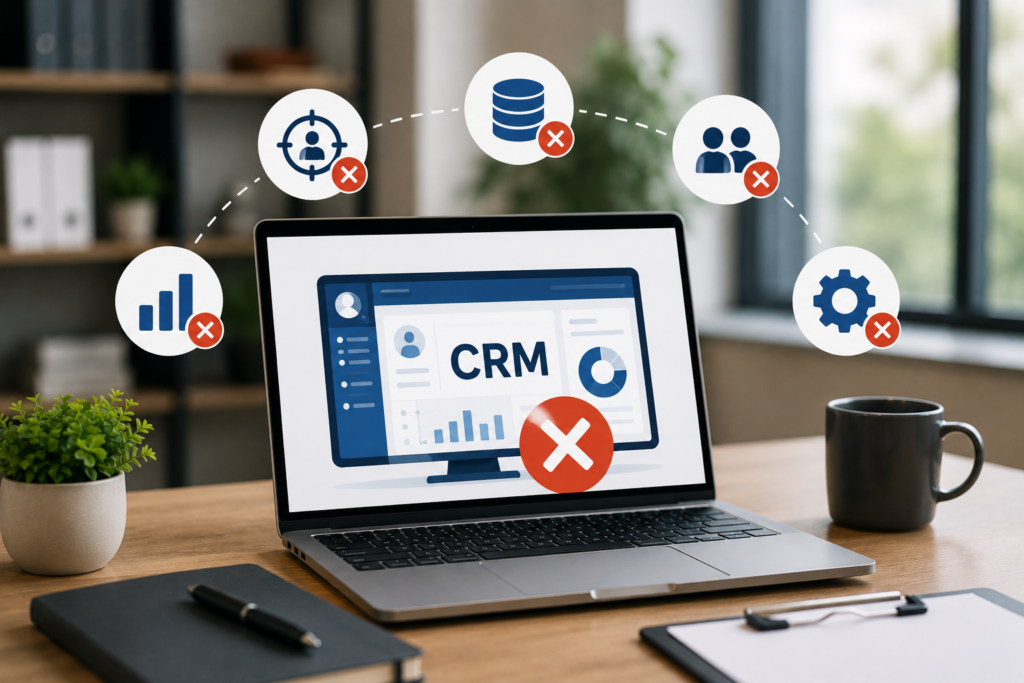
Table of Contents
- Why Avoiding CRM Mistakes Matters
- 1. Using CRM Without a Clear Strategy
- 2. Not Training the Sales and Support Team
- 3. Poor Customer Data Management
- 4. Ignoring Sales Automation Features
- 5. Not Tracking CRM Reports and Performance
- CRM Best Practices for Better Results
- Poor CRM Usage vs Smart CRM Usage
- Frequently Asked Questions
Why Avoiding CRM Mistakes Matters
CRM software is designed to help businesses manage customer relationships more efficiently. But when the system is poorly implemented, teams may continue using spreadsheets, miss important follow-ups, duplicate customer records, or fail to track leads correctly.
A clear CRM strategy ensures the platform supports sales, service, marketing, reporting, and customer retention goals. When the system is used properly, businesses can improve visibility, reduce manual work, and make faster decisions.
Every enquiry can be captured, assigned, and followed up properly.
Teams can access accurate customer records and interaction history.
Routine follow-ups, reminders, and tasks can be managed more efficiently.
Managers can review pipeline, conversion, and team performance clearly.
1. Using CRM Without a Clear Strategy
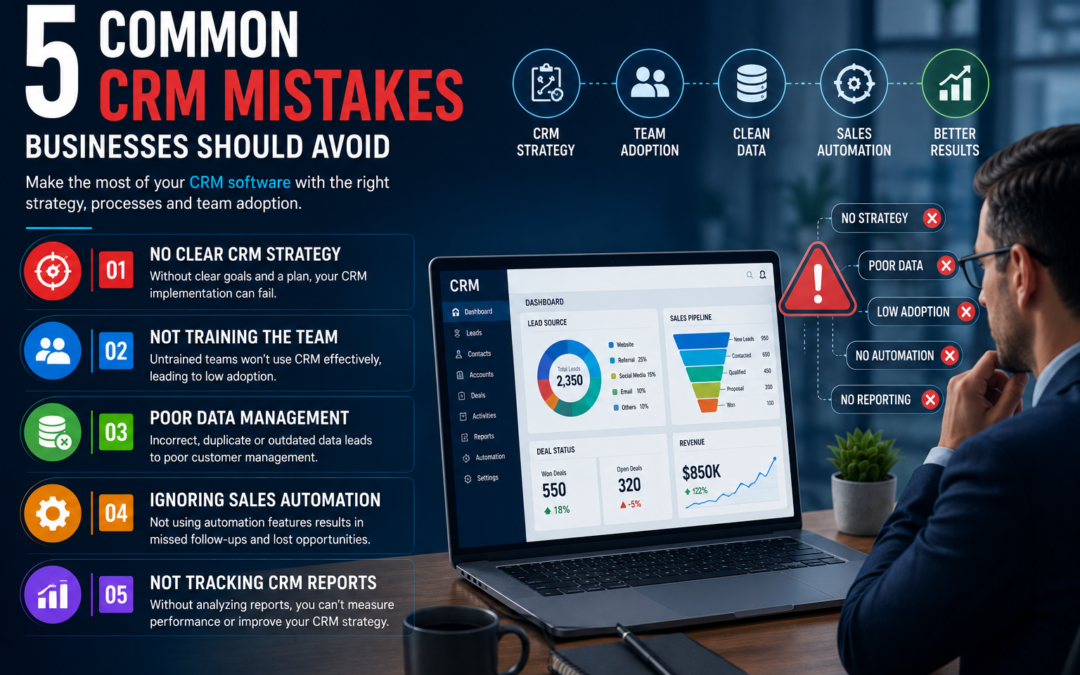
One of the biggest CRM mistakes is using the system without a clear plan. Businesses may purchase software but fail to define how it should support sales, service, marketing, customer management, and reporting.
Without direction, users may treat the platform like a simple contact list instead of a complete relationship management system. This reduces adoption and limits results.
Common Strategy Problems
- No defined CRM goals
- No lead tracking process
- No sales pipeline structure
- No customer follow-up rules
- No reporting KPIs
- No user responsibilities
How to Avoid It
- Define business objectives before implementation
- Create a clear sales pipeline
- Set lead follow-up rules
- Assign team responsibilities
- Track success metrics regularly
2. Not Training the Sales and Support Team
CRM software only works well when teams know how to use it properly. Without training, employees may avoid the system, enter incomplete information, or continue using old manual methods.
Training should not happen only once during setup. Sales, service, and management teams need regular guidance so they understand how the platform supports daily workflows.
Training Should Cover
- Lead entry process
- Customer profile updates
- Follow-up scheduling
- Sales pipeline movement
- Task reminders
- CRM reports
- Data entry standards
Proper training improves adoption and helps teams use the system consistently.

3. Poor Customer Data Management
CRM systems depend on accurate customer data. If records are incomplete, outdated, or duplicated, customer management becomes difficult and teams may lose trust in the platform.
Poor data can affect follow-ups, reporting, segmentation, sales forecasting, and customer communication. Clean data is the foundation of effective CRM usage.
Common Data Issues
- Duplicate contacts
- Missing phone numbers
- Wrong lead sources
- Incomplete customer history
- Outdated follow-up status
- Unclear deal stage information
How to Avoid It
- Clean customer data regularly
- Use standard data entry rules
- Remove duplicate records
- Update lead status after every interaction
- Review customer records monthly
4. Ignoring Sales Automation Features
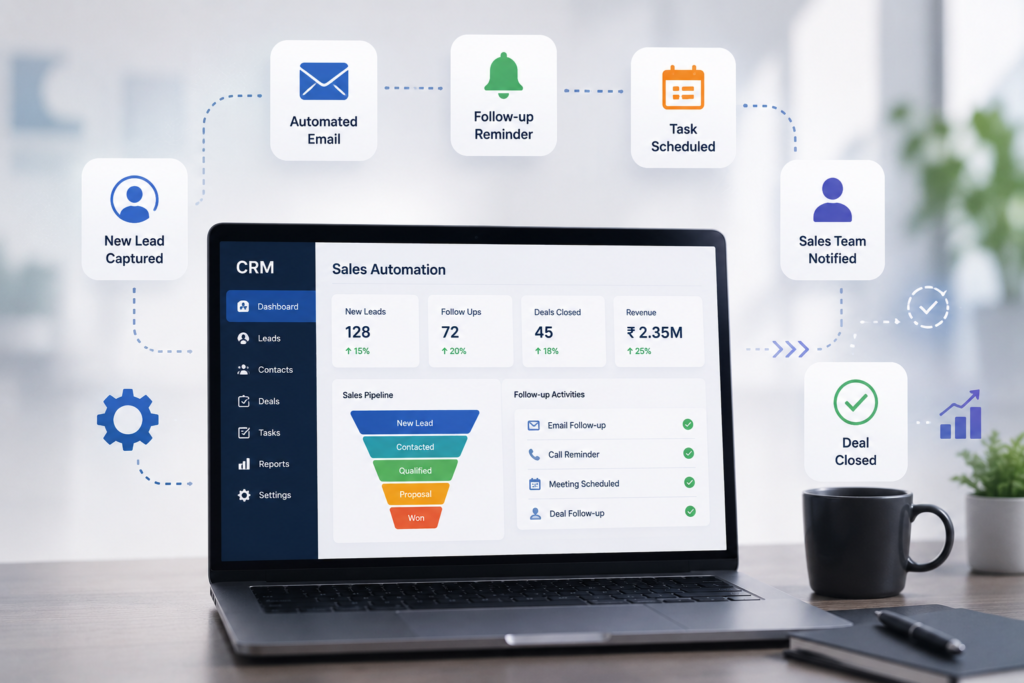
Many businesses use CRM software only as a contact database and ignore powerful sales automation capabilities. This limits efficiency and keeps teams stuck with manual tasks.
Automation helps sales teams reduce repetitive work, maintain follow-up discipline, and improve customer response speed. It should be used carefully to support the sales process without making communication feel robotic.
Useful Sales Automation Features
- Follow-up reminders
- Automated email sequences
- Lead assignment rules
- Task notifications
- Pipeline stage automation
- Renewal reminders
Using these features properly helps teams avoid missed opportunities and improve business productivity.
5. Not Tracking CRM Reports and Performance
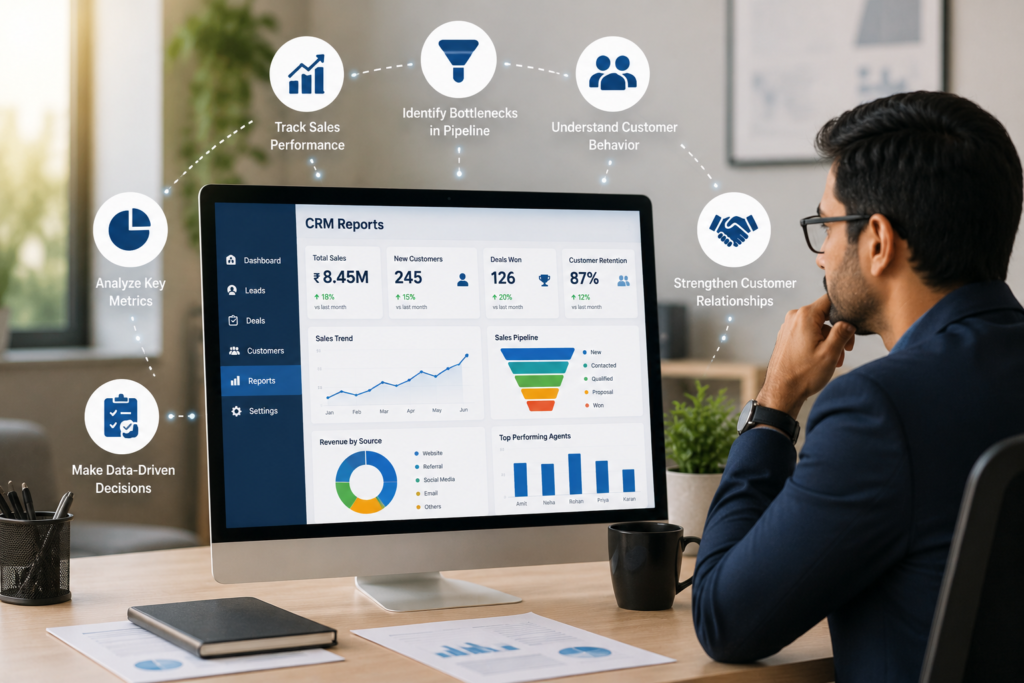
CRM reports help businesses understand sales performance, lead quality, customer behavior, and team productivity. Without reviewing reports, managers cannot identify what is working and what needs improvement.
Reporting should be part of the weekly sales review process. It helps leaders make better decisions, improve sales workflows, and refine the overall CRM strategy.
Important Reports to Review
- Lead source report
- Sales pipeline report
- Conversion rate report
- Follow-up activity report
- Lost deal report
- Customer retention report
- Revenue forecast report
You can learn more about CRM systems from Salesforce CRM Guide and HubSpot CRM.
CRM Best Practices for Better Results
A successful CRM system depends on clear goals, trained users, clean customer data, automation, and regular performance reviews. Businesses that follow structured processes are more likely to get better results from their investment.
Decide what the system should improve before implementation.
Make sure teams understand workflows and reporting.
Review records regularly and remove duplicates.
Automate reminders, tasks, and alerts to save time.
Track lead sources, conversion rates, and pipeline performance.
Update workflows as the business grows.
Poor CRM Usage vs Smart CRM Usage
| Area | Poor Usage | Smart Usage |
|---|---|---|
| Strategy | No defined goals or process | Clear objectives, workflows, and KPIs |
| Training | Users enter data inconsistently | Teams follow standard operating practices |
| Data | Duplicate and incomplete records | Clean, updated, and reliable customer data |
| Automation | Manual reminders and missed follow-ups | Automated tasks, reminders, and alerts |
| Reporting | Reports are ignored | Reports guide sales and service improvements |
Continue Reading
Frequently Asked Questions
Q: What are common CRM mistakes?
Common CRM mistakes include using the system without strategy, weak team training, poor customer data, ignoring automation, and not reviewing reports.
Q: Why is CRM strategy important?
A CRM strategy helps businesses define how the platform should support lead management, customer management, sales automation, reporting, and retention.
Q: How does CRM software improve customer management?
CRM software improves customer management by centralizing customer data, tracking interactions, scheduling follow-ups, and improving communication.
Q: What is sales automation in CRM?
Sales automation uses tools such as reminders, email sequences, lead assignment, task alerts, and pipeline updates to reduce manual work.
Q: How can businesses get better results from CRM?
Businesses can get better results by using a clear strategy, training users, maintaining clean data, automating follow-ups, and reviewing reports regularly.

Need Help Improving Your CRM Strategy?
A properly managed CRM system can help your business improve follow-ups, customer records, sales workflows, reporting, and team productivity.
Logicraftz Solutions LLP helps businesses implement CRM software, automate sales workflows, improve customer management, and create a stronger CRM strategy.
Introduction
In today's digital-first business environment, organizations need more than spreadsheets and manual processes to manage customer relationships effectively. Customers expect personalized communication, faster responses, and consistent service throughout every interaction. Businesses that fail to meet these expectations often struggle with declining engagement, missed opportunities, and inefficient operations.
Modern CRM software provides a centralized platform that helps businesses organize customer information, improve collaboration, automate repetitive activities, and make better business decisions. When combined with an effective CRM strategy, organizations can strengthen customer management, improve operational efficiency, and implement intelligent sales automation that supports sustainable growth.
Whether you're a startup, a growing business, or a large enterprise, investing in the right technology enables teams to work more efficiently while delivering exceptional customer experiences.
Understanding CRM Software
A Customer Relationship Management platform is designed to help businesses organize customer data, monitor interactions, and improve communication throughout the customer lifecycle.
Instead of storing information across multiple applications, employees gain access to one secure platform that contains contact information, communication history, quotations, service requests, meeting notes, documents, and activity records.
Having complete information available allows employees to make faster decisions while providing more personalized customer service.
A centralized platform also reduces duplication, improves data accuracy, and supports better collaboration between departments.
Why Customer Relationships Matter
Customers are the foundation of every successful business. Building long-term relationships requires trust, transparency, and consistent communication.
Organizations that understand customer expectations can provide faster support, recommend relevant products or services, and solve problems more efficiently.
Every interaction creates an opportunity to strengthen relationships while improving customer satisfaction.
Businesses that consistently deliver positive experiences often benefit from stronger retention, increased referrals, and long-term profitability.
Customer Management Creates Better Experiences
Effective customer management extends beyond maintaining contact records.
It involves understanding customer preferences, communication history, purchase behavior, service requirements, and future opportunities.
When employees have immediate access to this information, they can deliver more relevant conversations and faster responses.
Benefits include:
- Personalized communication
- Faster issue resolution
- Improved customer satisfaction
- Better service consistency
- Stronger customer trust
- Reduced response times
- Higher engagement
- Better collaboration
- Increased operational visibility
- Long-term relationship building
These improvements contribute to a better overall customer experience.
Sales Automation Simplifies Daily Operations
Growing businesses often struggle with repetitive administrative work.
Modern sales automation helps eliminate unnecessary manual activities while improving operational consistency.
Organizations can automate:
- Lead assignment
- Appointment scheduling
- Follow-up reminders
- Internal notifications
- Approval workflows
- Customer updates
- Email sequences
- Opportunity progression
- Activity recording
- Task creation
Automation ensures important activities are completed on time without relying on manual reminders.
Employees can focus on building customer relationships instead of repetitive administration.
Build an Effective CRM Strategy
Technology alone does not guarantee business success.
A successful CRM strategy combines technology, people, and well-defined business processes.
Organizations should begin by understanding their customer journey and identifying opportunities to improve communication, service quality, and operational efficiency.
An effective strategy typically includes:
- Clearly defined objectives
- Standardized business processes
- Accurate customer information
- Employee training
- Department collaboration
- Performance monitoring
- Continuous improvement
- Customer feedback collection
- Process optimization
- Technology integration
A structured approach helps organizations maximize the value of their business technology.
Improve Collaboration Across Departments
Business success depends on effective teamwork.
Modern business platforms connect:
- Marketing
- Sales
- Customer support
- Finance
- Operations
- Management
Every department works with the same customer information.
This eliminates duplicate records, reduces communication gaps, and improves coordination throughout the organization.
Employees gain greater visibility into customer interactions while management benefits from improved reporting.
Artificial Intelligence Improves Decision Making
Artificial Intelligence is becoming an important part of business software.
AI-powered capabilities help organizations:
- Predict customer behavior
- Analyze engagement
- Recommend next actions
- Improve forecasting
- Generate insights
- Detect business trends
- Personalize communication
- Support planning
- Identify opportunities
- Improve operational efficiency
Rather than replacing employees, AI provides intelligent recommendations that improve productivity and decision-making.
Real-Time Reporting Supports Better Planning
Business leaders require accurate information to guide strategic decisions.
Interactive dashboards provide visibility into:
- Revenue performance
- Customer activity
- Team productivity
- Opportunity progress
- Service quality
- Operational efficiency
- Employee performance
- Resource utilization
- Customer satisfaction
- Organizational growth
Immediate access to meaningful information enables businesses to identify challenges early and respond with confidence.
Cloud Technology Supports Business Flexibility
Cloud-based platforms allow organizations to operate securely from virtually anywhere.
Employees can access important business information using laptops, desktops, tablets, or smartphones.
Cloud technology provides several advantages:
- Secure accessibility
- Automatic updates
- Reliable backups
- Improved collaboration
- Lower infrastructure costs
- Business continuity
- Better scalability
- Flexible deployment
- Enhanced security
- Faster implementation
Cloud solutions help organizations remain agile while supporting future expansion.
Mobile Accessibility Keeps Teams Connected
Today's workforce is increasingly mobile.
Employees need instant access to business information while attending meetings, visiting customers, or working remotely.
Mobile applications allow users to:
- View customer records
- Update activities
- Schedule appointments
- Capture meeting notes
- Access reports
- Review opportunities
- Monitor dashboards
- Communicate with colleagues
- Respond to enquiries
- Stay productive anywhere
This flexibility improves responsiveness while increasing operational efficiency.
Data Security Builds Customer Trust
Protecting customer information is essential.
Modern business platforms include security features such as:
- Data encryption
- Secure authentication
- Role-based permissions
- Activity monitoring
- Audit trails
- Cloud security
- Backup management
- Disaster recovery
- Compliance support
- Permission controls
Strong security practices help organizations protect sensitive information while building confidence among customers and business partners.
Industries Benefiting from Modern Business Platforms
Organizations across many industries use intelligent customer relationship platforms to improve efficiency and service quality.
These industries include:
- Manufacturing
- Healthcare
- Retail
- Hospitality
- Education
- Financial Services
- Logistics
- Construction
- Information Technology
- Automotive
- Professional Services
- Distribution
- Real Estate
- Consulting
- E-commerce
Regardless of industry, every organization benefits from improved communication, better organization, and streamlined operations.
Why Businesses Choose Logicraftz
Logicraftz delivers intelligent business solutions that help organizations modernize operations through innovation and technology. The company specializes in customized CRM implementation, ERP development, AI-powered business automation, website development, cloud solutions, mobile applications, and digital transformation consulting.
Rather than providing generic software, Logicraftz develops tailored solutions that align with each organization's operational goals and future growth plans. Every implementation is supported through consultation, planning, customization, deployment, employee training, and ongoing technical assistance.
The company's customer-focused approach ensures businesses receive scalable technology that improves productivity, strengthens relationships, and supports long-term operational success.
Organizations partnering with Logicraftz benefit from experienced professionals, reliable support, modern technology, and continuous innovation that helps them remain competitive in today's rapidly evolving digital marketplace.
Conclusion
Modern businesses need intelligent technology that supports collaboration, improves operational visibility, and enhances customer experiences. By combining CRM software, effective customer management, structured sales automation, and a well-planned CRM strategy, organizations can create stronger customer relationships while improving efficiency and long-term profitability.
Businesses that embrace digital transformation today are better prepared to respond to changing customer expectations, optimize internal operations, and achieve sustainable success. Investing in modern business technology is no longer just an operational improvement—it is a strategic decision that creates lasting value for employees, customers, and the organization as a whole.
Future Trends Shaping Customer Relationship Technology
The business landscape continues to evolve as organizations embrace intelligent technologies to improve operational performance and customer experiences. Companies are no longer focused only on managing contacts—they are investing in connected digital ecosystems that provide deeper insights, faster communication, and smarter decision-making.
Artificial intelligence, machine learning, predictive analytics, and cloud computing are changing how organizations engage with customers throughout every stage of the business journey. These innovations help identify customer behavior patterns, forecast future opportunities, and recommend actions that improve both efficiency and satisfaction.
Another significant trend is hyper-personalization. Businesses can now deliver tailored recommendations, targeted marketing campaigns, and customized communication based on customer preferences, previous interactions, and purchasing behavior. This creates more meaningful experiences while strengthening long-term relationships.
Voice technology is also becoming increasingly popular. Employees can update records, retrieve customer information, schedule meetings, and generate reports using simple voice commands, allowing teams to work more efficiently and reduce administrative effort.
Data visualization has improved significantly in recent years. Interactive dashboards provide instant access to key business metrics, enabling leadership teams to identify opportunities, monitor performance, and make informed decisions without manually compiling reports.
Best Practices for Successful Implementation
Technology alone cannot transform a business. Success depends on proper planning, employee adoption, and continuous improvement.
Organizations should begin by identifying operational challenges and defining measurable objectives. Understanding existing workflows makes it easier to configure solutions that genuinely improve efficiency rather than adding unnecessary complexity.
Employee training plays an equally important role. When teams understand how to use new systems effectively, adoption increases naturally, resulting in higher productivity and better collaboration across departments.
Maintaining clean and accurate business data is another essential practice. Duplicate records, outdated contact information, and inconsistent reporting can reduce the value of even the most advanced business platform. Regular data reviews help maintain accuracy while improving reporting quality.
Businesses should also review operational performance regularly. Monitoring customer satisfaction, response times, employee productivity, and conversion performance helps identify opportunities for continuous improvement.
Building Long-Term Competitive Advantage
Successful organizations understand that technology is not simply an operational tool—it is a strategic investment that supports long-term competitiveness.
Businesses that embrace innovation can respond more quickly to changing market conditions, improve communication, and strengthen customer engagement while reducing operational inefficiencies.
As customer expectations continue to rise, organizations must remain flexible and adaptable. Continuous investment in digital capabilities enables businesses to improve internal collaboration, optimize decision-making, and deliver consistent service across every communication channel.
Companies that combine intelligent technology with customer-focused thinking are better positioned to increase profitability, improve brand reputation, and create sustainable growth.
Why Logicraftz Is the Right Technology Partner
Logicraftz helps businesses transform complex processes into streamlined digital operations through customized technology solutions. The company's expertise extends beyond implementation by providing strategic consultation, process analysis, customization, system integration, user training, and ongoing technical support.
Every solution is designed around the client's unique operational requirements rather than following a generic approach. This ensures businesses receive scalable platforms that adapt as the organization grows.
Logicraftz also emphasizes security, performance, user experience, and seamless integration with existing business applications, allowing organizations to maximize technology investments while minimizing operational disruption.
Whether an organization is beginning its digital transformation journey or upgrading existing systems, Logicraftz delivers reliable, future-ready solutions that improve efficiency, strengthen customer relationships, and support sustainable business success.
By combining innovation, technical expertise, and a customer-first approach, Logicraftz continues to help organizations modernize operations, improve collaboration, and achieve measurable results in an increasingly competitive business environment.