
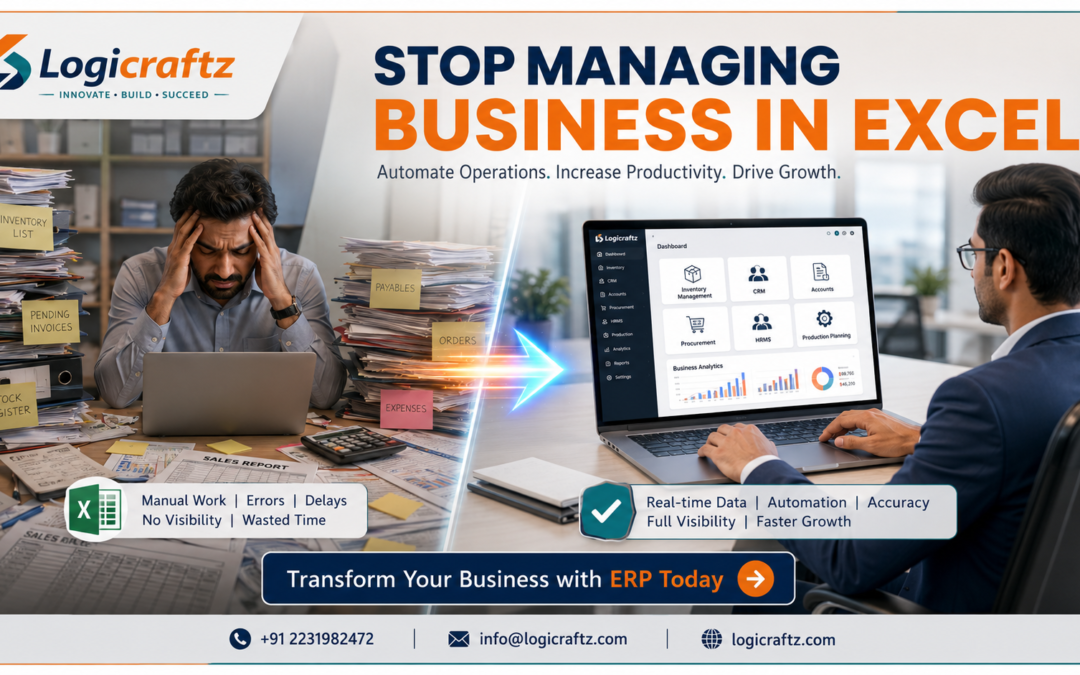
Call Logicraftz Professionals +912231982472 to explore the key benefits of ERP for SMEs, from inventory management and financial control to better decision-making and business scalability.
Benefits of ERP for SMEs
A modern ERP system helps small and medium enterprises reduce costs, streamline operations, improve visibility, and scale with confidence.
Introduction
The digital transformation journey begins with the right tools. For small and medium enterprises (SMEs), implementing an Enterprise Resource Planning (ERP) system isn't just a technological upgrade—it's a strategic investment that can redefine how your business operates. Benefits of ERP
According to recent studies, 78% of SMEs that implemented ERP systems reported significant improvements in operational efficiency within the first year. Yet, many business leaders remain uncertain about whether ERP is the right fit for their organization. This guide explores the tangible benefits of ERP systems specifically designed for SMEs. Benefits of ERP
Advantages of ERP
What is an ERP System?
Understanding ERP Fundamentals
An Enterprise Resource Planning (ERP) system is an integrated software platform that consolidates all your business processes—from accounting and inventory management to customer relations and supply chain operations—into a single, unified system. Benefits of ERP
Unlike disconnected legacy systems that require manual data entry and create information silos, ERP solutions provide:
- Real-time data visibility across all departments
- Centralized database accessible to authorized users
- Automated workflows that reduce manual tasks
- Standardized processes across your organization
Understanding ERP Fundamentals
An Enterprise Resource Planning (ERP) system is an integrated business management software platform that connects and manages an organization's core functions through a single, centralized system. Instead of operating different departments with separate software applications, ERP brings finance, inventory, sales, procurement, customer management, manufacturing, human resources, and reporting together on one unified platform.
Traditionally, many small and medium-sized enterprises (SMEs) rely on spreadsheets, standalone accounting software, manual paperwork, and disconnected systems to manage their daily operations. While these methods may work during the initial stages of business growth, they often become inefficient as the organization expands. Information gets stored in different locations, employees spend considerable time entering the same data repeatedly, and management struggles to obtain accurate, real-time business insights.
ERP systems eliminate these challenges by creating a single source of truth for the entire organization. Every department works with the same real-time information, ensuring data consistency and improving collaboration between teams. For example, when a sales order is entered into the system, inventory levels are automatically updated, the finance team can immediately view revenue information, and the logistics department receives the necessary fulfillment instructions. This seamless flow of information significantly reduces delays, errors, and operational inefficiencies.
Modern ERP solutions provide several key advantages for SMEs:
Real-Time Data Visibility
ERP systems provide instant access to business information across all departments. Business owners and managers can monitor sales performance, inventory levels, financial health, customer activities, and operational metrics through real-time dashboards and reports. This visibility enables faster decision-making and allows organizations to respond quickly to market changes and business opportunities.
Centralized Database
An ERP system maintains all business information in a secure, centralized database accessible to authorized users. Employees no longer need to search through multiple spreadsheets, emails, or separate applications to find information. Since everyone works from the same database, data duplication and inconsistencies are significantly reduced.
Workflow Automation
One of the biggest benefits of ERP software is automation. Routine tasks such as invoice generation, purchase approvals, inventory updates, payroll calculations, and financial reporting can be automated. Automation reduces manual effort, minimizes human errors, and allows employees to focus on strategic and value-added activities.
Standardized Business Processes
ERP systems help organizations establish standardized workflows and best practices across departments. Whether processing customer orders, managing procurement activities, or generating financial reports, every process follows consistent procedures. Standardization improves operational efficiency, strengthens compliance, and enhances overall productivity.
Improved Decision-Making
Since ERP systems consolidate information from multiple business functions, management gains access to comprehensive and accurate data for decision-making. Instead of relying on assumptions or outdated reports, leaders can make informed decisions based on real-time analytics, forecasts, and performance indicators.
Enhanced Collaboration
ERP promotes collaboration between departments by eliminating information silos. Sales teams, finance departments, procurement staff, warehouse personnel, and management all work with synchronized information. Better communication and transparency lead to faster execution and improved customer service.
Scalability for Future Growth
Modern cloud-based ERP solutions are highly scalable and can grow alongside the business. As SMEs expand operations, add new products, open additional locations, or increase workforce size, the ERP system can accommodate changing requirements without requiring major technology replacements.
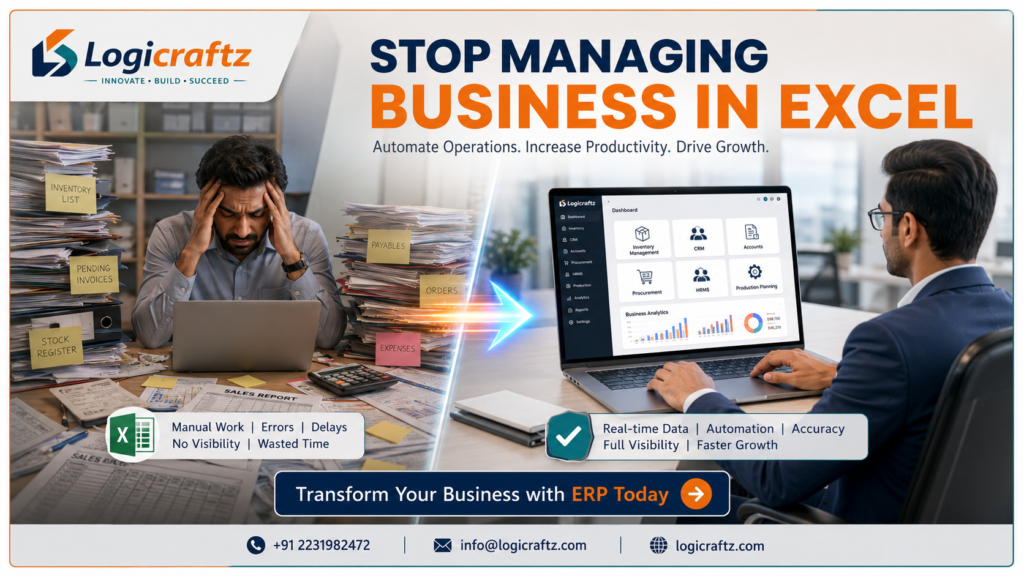
For SMEs, implementing an ERP system represents a transformation from fragmented, spreadsheet-driven operations to intelligent, data-driven business management. Today's ERP solutions are specifically designed for growing businesses, offering enterprise-grade capabilities without the complexity, infrastructure requirements, or substantial investment traditionally associated with large corporate systems. By integrating people, processes, and information into one unified platform, ERP empowers SMEs to improve efficiency, increase profitability, and build a strong foundation for sustainable long-term growth.
For SMEs, this means transitioning from spreadsheet-heavy operations to intelligent, data-driven management—without the enterprise-level complexity or budgetary constraints.
Top 8 Benefits of ERP for SMEs
1. Cost Reduction and ROI
The Financial Impact
- 20–30% reduction in operational costs within 12–18 months
- 40–50% reduction in inventory holding costs
- 25–35% decrease in manual labor hours
- ROI in 2–3 years for many SMEs
ERP removes redundancy, reduces errors, and gives teams one reliable source of truth.
2. Operational Efficiency
Streamlined Business Processes
- Purchase order management → automated approvals
- Invoice processing → digital tracking and auto-matching
- Inventory management → auto reorder triggers
- Payroll processing → automated calculations and compliance
Typical gains include 60–70% faster processing, 80–90% fewer manual errors, and 25–40% higher productivity.
3. Better Decision-Making
Real-Time Business Intelligence
- Sales and pipeline visibility
- Cash flow and financial position
- Inventory movement tracking
- Customer retention metrics
- Production utilization insights
Real-time insights help leadership make faster, data-backed decisions and move from reactive to proactive management.
4. Inventory Management
Optimization Through Visibility
- 25–40% reduction in inventory levels
- Fewer stockouts through predictive ordering
- Reduced dead stock and obsolescence
- Inventory accuracy improved to 95%+
ERP supports reordering automation, multi-location tracking, barcode integration, and supplier coordination.
5. Scalability for Growth
Growing Without Growing Pains
- Support for new locations and business units
- Multi-currency and multi-language functionality
- Handles growing transaction volume
- Flexible user licensing and module expansion
ERP allows SMEs to scale incrementally without replacing their core system.
6. Customer Relationship Improvement
360-Degree Customer View
- Order and transaction history
- Service and support interactions
- Payment history and credit status
- Preferences and communication records
Outcomes include 35–50% faster responses, 15–25% better satisfaction, and stronger retention.
7. Compliance and Risk Management
Built-in Compliance Features
- Automated audit trails
- Role-based access controls
- Accounting compliance support
- Automated tax calculations
- Secure archiving and encryption
ERP reduces compliance risk, simplifies audits, and strengthens data security.
8. Competitive Advantage
Strategic Business Benefits
- Faster order fulfillment
- Improved product quality
- Data-driven marketing
- Better vendor relationships
- Higher employee satisfaction
ERP helps SMEs operate like larger, more mature organizations while staying agile.
How SMEs Benefit More Than Larger Enterprises
The SME Advantage
While large enterprises often face lengthy, complex ERP implementations, SMEs usually benefit from faster rollout and simpler change management.
Why SMEs Succeed Faster
- Smaller user base means quicker training
- Less legacy system baggage to migrate
- More flexible processes that adapt to best practices
- Direct leadership buy-in speeds adoption
- Rapid feedback loops enable quick adjustments
Real-World Success Stories
Manufacturing SME
Challenge: Inventory discrepancies, delayed order fulfillment, and fragmented financial data.
Solution: Cloud ERP with integrated production planning.
Results:
- Lead times reduced by 40%
- Inventory accuracy improved to 98%
- On-time delivery rose from 78% to 94%
- Administrative costs reduced by 30%
Distribution Company
Challenge: Integrating 3 new locations while maintaining data consistency.
Solution: ERP with multi-location inventory and centralized purchasing.
Results:
- Unified inventory across locations
- Procurement costs reduced by 18%
- Order accuracy improved to 99.2%
- Supported 40% growth without proportional overhead increase
ERP Implementation Costs for SMEs
Understanding the Investment
ERP implementations don't have to break the bank for SMEs.
| Component | Cost Range |
|---|---|
| Software Licensing | $5,000 - $50,000/year |
| Implementation & Setup | $10,000 - $75,000 |
| Training & Change Management | $5,000 - $25,000 |
| Hardware (if on-premise) | $10,000 - $50,000 |
| First Year Total | $30,000 - $200,000 |
Cloud ERP
- Lower upfront costs
- Automatic updates and maintenance
- Scalable pricing model
- No IT infrastructure investment
- Faster implementation
- Better vendor-managed security
On-Premise ERP
- Higher initial investment
- Ongoing IT maintenance costs
- More control over customization
- Data remains on-site
For most SMEs, cloud-based ERP delivers better value and faster ROI.
Key Metrics: What SMEs Can Expect
Operational Metrics
| Metric | Typical Improvement |
|---|---|
| Order Processing Time | -60% to -70% |
| Inventory Holding Cost | -40% to -50% |
| Manual Data Entry Hours | -80% to -90% |
| Procure-to-Pay Cycle | -50% to -60% |
| Invoice Processing Time | -70% to -80% |
| Inventory Accuracy | Improves to 95%+ |
Financial Metrics
| Metric | Typical Outcome |
|---|---|
| Operational Cost Reduction | 20-30% |
| Working Capital Improvement | 15-25% |
| Cash Flow Improvement | 20-30% |
| Revenue per Employee | +15-25% |
| Payback Period | 2-3 years |
Common ERP Implementation Challenges for SMEs
Solution: Choose cloud-based solutions with managed support.
Solution: Use strong sponsorship, phased rollouts, training, and communication.
Solution: Clean data first and use phased migration with validation.
Solution: Start with core modules and phase the implementation.
Solution: Prefer standard configurations unless customization creates strategic value.
Selecting the Right ERP for Your SME
Evaluation Criteria
Does it serve your industry well? Are there pre-built templates? Does it have customers like you?
Can it grow with your business? Does it support flexible modules, licensing, and multi-location operations?
Look for intuitive UI, mobile access, and minimal training requirements.
Check APIs, connectors, and compatibility with your current tools.
Prioritize transparent pricing and evaluate total cost of ownership over 5 years.
Assess support responsiveness, training resources, and product update frequency.
The Path Forward: Getting Started with ERP
Phase 1: Assessment
Weeks 1–4
- Review current pain points
- Identify stakeholders
- Define success metrics
- Set scope and budget
Phase 2: Selection
Weeks 4–8
- Request vendor proposals
- Run demos
- Check SME references
- Negotiate terms
Phase 3: Planning
Weeks 8–12
- Create project plan
- Assign core team
- Communicate vision
- Plan data migration
Phase 4: Implementation
Weeks 12–24
- Configure system
- Clean and migrate data
- Train users
- Go live with support
Phase 5: Optimization
Months 6–12+
- Track KPIs
- Refine processes
- Expand modules
- Support continuous improvement
Benefits of ERP for SMEs
FAQ: ERP for SMEs
A: ERP implementation timelines vary depending on the size of the business, number of departments involved, and the level of customization required. For most SMEs, cloud-based ERP implementations typically take 4 to 12 months. Simpler deployments can be completed in as little as 8 to 12 weeks, while highly customized projects may require more time.
A typical implementation process includes:
- Business requirement analysis
- Software selection and planning
- Data migration
- System configuration and customization
- User training
- Testing and quality assurance
- Go-live and post-implementation support
Although full implementation may take several months, many businesses begin seeing measurable improvements such as better reporting, reduced manual work, and improved process visibility within 3 to 6 months after going live.
A: Yes. Modern ERP implementations are designed to minimize operational disruption. Most successful ERP projects use a phased implementation approach, where different modules are deployed gradually rather than all at once.
Strategies that reduce business interruption include:
- Implementing one department at a time
- Running old and new systems simultaneously during transition
- Scheduling migrations during low business periods
- Conducting employee training before deployment
- Performing extensive testing before going live
With proper planning and change management, businesses can continue serving customers and maintaining productivity throughout the ERP implementation process.
A: ERP systems are no longer reserved only for large enterprises. Today, many small and medium-sized businesses benefit significantly from ERP solutions.
ERP is particularly valuable for businesses that:
- Have 50 or more employees
- Generate annual revenues exceeding $5 million
- Operate multiple departments or locations
- Manage large inventories
- Handle complex financial operations
- Experience rapid business growth
- Depend heavily on spreadsheets and manual processes
Even smaller companies can benefit from ERP if they face challenges such as inventory inaccuracies, disconnected systems, delayed reporting, or inefficient workflows. The right ERP system helps businesses establish a strong foundation for future growth. Benefits of ERP
A: Not necessarily, but some process improvements are usually recommended. Modern ERP solutions are highly configurable and can accommodate many existing workflows. However, ERP systems are built around industry best practices that often improve efficiency and standardization. Benefits of ERP
Organizations should evaluate:
- Which current processes are effective and should remain
- Which processes are outdated or inefficient
- Opportunities for automation
- Areas where standardization can improve productivity
Rather than completely changing the business to fit the software, the ideal approach is to strike a balance between maintaining unique business requirements and adopting proven industry practices that improve efficiency. Benefits of ERP
A: Employee adoption is one of the most critical factors in ERP success. Even the best ERP software will fail to deliver value if employees are not properly trained and engaged. Benefits of ERP
Successful adoption strategies include:
- Strong support from company leadership
- Involving employees during planning and implementation
- Providing role-based training programs
- Communicating the benefits of the new system clearly
- Offering continuous support after go-live
- Creating ERP champions within departments
- Encouraging feedback and continuous improvement
When employees understand how ERP makes their jobs easier by reducing repetitive tasks and improving access to information, adoption rates improve significantly. Benefits of ERP
A: The primary difference lies in the level of built-in functionality.
Industry-Specific ERP
Designed specifically for certain sectors such as manufacturing, pharmaceuticals, retail, healthcare, or construction.
Advantages:
- Pre-configured industry workflows
- Faster implementation
- Industry-specific reporting
- Built-in compliance requirements
- Reduced customization costs
Generic ERP
Provides a flexible platform that can be adapted to different industries.
ERP Advantages:
- Greater customization flexibility
- Suitable for diverse business models
- Supports multiple industries
- Easier expansion into new business areas
Industry-specific ERP often delivers quicker returns because many business processes are already built into the system. Generic ERP may require additional configuration but provides greater flexibility for unique operational requirements..
A: Yes. Most modern ERP solutions are designed to integrate seamlessly with existing business applications.
Common integrations include:
- Accounting software
- CRM platforms
- E-commerce websites
- HR and payroll systems
- Banking applications
- Inventory management systems
- Business intelligence tools
- Shipping and logistics platforms
- Mobile applications
- Third-party marketplaces
Modern ERP systems use APIs, web services, and integration platforms to enable secure data exchange between applications. Integration eliminates duplicate data entry, improves information accuracy, and creates a unified business ecosystem.
A: ERP significantly enhances customer service by providing employees with complete and accurate customer information in real time.
ERP Benefits include:
Faster Response Times
Customer service representatives can immediately access order history, invoices, inventory status, and support requests. Benefits of ERP
Better Personalization
Having complete customer information enables businesses to provide more personalized recommendations and services. Benefits of ERP
Improved Order Fulfillment
Integrated inventory and supply chain management reduce delivery delays and improve order accuracy. Benefits of ERP
Proactive Issue Resolution
ERP provides alerts and analytics that help businesses identify and resolve potential issues before they impact customers. Benefits of ERP
Consistent Customer Experience
All departments work with the same customer information, ensuring consistent communication and service quality. Benefits of ERP
By connecting sales, inventory, finance, and customer support processes into one platform, ERP enables businesses to deliver faster, more accurate, and more satisfying customer experiences, leading to higher customer retention and long-term growth. Benefits of ERP
- CRM Software Solutions
- CRM Implementation Services
- Customer Management Software
- Sales CRM Services
- Business Automation Services
Transform Your SME with ERP
The benefits of ERP for SMEs extend far beyond cost reduction—they fundamentally transform how your business operates. From enhanced visibility and improved efficiency to scalability and competitive advantage, ERP systems empower small and medium enterprises to compete effectively in digital-first markets.
The data is compelling:
- 78% of SMEs report significant operational improvements
- Average 20–30% cost reduction within 18 months
- 2–3 year payback period for most implementations
- 95%+ inventory accuracy is achievable
- Substantial customer satisfaction improvement
The question isn't whether your SME can afford to implement ERP—it's whether you can afford not to.
Ready to transform your SME? Start by assessing current challenges, defining success metrics, and choosing an ERP partner that understands the needs of growing businesses.
Benefits of ERP for SMEs
ERP Benefits
Advantages of ERP
ERP Advantages
The Benefits of ERP for SMEs extend far beyond simplifying daily operations. Modern ERP platforms help small and medium-sized enterprises streamline business processes, improve collaboration across departments, enhance inventory control, strengthen financial management, and provide real-time business insights for better decision-making. Among the most valuable ERP benefits are increased productivity, reduced manual errors, improved customer service, better compliance, and lower operational costs. The many advantages of ERP also include scalable business management, centralized data access, faster reporting, and improved resource utilization, enabling growing businesses to operate more efficiently while building a strong foundation for long-term success.