AI-Native CRM for SMEs: Building Enterprise-Level Customer Intelligence Without Enterprise Budgets
Small and medium-sized enterprises operate in a business environment where customer expectations, competition and technology are changing rapidly. Large organisations often have dedicated sales operations teams, advanced analytics platforms, marketing automation and sophisticated customer relationship management systems. Smaller businesses, however, may still depend on spreadsheets, disconnected applications and manually maintained customer records.
This technology gap can affect how efficiently a business identifies potential customers, responds to enquiries, manages sales opportunities and retains existing accounts. The challenge is not simply storing customer information. It is turning that information into decisions that improve business performance.
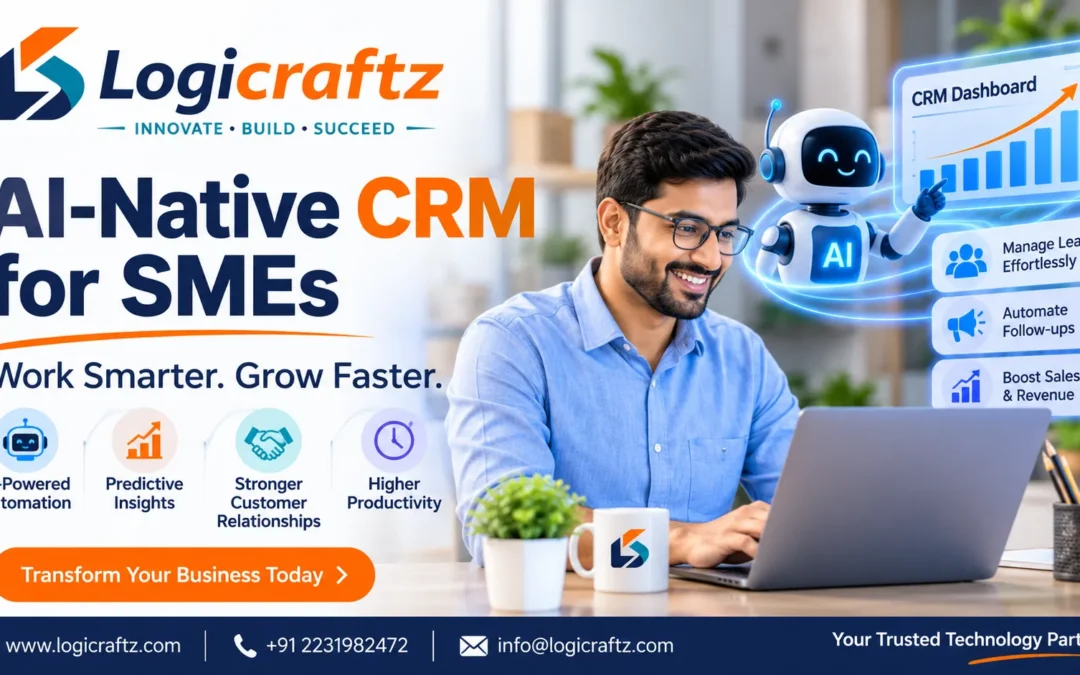
AI-Native CRM for SMEs introduces a more intelligent approach to customer management. Instead of treating artificial intelligence as an optional feature added to traditional CRM software, an AI-native architecture integrates intelligence, automation and data-driven decision-making into the system’s core operations.
It can help businesses connect customer information, understand purchasing behaviour, identify sales opportunities and automate repetitive activities without necessarily investing in complex enterprise infrastructure. The objective is not to replicate every technology system used by a large corporation. It is to give smaller organisations access to practical customer intelligence capabilities that support more consistent operations and sustainable growth.
What Is an AI-Native CRM and Why Does It Matter for SMEs?
An AI-native Customer Relationship Management (CRM) system is designed around connected customer data, artificial intelligence and automated workflows. AI is integrated into the system’s operating architecture rather than being limited to a separate chatbot or optional writing assistant.
Depending on the platform and implementation, an AI-native CRM can analyse customer interactions, identify patterns, recommend next steps and coordinate approved business activities. It can support employees by reducing repetitive administration and making relevant customer information easier to access.
For example, a business owner may want to understand which customers have not purchased recently, which sales opportunities have remained inactive or which enquiries require immediate attention. An intelligent CRM can analyse authorised records and present relevant information without requiring employees to manually combine several spreadsheets.
AI-Native CRM vs Traditional CRM with AI Features
Adding an AI assistant to a conventional CRM does not automatically make the platform AI-native. A traditional CRM may offer useful capabilities such as email drafting, meeting summaries and automated reminders while retaining a largely employee-driven operating model.
An AI-native architecture places greater emphasis on connecting data, intelligence and workflow execution. Its AI components can work with authorised business information and interact with approved tools under defined permissions.
| Capability | Traditional CRM | AI-Native CRM Approach |
|---|---|---|
| Data management | Primarily employee-driven entry | Automated capture and enrichment where integrated |
| Lead management | Manual or rule-based assignment | Scoring, prioritisation and intelligent routing |
| Customer analysis | Historical reports | Predictive insights and conversational analysis |
| Workflow execution | Mostly employee-driven | AI-assisted or agent-executed approved workflows |
| Decision support | Descriptive analytics | Recommendations and predictive analysis |
These are general architectural distinctions, not absolute product classifications. Modern traditional CRM platforms can also provide advanced AI capabilities. Buyers should examine how a product handles data access, automation, permissions and auditability instead of relying only on the term AI-native in marketing material.
Why SMEs Need Enterprise-Level Customer Intelligence
Customer intelligence is the process of collecting, connecting and analysing customer information to understand purchasing behaviour, preferences, requirements and commercial potential. For SMEs, this information can be particularly valuable because individual customer relationships may represent a meaningful share of overall revenue.
Fragmented Customer Data Creates Business Blind Spots
Many businesses store customer information across different applications. Contact details may sit in spreadsheets, enquiries arrive through website forms, conversations remain in email accounts, invoices are maintained in accounting software and orders are recorded in ERP or inventory applications.
Each system may contain useful information, but disconnected records make it difficult to understand the complete customer relationship. A salesperson may contact a customer without knowing that the finance department has identified an overdue payment or that the operations team is already handling a delivery issue.
An integrated CRM architecture can connect these information sources through APIs, webhooks and supported integrations. This gives authorised employees a more complete view of customer activity while preserving the role of each source system.
Customer Retention Requires Better Visibility
Customer acquisition is only one part of business growth. Existing customers can generate repeat orders, referrals, service contracts and additional product opportunities. However, a business cannot respond effectively to customer changes if it has limited visibility into purchasing frequency, service history or unresolved issues.
AI-assisted CRM analytics can flag unusual changes in customer activity, such as a decline in order frequency or repeated support requests. These indicators help employees investigate possible problems and decide whether a customer needs a service call, account review or relevant product recommendation.
How an Affordable AI-Native CRM Architecture Works
Building an intelligent CRM does not require every SME to develop its own AI model or purchase an expensive enterprise data platform. A practical architecture can combine a reliable CRM database, connected business applications, AI services, workflow automation and reporting tools.
Customer Data Layer: Establish a Reliable Source of Truth
The customer data layer stores the information required to understand and manage business relationships. Typical records include contact details, company information, lead sources, enquiry history, sales opportunities, quotations, customer communication, purchase history and support requests.
Records should use consistent identifiers. A customer should not appear as several unrelated accounts simply because their name has been entered differently in the CRM, accounting software and ERP system. Deduplication, validation rules and master data management help maintain consistency.
Integration Layer: Connect CRM with Business Applications
APIs, webhooks and integration services allow CRM platforms to exchange information with other business applications. Common connections include website enquiry forms, email platforms, supported WhatsApp Business integrations, ERP systems, accounting applications, marketing tools and customer support software.
Not every integration requires real-time synchronisation. New customer enquiries may need immediate processing, while some analytical reports can operate through scheduled updates. Integration frequency should reflect the business importance, sensitivity and operational requirements of the information.
Intelligence Layer: Apply AI to Relevant Business Tasks
The intelligence layer processes structured and unstructured information to generate useful business insights. It may include machine learning models for lead scoring, large language models for conversation summaries, predictive analytics for forecasting and AI agents for executing approved workflows.
Different tasks require different technologies. A statistical model may be more appropriate for predicting customer churn than asking a general-purpose language model to estimate the probability of losing an account. Similarly, an LLM can summarise a sales conversation, but important commercial figures should be retrieved and validated against authoritative CRM or ERP records.
Workflow Layer: Convert Insights into Business Actions
Analytics alone does not improve business performance. Insights must lead to appropriate operational action. A workflow engine can translate AI recommendations into processes that employees can review and execute.
For example, when a customer has not placed an order within their usual purchasing interval, the CRM could identify the change, review the customer’s order history, check for unresolved service issues and prepare an account summary for the responsible sales representative. The employee can then decide whether to contact the customer and record the next action.
Governance Layer: Control AI Access and Execution
AI agents should operate with restricted permissions rather than unrestricted access to the entire customer database. A practical governance layer includes role-based access, approval requirements, audit logs, encryption, retention policies, activity monitoring and recovery procedures.
An AI agent may be allowed to prepare a quotation draft but require human approval before sending it or changing an approved price. This separation between recommendation and execution is essential for responsible automation.
Essential AI-Native CRM Features for Small and Medium Businesses
Not every business needs dozens of AI features. A practical implementation should begin with capabilities that solve existing operational problems and can be measured after deployment.
Intelligent Lead Scoring and Qualification
Lead scoring evaluates potential customers according to their likelihood of progressing towards a defined sales milestone. Traditional scoring may use fixed criteria such as industry, location, company size and enquiry source. Predictive lead scoring can incorporate historical sales patterns and other relevant variables.
For example, a B2B technology company may prioritise enquiries from organisations that match its target industry, have a defined purchasing requirement and demonstrate meaningful engagement. Scores should be explainable enough for employees to understand why a lead received its ranking. Businesses should monitor false positives and false negatives rather than treating predictions as guaranteed sales outcomes.
Automated Customer Segmentation
Customer segmentation groups accounts according to characteristics or behaviour. AI-assisted analysis can help identify frequent buyers, inactive accounts, high-value customers, customers with declining engagement and accounts interested in particular product categories.
These segments can support more relevant marketing campaigns, sales follow-ups and customer service strategies. The quality of the segments depends on accurate records and sensible business definitions.
Predictive Customer Churn Intelligence
Customer churn prediction estimates which customers may discontinue or reduce their relationship with a business. Depending on the business model, relevant indicators may include purchase frequency, service complaints, payment delays, engagement levels and contract renewal history.
A CRM can combine these indicators into a risk score and recommend an appropriate retention action. However, a high churn score is a warning signal, not proof that a customer intends to leave. Employees should investigate the underlying reasons before initiating retention campaigns.
AI-Powered Sales Forecasting
Sales forecasting estimates future revenue or sales activity using pipeline information, historical performance, seasonality and other relevant factors. AI-assisted forecasting can help SMEs identify potential revenue gaps, delayed opportunities and differences between expected and actual performance.
For example, a distributor may analyse historical seasonal demand, open quotations and repeat purchase patterns to support sales planning. Forecasts should be reviewed against actual business conditions because unexpected market changes can affect model accuracy.
Conversational Intelligence and Customer Service Automation
Conversational intelligence analyses customer interactions to extract useful information. With appropriate consent and integration, CRM systems can process supported call transcripts, emails and messages to identify customer requirements, purchase objections, unresolved questions, agreed follow-up activities and feedback.
AI agents can also handle eligible routine enquiries, retrieve approved information, create support tickets and provide status updates. They should recognise when a request requires human intervention, particularly for complaints, financial disputes, sensitive personal information or complex technical issues.
AI-Powered Product and Next-Best-Action Recommendations
Recommendation systems suggest relevant actions based on customer history, product relationships and business rules. An industrial equipment supplier, for example, may identify customers who purchased a particular machine but have not purchased a recommended maintenance service. The CRM can flag the opportunity for an account manager to review.
How SMEs Can Build Customer Intelligence Without Enterprise Budgets
A common mistake in CRM transformation is purchasing every available technology capability before identifying the actual business problems that need to be solved. A smaller organisation should follow a modular implementation strategy that controls expenditure and allows the technology to expand as requirements grow.
Use Existing Systems Before Replacing Them
Before investing in a new CRM, identify the applications already used by the organisation. Existing accounting software, ERP applications, email systems, website forms and customer communication platforms may contain valuable information that can be connected through APIs or supported integrations.
Replacing every application can introduce unnecessary implementation costs and operational disruption. A better approach is to identify which system should remain authoritative for each type of information and integrate relevant data into the customer management architecture.
Choose Cloud-Based and Modular Infrastructure
Cloud CRM applications can reduce the need to purchase and maintain dedicated server infrastructure. Managed databases, hosted AI services and modular software components allow SMEs to begin with limited workloads and increase capacity as required.
Cloud infrastructure is not automatically inexpensive. Businesses should evaluate subscriptions, storage, data transfer, AI consumption, integration fees, backup requirements and support costs before selecting a provider.
Use Existing AI Models Through Managed Services
Most SMEs do not need to train a large language model from scratch. They can evaluate existing AI services for conversation summarisation, information extraction, customer enquiry classification and natural-language reporting.
For specialised predictions, smaller machine learning models may be more cost-effective and easier to validate. The technology choice should depend on task complexity, data sensitivity, response quality and expected operating volume.
Automate High-Value Processes First
Begin with workflows that consume significant employee time and have clearly defined business rules. Practical starting points include incoming lead assignment, customer account summaries, overdue quotation reminders, enquiry classification and repeat-purchase alerts.
Automating one reliable workflow is often more useful than deploying multiple AI agents that employees do not trust or use. Measure the time saved, error rate and employee adoption before expanding the automation programme.
Avoid Unnecessary Vendor Lock-In
SMEs should evaluate API availability, data export options, integration documentation and support for common data formats before selecting a CRM platform. Modular architecture and model-independent integration layers can make it easier to change AI providers without rebuilding the entire customer management system.
AI-Native CRM Use Cases Across SME Industries
Customer intelligence requirements differ between industries. A CRM architecture should reflect how a particular business acquires customers, manages relationships and generates revenue.
Manufacturing and Engineering SMEs
Manufacturers frequently manage distributors, dealers, industrial buyers, procurement teams and repeat-order customers. An intelligent CRM can connect sales enquiries with product information, quotation history, order records and customer service activities.
Consider a company manufacturing industrial components. Its CRM could identify customers who regularly order a particular component, monitor the time since their last purchase and alert the sales team when a repeat-order opportunity may exist. When integrated with ERP and inventory management, the system can also provide relevant stock and order information to authorised employees.
Retail and Distribution Businesses
Retail and distribution organisations handle multiple customer segments, product categories and purchasing patterns. AI-powered segmentation can help identify frequent customers, inactive accounts, seasonal demand and relevant product recommendations.
For a distributor, connecting CRM with inventory and accounting records can help account managers understand customer purchase history and payment status before following up.
Healthcare Administration and Service Businesses
Healthcare organisations and service providers can use CRM capabilities to coordinate appointment requests, administrative communication, service reminders and customer support. However, healthcare information requires stricter access controls and privacy safeguards. AI should not independently make clinical decisions or access sensitive records without an appropriate legal and technical framework.
Logistics and Supply Chain SMEs
Logistics businesses manage enquiries, quotations, shipment updates, service requests and customer account relationships. An integrated CRM can connect customer enquiries with transport management, delivery tracking and service history.
AI can help classify customer requests, identify repeated service issues and prepare account summaries for sales and operations teams.
IT Services and Professional Services
Technology companies and professional service providers often manage lengthy sales cycles, project enquiries, client requirements and service renewals. AI-native CRM capabilities can summarise meetings, identify action items, monitor opportunity stages and highlight accounts requiring attention.
CRM and ERP Integration: Connecting Customer Intelligence with Business Operations
Customer intelligence becomes more useful when CRM can access relevant operational information from Enterprise Resource Planning (ERP) systems. CRM primarily supports customer-facing processes, while ERP manages operations such as finance, inventory, procurement, production and order processing.
Connecting the two systems creates a more complete view of the customer relationship. The integration should define which application owns each data record and how changes are synchronised.
| Business Information | CRM Application | ERP Application |
|---|---|---|
| Customer details | Relationship management | Customer account records |
| Product availability | Sales visibility | Inventory records |
| Sales quotations | Opportunity tracking | Commercial processing where integrated |
| Orders | Customer visibility | Order fulfilment |
| Payment status | Account relationship context | Financial records |
| Production status | Customer communication | Manufacturing management |
Example: Intelligent Customer Management for a Manufacturing SME
Imagine a manufacturer receiving an enquiry for 5,000 units of an industrial component. The CRM records the enquiry and identifies the customer as an existing distributor. An integrated ERP system provides authorised access to current stock information, product details and relevant order history.
An AI assistant can prepare a customer summary, highlight previous quotations and identify missing information required for the new enquiry. The sales representative reviews the details and approves the quotation workflow.
Once an order is confirmed, the ERP manages the relevant operational transactions while the CRM maintains customer-facing communication and follow-up activities. This is more useful than a standalone AI chatbot because the intelligence is connected to actual business operations.
Businesses evaluating an integrated software environment can explore ERP software solutions and assess how CRM, inventory, accounting and manufacturing processes can work together.
Understanding AI-Native CRM Costs for SMEs
There is no universal price for an AI-native CRM. The total investment depends on the number of users, application requirements, integrations, AI consumption, security needs and customisation. Businesses should distinguish between software subscription costs and total cost of ownership.
Key CRM Investment Components
- CRM subscriptions and employee licences.
- Cloud database and hosting expenses.
- AI model or API consumption.
- Third-party integration charges.
- Custom development and configuration.
- Data cleaning and migration.
- Employee training and adoption.
- Security, monitoring, backup and maintenance.
A Practical CRM Investment Approach
| Implementation Stage | Main Capabilities | Investment Approach |
|---|---|---|
| Starter CRM | Contacts, leads and pipeline tracking | Use existing or entry-level CRM capabilities |
| Connected CRM | Website, email and workflow integration | Add integrations according to business priority |
| Intelligent CRM | Lead scoring, summaries and predictive analytics | Use managed AI services and validated models |
| Advanced AI CRM | AI agents and cross-system automation | Expand after measuring pilot performance |
These are implementation stages, not fixed market prices. SMEs should obtain quotations based on user count, integrations, customisation, security requirements and expected AI usage.
How SMEs Can Control AI CRM Operating Costs
Businesses can manage expenditure by using smaller models for simple classification tasks where quality is sufficient, reserving more capable models for complex reasoning, limiting unnecessary API calls, monitoring token consumption and setting usage alerts. Event-driven automation can also reduce unnecessary processing compared with repeatedly checking every system.
The goal is not to minimise AI expenditure at any cost. It is to ensure that each recurring technology expense supports a meaningful business requirement.
AI-Native CRM Security, Privacy and Data Governance
Customer intelligence creates business value, but it also increases responsibility for protecting business and personal information. SMEs should not assume that a cloud CRM or AI provider automatically handles every aspect of data protection on their behalf.
Role-Based Access and Secure Integration
Employees should only access the information required for their responsibilities. Sales representatives, finance teams, customer support employees and administrators may need different permissions. AI agents should follow the same principle through scoped credentials and restricted tools.
Businesses should assess encryption in transit and at rest, secure authentication, API key management and the security practices of connected providers. Integration credentials should not be stored in publicly accessible scripts, spreadsheets or unrestricted configuration files.
Human Oversight of AI Decisions
AI recommendations should not automatically become business decisions. High-impact activities such as changing prices, approving refunds, modifying financial records, making credit decisions or sending sensitive communications should have appropriate approval controls.
Privacy and Regulatory Considerations in India
Indian businesses processing digital personal data should evaluate their obligations under the Digital Personal Data Protection Act, 2023 and the Digital Personal Data Protection Rules, 2025, including the applicable commencement timeline for relevant provisions. The rules were notified in November 2025 and provide for phased commencement. Businesses should review the official notifications and obtain appropriate legal advice for their specific processing activities.
Organisations should document what information is collected, why it is processed, who can access it, how long it is retained and which service providers process it. Privacy notices, consent mechanisms where applicable, security safeguards and processes for handling individual requests should be considered as part of system design.
Monitor AI Accuracy and Operational Performance
AI models can produce inaccurate classifications, incomplete summaries and incorrect recommendations. Businesses should test important workflows against representative examples and monitor error rates after deployment.
Audit logs, employee feedback and exception reports can help identify problems before they affect a large number of customer interactions. The organisation should also define who is responsible for reviewing and correcting AI-generated information.
A Practical 90-Day AI-Native CRM Implementation Roadmap
SMEs can reduce implementation risk by introducing customer intelligence in stages instead of attempting a complete transformation immediately. The following roadmap is a planning framework; actual timelines depend on data quality, integration complexity, internal resources and compliance requirements.
Days 1–30: Assess Business Processes and Customer Data
The first phase should focus on understanding existing operations. Identify customer information sources, review the current CRM or contact management process, identify duplicate and incomplete records, document the lead-to-customer journey and identify repetitive sales and service activities.
Define measurable objectives before selecting AI features. Useful baseline metrics include lead response time, lead qualification accuracy, sales cycle duration, customer retention, manual data entry time and support resolution time.
Days 31–60: Build the Connected CRM Foundation
Configure contact and company records, establish consistent customer identifiers, connect website enquiry forms and integrate relevant email and communication systems. Connect ERP or accounting information where justified, configure permissions and audit logging, and test data synchronisation and error handling.
At this stage, reliable information flow is more important than advanced AI features. Poorly integrated data can undermine even sophisticated analytics.
Days 61–90: Introduce AI and Measure Results
Deploy selected AI capabilities to support actual business workflows. Introduce AI-assisted lead qualification, automate customer interaction summaries, configure follow-up recommendations, test customer segmentation and measure employee adoption and workflow accuracy.
At the end of the pilot, review total cost, data quality, employee feedback, error rates and operational improvements before expanding the implementation. A 90-day roadmap is a proposed framework, not a guaranteed deployment timeline.
How to Measure the ROI of an AI-Native CRM
Implementing AI is not a business outcome by itself. SMEs need to determine whether the system improves customer management, reduces operational effort or supports profitable growth.
Return on Investment (ROI) can be calculated using the following formula:
Important AI CRM Performance Indicators
| KPI | What It Measures | Business Relevance |
|---|---|---|
| Lead response time | Time between enquiry and response | Sales responsiveness |
| Lead conversion rate | Percentage of leads becoming customers | Sales effectiveness |
| Customer retention rate | Customers retained over a defined period | Relationship quality |
| Customer lifetime value | Estimated value over the relationship | Long-term profitability |
| Cost per qualified lead | Acquisition expenditure per qualified prospect | Marketing efficiency |
| Data completeness | Required customer information available | CRM reliability |
| Automation success rate | Percentage of workflows completed correctly | Operational efficiency |
Illustrative Business Example
Consider an SME that spends 120 employee hours every month on manual lead updates, customer follow-ups and sales administration. Assume a selected AI-enabled CRM workflow reduces this workload by 35 hours monthly. If the fully loaded employee cost is an illustrative ₹400 per hour, the estimated monthly labour capacity released is ₹14,000.
This is not automatically a cash saving. The financial benefit depends on whether the released time reduces overtime, avoids additional hiring, supports more customer activity or improves productive capacity. Businesses should also account for software subscriptions, implementation, AI consumption, training and maintenance before calculating the final ROI.
Choosing the Right AI CRM Platform for a Growing SME
The best AI CRM for a small business is not necessarily the platform with the largest number of advertised AI features. It is the platform that fits the organisation’s workflows, customer data, integration requirements, security expectations and operating budget.
What Should Businesses Evaluate?
- Data model flexibility: Can the CRM represent the organisation’s customer, product and sales processes?
- AI capabilities: Does the platform provide useful analytics, automation and AI assistance?
- Integration support: Can it connect with existing accounting, ERP, website and communication applications?
- Automation controls: Can employees review, approve and monitor automated activities?
- Data portability: Can the organisation export its records in usable formats?
- Scalability: Can the platform support increasing customer and transaction volumes?
- Security: Are access controls, audit logs and appropriate data protection features available?
- Total cost: Are subscriptions, add-ons, AI usage and integration charges transparent?
- Implementation support: Is technical assistance available for configuration and customisation?
Examples of CRM Platforms and Their AI Ecosystems
Several established platforms offer CRM and AI capabilities that SMEs can evaluate according to their requirements.
Zoho CRM provides its Zia AI ecosystem, which includes capabilities such as prediction, recommendations, anomaly detection, workflow assistance and sales intelligence. Feature availability depends on the product edition and configuration.
HubSpot offers a customer platform that combines CRM data with sales, marketing and service capabilities. Its AI ecosystem includes assistants and specialised agents.
Salesforce provides a broad CRM ecosystem with Einstein and Agentforce capabilities. Its functionality and commercial requirements should be assessed against the scale and complexity of the organisation.
Odoo offers an integrated business application ecosystem that includes CRM, sales, inventory and other operational modules. ERPNext provides an open-source ERP ecosystem with customer and sales management capabilities. Both can be evaluated for integration and customisation requirements.
These products do not all have identical AI-native architectures. A platform offering AI features should not automatically be classified as AI-native. Buyers should verify how AI interacts with underlying data, permissions and execution controls.
Common AI CRM Implementation Mistakes SMEs Should Avoid
Choosing AI Before Defining the Business Problem
Purchasing AI tools without identifying the actual operational bottleneck can create additional expenditure without measurable improvement. Businesses should first determine whether their primary challenge is lead management, poor data quality, slow follow-ups, customer retention or fragmented reporting.
Ignoring Data Quality
Duplicate records, inconsistent customer names, outdated contact details and incomplete transaction histories can reduce the reliability of AI-generated insights. Data cleaning and validation should be treated as core implementation activities.
Automating Poorly Designed Processes
AI automation does not automatically correct an inefficient business process. Automating unnecessary approval steps or inaccurate lead-routing rules can make existing problems occur faster. Review the workflow before introducing automation.
Giving AI Excessive Permissions
Autonomous execution should be limited to approved tasks. Sensitive activities should require appropriate human review and authorisation. Businesses should also maintain logs of important actions performed by AI agents.
Ignoring Employee Adoption and Expecting Immediate Revenue Growth
Employees may resist a CRM system that introduces additional administrative work or produces recommendations they cannot understand. Training, feedback and practical workflow design are essential for adoption.
Better customer intelligence can support business decisions, but it does not guarantee more sales. Market demand, pricing, product quality, customer service and sales execution continue to influence commercial performance.
The Future of AI-Native CRM: From Customer Records to Intelligent Business Operations
CRM is evolving beyond contact databases and conventional sales pipelines. As AI models, business integrations and autonomous agents become more capable, CRM platforms may increasingly operate as an intelligence and execution layer across the customer journey.
Autonomous Customer Relationship Workflows
AI agents may increasingly coordinate routine activities such as lead enrichment, customer communication, follow-up scheduling, record updates and support classification. Employees will continue to supervise sensitive decisions, manage exceptions and develop strategic customer relationships.
Natural Language Business Intelligence
Business owners may be able to ask questions such as which customers have not placed an order in the last 90 days, which sales opportunities have remained inactive or which product categories generate the most repeat purchases.
Natural language interfaces can make business information easier to access without requiring every employee to understand complex reporting tools. However, answers must be grounded in authoritative records, with appropriate access controls and clear reporting definitions.
Predictive Customer Experience
Future CRM systems may become better at identifying customer requirements before a direct enquiry is submitted. Changes in order frequency, service history and customer engagement could help a business identify potential service or replenishment needs.
These predictions should be used responsibly, with validation and appropriate customer communication practices.
Multi-Agent Business Operations
Specialised AI agents may collaborate across CRM, ERP, HRMS, accounting and customer service systems. A sales agent could identify an opportunity, an inventory-aware workflow could check product availability, and a service agent could coordinate the required customer communication.
Such coordination requires reliable APIs, shared data definitions, permissions, transaction controls and monitoring. Without these foundations, multiple agents can create conflicting records or execute actions that do not reflect the organisation’s actual business rules.
Smaller Businesses Competing Through Intelligence
The long-term opportunity is not that every SME will operate like a multinational corporation. It is that smaller businesses can gain access to selected analytical and automation capabilities without building large internal technology departments.
A focused, integrated CRM can help a small team understand customers, prioritise opportunities and coordinate activities with greater consistency. The right architecture should expand according to real business needs rather than technology trends alone.
How Logicraftz Solutions LLP Supports SME Digital Transformation
Building an intelligent customer management environment requires more than selecting a CRM application. Businesses need to understand their existing processes, establish reliable data connections and identify the right opportunities for automation.
Logicraftz Solutions LLP focuses on business technology and digital transformation, helping organisations evaluate software solutions that support connected operations and improved process management.
CRM Software and Customer Management
CRM systems can help businesses organise customer information, manage leads, track opportunities, coordinate follow-ups and improve visibility across sales activities. Workflow automation and intelligent reporting can further support organisations seeking to reduce repetitive administrative tasks and improve customer management.
ERP Software and Business Integration
Connecting CRM with ERP systems can provide better coordination between sales, inventory, accounting, purchasing and manufacturing processes. Businesses can evaluate ERPNext and Odoo ERP according to their operational requirements, existing infrastructure and customisation needs.
Website Development and Lead Management
A well-structured business website can become an important source of qualified customer enquiries. Integrating website forms with CRM workflows can help capture enquiries, maintain contact records and coordinate timely sales follow-ups.
Business Automation and Custom Applications
Every organisation has processes that may not fit perfectly into standard software workflows. Custom application development and integration can help connect business applications and automate specific operational requirements.
Build a Connected Digital Business
The objective of digital transformation should be to create a connected technology environment in which customer information, business processes and operational reporting work together.
Build Intelligent Business Operations with Logicraftz
Looking to improve customer management, connect CRM with ERP, automate business workflows or explore AI-powered solutions? Discuss your technology requirements with Logicraftz Solutions LLP.
Phone: +91 2231982472
Email: info@logicraftz.com
Frequently Asked Questions About AI-Native CRM for SMEs
What is an AI-native CRM for SMEs?
An AI-native CRM for SMEs is a customer management platform designed around integrated customer data, AI intelligence and workflow automation. It helps smaller businesses analyse customer behaviour, manage sales activities and automate selected processes without necessarily requiring complex enterprise infrastructure.
How is an AI-native CRM different from a traditional CRM?
A traditional CRM primarily stores customer records and supports employee-driven processes. An AI-native CRM is designed to integrate intelligence and automated execution into its underlying workflows, allowing AI agents to access authorised data, recommend actions and perform approved tasks.
Can small businesses afford AI-powered CRM software?
Yes. SMEs can begin with modular CRM platforms, existing AI services and selected automation workflows. The total investment depends on subscriptions, integrations, usage, implementation and maintenance. A phased approach can help control initial expenditure.
Does an AI-native CRM require a large amount of customer data?
Not necessarily. Businesses can begin with available customer records and gradually improve data quality and integration. However, predictive models generally require sufficient relevant historical data to produce reliable results. Limited or poor-quality data can reduce prediction accuracy.
Can AI-native CRM improve sales conversion rates?
It can support sales conversion through lead prioritisation, faster follow-ups, customer segmentation and better visibility into sales opportunities. Actual conversion improvements depend on lead quality, market conditions, sales execution and customer requirements.
Can SMEs integrate AI CRM with ERP software?
Yes. CRM and ERP systems can exchange relevant information through APIs, webhooks and supported integrations. This can connect customer management with inventory, accounting, order processing and manufacturing operations.
What is the difference between AI-powered CRM and AI-native CRM?
AI-powered CRM generally describes a CRM platform that offers AI features. AI-native CRM refers to an architecture in which AI and automated workflows are central to the platform’s design. The distinction should be evaluated through actual data access, execution capabilities, permissions and auditability rather than marketing labels.
Can AI agents replace CRM employees?
AI agents can automate selected repetitive activities, including data updates, summaries, lead classification and follow-up scheduling. They do not eliminate the need for human judgement, relationship management, complex negotiations or exception handling.
Which AI CRM features should an SME implement first?
Lead capture, automated follow-up reminders, customer record summaries, basic lead scoring and workflow automation are practical starting points. The selection should depend on the organisation’s existing processes and the business value of each capability.
Is customer data secure in AI-native CRM systems?
Security depends on the CRM provider, hosting environment, integration design, permissions and data governance practices. Businesses should evaluate encryption, access control, audit logging, retention, third-party data processing and applicable privacy requirements before deployment.
How long does it take to implement an AI-native CRM?
A basic CRM configuration may take considerably less time than a customised platform connected to multiple business applications. Data migration, integration complexity, workflow design, security reviews and employee adoption determine the actual implementation timeline.
What is the best AI-native CRM for a growing SME?
There is no universally best platform. Businesses should compare functionality, integration support, AI capabilities, customisation, data portability, security and total cost of ownership against their specific requirements.
Why Customer Intelligence Will Become a Competitive Advantage for SMEs
Smaller businesses do not need to compete with large enterprises by matching every technology investment they make. They need to identify the capabilities that create the greatest value for their customers and operations.
AI-native CRM provides a practical direction for this transformation by combining customer data, intelligent analytics and workflow execution within a connected business environment. When implemented correctly, it can help SMEs identify promising leads, understand customer behaviour, coordinate sales activities and respond to business opportunities with greater consistency.
Successful adoption depends on more than artificial intelligence. Data quality, system integration, employee adoption, governance and measurable business objectives remain essential. The most effective strategy is to begin with reliable customer information, introduce automation where it solves genuine problems and expand intelligent capabilities as the business grows.
Enterprise-level customer intelligence is increasingly an architectural and implementation decision rather than a privilege reserved exclusively for enterprise-sized organisations. For SMEs, the opportunity is to build a smarter, more connected business without investing in complexity that does not serve a real business purpose.
Industry References and Further Reading
- Google Search Central: Creating Helpful, Reliable, People-First Content
- Google Search Central: AI Features and Your Website
- Google Search Central: Guidance on Generative AI Content
- Zoho CRM: AI Features and Zia
- Ministry of Electronics and Information Technology, Government of India
- Press Information Bureau: Digital Personal Data Protection Rules, 2025