
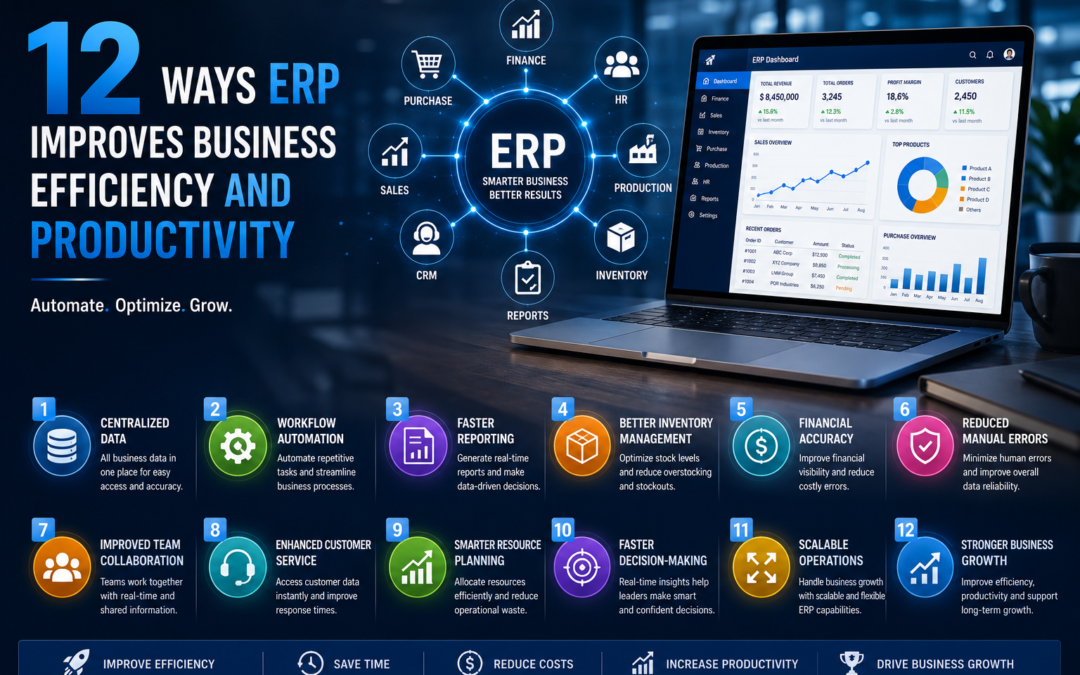
Call Logicraftz Professionals +912231982472 to improve ERP productivity, business efficiency, E.R.P. software usage, workflow automation, and business growth.
ERP Productivity: 12 Ways to Improve Efficiency
A practical guide to business efficiency, E.R.P. software, workflow automation, operational control, and scalable business growth.
Introduction
ERP productivity has become a major priority for growing businesses that want to reduce manual work, improve operational control, and increase output without increasing unnecessary costs. As companies expand, disconnected tools and spreadsheet-based processes often slow teams down.
Modern E.R.P. software helps businesses improve business efficiency by connecting departments, automating workflows, centralizing data, and providing real-time insights. With the right ERP system, teams can complete tasks faster, reduce errors, and make better decisions.
In this guide, we will explore 12 practical ways ERP improves daily performance, supports workflow automation, and contributes to long-term business growth.

Table of Contents
- Why ERP Productivity Matters
- 1. Centralized Business Data
- 2. Automated Daily Workflows
- 3. Faster Reporting
- 4. Better Inventory Control
- 5. Improved Financial Accuracy
- 6. Reduced Manual Errors
- 7. Improved Team Collaboration
- 8. Better Customer Service
- 9. Smarter Resource Planning
- 10. Faster Decision-Making
- 11. Scalable Operations
- 12. Stronger Business Growth
- Manual Process vs ERP-Driven Process
- Common ERP Productivity Mistakes
- Frequently Asked Questions
Why ERP Productivity Matters for Business Efficiency
Productivity is not only about working faster. It is about using better systems, reducing repetitive tasks, improving coordination, and allowing teams to focus on high-value work.
An ERP system creates a single platform for business operations, making it easier for departments to work together and access accurate information. This reduces confusion and improves operational performance across finance, inventory, sales, HR, procurement, and management.
Approvals, reports, and updates move faster through structured processes.
Automation helps teams spend less time on repetitive tasks.
Departments work with shared data instead of disconnected files.
Leaders get better visibility into daily operations and performance.
1. Centralized Business Data
E.R.P. software brings important business data into one centralized platform. This eliminates the need to search through multiple spreadsheets, email threads, or disconnected tools.
Centralized Data Can Include
- Sales data
- Customer records
- Inventory details
- Finance reports
- Purchase information
- HR records
- Vendor details
Centralized data improves accuracy, saves time, and gives departments access to the same updated information.
2. Workflow Automation Reduces Repetitive Tasks
Workflow automation is one of the biggest advantages of E.R.P. software. It reduces manual work and allows employees to focus on strategic responsibilities instead of repeated administrative tasks.
Processes ERP Can Automate
- Automatic invoice generation
- Purchase approval workflows
- Inventory update alerts
- Order processing automation
- Payroll workflows
- Task notifications
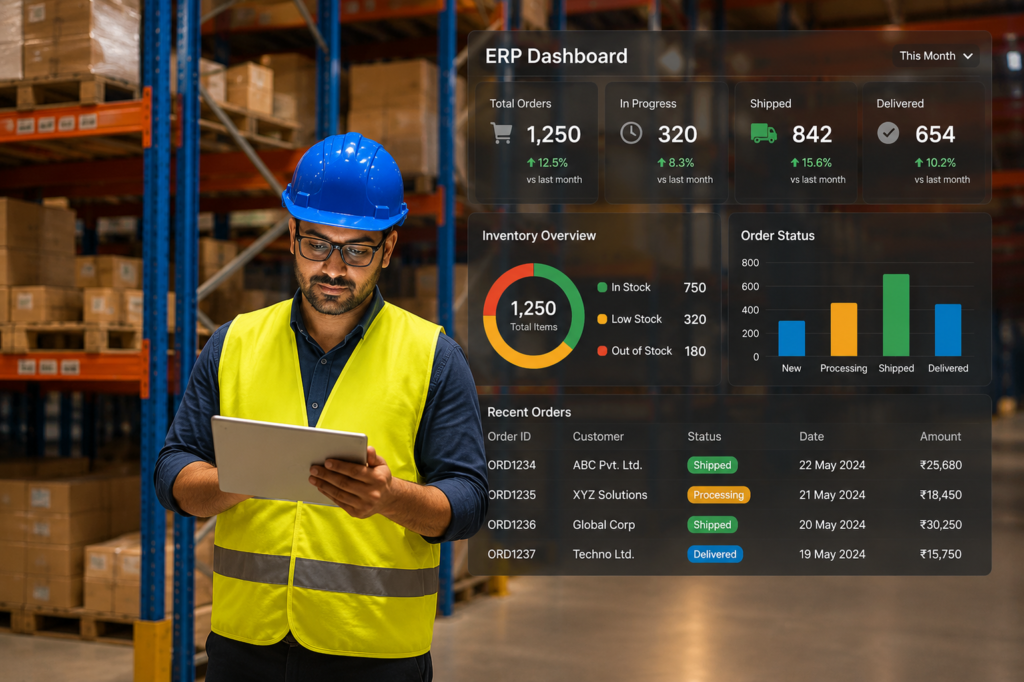
Workflow automation helps businesses reduce repetitive tasks and delays
3. ERP Software Speeds Up Reporting
Manual reporting takes time and often leads to errors. ERP systems provide real-time reports and dashboards that help teams access accurate information quickly.
Faster reporting improves planning, review meetings, performance tracking, and management decisions. Leaders can monitor sales, finance, inventory, operations, and HR without waiting for manual updates.
4. Better Inventory and Stock Control
ERP software helps businesses track inventory levels, stock movement, demand trends, reorder points, warehouse activity, and purchase planning more effectively.
This reduces stock shortages, overstocking, delayed dispatches, and unnecessary inventory costs.
Inventory Control Helps With
- Stock level monitoring
- Reorder planning
- Warehouse visibility
- Purchase forecasting
- Product movement tracking
- Demand planning

Inventory dashboard for stock control, purchasing, and operational planning
5. Strengthens Financial Accuracy
Finance teams benefit from ERP systems because transactions, billing, expenses, budgets, and reports are managed in one connected platform. This reduces manual errors and improves financial visibility.
Financial Benefits Include
- Better cash flow visibility
- Accurate invoicing
- Expense control
- Tax-ready reporting
- Budget monitoring
- Payment tracking
6. Reduces Manual Errors
Manual data entry can create costly mistakes. ERP software reduces errors by automating processes and maintaining consistent data across departments.
When information is entered once and shared across connected modules, teams do not need to repeatedly copy the same data into different systems. This improves operational reliability and business efficiency.
7. Improves Team Collaboration
When all teams use the same ERP system, communication becomes faster and more accurate. Sales, finance, operations, inventory, HR, and management teams can work with shared real-time data instead of outdated information.
This reduces repeated follow-ups and helps teams coordinate work more effectively.
8. Enhances Customer Service
ERP systems help teams access customer orders, payment status, delivery updates, invoices, inventory availability, and service history quickly.
This enables faster response times and better customer experiences. When employees can answer customer queries with accurate data, trust and satisfaction improve.

ERP dashboards help teams collaborate and respond to customers faster
9. Supports Smarter Resource Planning
E.R.P. software helps businesses plan manpower, inventory, budgets, production capacity, purchasing needs, and project resources more effectively.
Better resource planning improves output, reduces waste, and helps managers allocate people, materials, and budgets where they are needed most.
10. Enables Faster Decision-Making
ERP dashboards provide leaders with real-time performance insights. This helps decision-makers identify trends, risks, bottlenecks, and opportunities faster.
Instead of waiting for manually prepared reports, leadership teams can review live data and take action quickly.
You can learn more about enterprise software trends from Gartner IT Research and Oracle ERP Guide.
11. Supports Scalable Operations
As businesses grow, operations become more complex. ERP systems provide scalable processes that can support more users, departments, locations, products, transactions, vendors, and reports.
This helps companies grow without depending on disconnected systems that create confusion and delays.
12. Drives Long-Term Business Growth
ERP productivity improvements directly support business growth by improving efficiency, reducing costs, and helping teams perform better.
A productive ERP-driven business can scale faster with stronger control, clearer reporting, and better operational visibility.

ERP-driven productivity supports scalable growth and better performance
Manual Process vs ERP-Driven Process
| Area | Manual Process | ERP-Driven Process |
|---|---|---|
| Data | Scattered across spreadsheets | Centralized and accessible |
| Reports | Prepared manually | Real-time dashboards |
| Workflows | Approval delays and manual tasks | Automated workflows and alerts |
| Collaboration | Departments work separately | Teams use shared information |
| Growth | Hard to scale operations | Scalable systems and processes |
Common ERP Productivity Mistakes Businesses Should Avoid
Map workflows clearly before implementation.
Teams need proper training to use the system correctly.
Use automation for approvals, reports, tasks, and updates.
Clean data improves reports and user confidence.
Customize reports for decision-makers and departments.
Track efficiency, workflow speed, and process improvements.
Continue Reading
Frequently Asked Questions
Q: What is ERP productivity?
ERP productivity refers to how ERP software improves efficiency, reduces manual work, speeds up workflows, and helps teams complete tasks more effectively.
Q: How does ERP improve business efficiency?
ERP improves business efficiency by centralizing data, automating workflows, reducing errors, improving reporting, and connecting departments.
Q: What is workflow automation in ERP?
Workflow automation in ERP uses software rules to automate repetitive tasks such as approvals, invoice generation, order updates, and reporting.
Q: Can ERP software support business growth?
Yes. ERP software supports business growth by improving scalability, productivity, operational visibility, and resource planning.
Q: Is ERP suitable for growing companies?
Yes. ERP is useful for growing companies that need better control over finance, inventory, sales, operations, and reporting.
Ready to Improve Productivity With ERP?
A modern ERP system helps businesses centralize data, automate workflows, improve reporting, reduce errors, and scale operations with better control.
Logicraftz Solutions LLP helps businesses implement ERP software solutions that improve workflow automation, business efficiency, and scalable growth.
Introduction
In today's competitive marketplace, organizations must balance operational excellence, cost control, customer satisfaction, and innovation to remain successful. As businesses expand, managing finance, procurement, inventory, production, human resources, sales, and customer service through disconnected systems becomes increasingly challenging. Manual processes often create delays, duplicate records, communication gaps, and inconsistent reporting, limiting overall performance.
A modern ERP software platform helps organizations centralize operations by connecting departments through a unified digital environment. Combined with intelligent workflow automation, companies can improve business efficiency, reduce repetitive tasks, and create the foundation for sustainable business growth. Instead of spending valuable time on administrative activities, employees can focus on strategic initiatives that improve customer value and organizational performance.
Businesses across manufacturing, healthcare, retail, education, logistics, hospitality, construction, and professional services are adopting integrated technologies to improve collaboration, strengthen decision-making, and support long-term expansion.
Understanding Business Efficiency
Improving business efficiency means completing work with fewer delays, lower costs, and better use of available resources while maintaining quality and customer satisfaction.
Organizations achieve higher efficiency by:
- Standardizing operational processes
- Reducing manual work
- Improving communication
- Eliminating duplicate data
- Increasing collaboration
- Monitoring performance
- Optimizing resource allocation
- Simplifying approvals
- Improving reporting
- Encouraging continuous improvement
When departments operate with accurate information and clearly defined processes, organizations become more productive and adaptable.
Why ERP Software Matters
A centralized ERP software solution integrates essential business functions into one connected platform. Instead of maintaining separate applications for accounting, inventory, procurement, payroll, manufacturing, and reporting, employees work from a shared system where information updates automatically across departments.
Key benefits include:
- Centralized business information
- Improved financial visibility
- Faster reporting
- Better inventory management
- Reduced operational errors
- Improved collaboration
- Stronger compliance
- Better resource planning
- Greater transparency
- Higher organizational productivity
Employees spend less time searching for information and more time completing valuable work that supports organizational objectives.
Workflow Automation Simplifies Daily Operations
Many business activities follow predictable patterns that can be automated without sacrificing quality or control.
Implementing workflow automation helps organizations streamline repetitive activities such as:
- Purchase approvals
- Invoice verification
- Employee onboarding
- Leave requests
- Inventory updates
- Internal notifications
- Document approvals
- Task assignments
- Scheduled reports
- Reminder notifications
Automation reduces administrative effort while ensuring processes are completed consistently and on time.
Employees are free to focus on problem-solving, innovation, customer relationships, and strategic planning rather than repetitive manual tasks.
Build the Foundation for Business Growth
Sustainable business growth requires more than increasing sales. Organizations must build scalable operational processes capable of supporting expansion without increasing complexity.
Integrated business platforms help organizations:
- Improve operational visibility
- Strengthen departmental collaboration
- Accelerate decision-making
- Improve financial control
- Optimize resource utilization
- Reduce operating costs
- Increase employee productivity
- Improve service quality
- Support organizational scalability
- Prepare for future expansion
By creating efficient internal processes today, businesses establish a stronger foundation for future opportunities while remaining competitive in rapidly changing markets.
Real-Time Reporting Improves Business Decisions
Every successful organization depends on accurate information. Business leaders need reliable insights to evaluate performance, allocate resources, and respond quickly to changing market conditions. Delayed reports and disconnected spreadsheets often prevent organizations from making timely decisions.
A centralized platform provides interactive dashboards that present operational data in real time. Instead of waiting for manually prepared reports, management teams can instantly review important metrics and identify opportunities for improvement.
Business dashboards commonly provide visibility into:
- Financial performance
- Department productivity
- Procurement activities
- Inventory availability
- Production schedules
- Customer orders
- Employee performance
- Operational expenses
- Resource utilization
- Strategic objectives
Having immediate access to reliable information allows organizations to solve problems faster while planning future initiatives with greater confidence.
Financial Operations Become More Transparent
Financial management is one of the most important responsibilities within any organization. Accurate accounting records, budget planning, expense monitoring, and revenue tracking support better strategic planning while maintaining regulatory compliance.
An integrated platform simplifies financial processes by connecting accounting with purchasing, inventory, operations, and payroll.
Organizations can efficiently manage:
- General ledger
- Accounts payable
- Accounts receivable
- Budget forecasting
- Cash flow monitoring
- Expense management
- Asset tracking
- Tax preparation
- Financial statements
- Bank reconciliation
When departments share the same financial information, reporting becomes more accurate, reducing duplicate work and improving operational transparency.
Inventory and Supply Chain Optimization
Efficient inventory management ensures products and materials are available when required while avoiding unnecessary storage costs.
Organizations can monitor stock movement, supplier performance, warehouse operations, purchase orders, and demand forecasts from one connected platform.
Benefits include:
- Better inventory accuracy
- Faster stock movement
- Improved warehouse coordination
- Reduced procurement delays
- Better supplier communication
- Lower carrying costs
- Improved demand planning
- Reduced stock shortages
- Better order fulfillment
- Increased operational reliability
Improved coordination between procurement, warehousing, and operations helps organizations reduce waste while improving customer satisfaction.
Workforce Productivity Through Smart Processes
Employees perform best when they have access to accurate information and clearly defined procedures.
Organizations can improve productivity by:
- Simplifying daily tasks
- Reducing paperwork
- Standardizing approvals
- Improving communication
- Providing real-time information
- Eliminating duplicate work
- Encouraging collaboration
- Supporting remote employees
- Improving accountability
- Investing in continuous learning
Providing employees with modern digital tools allows them to spend more time creating value and less time completing repetitive administrative activities.
Cloud Technology Supports Organizational Flexibility
Cloud computing enables organizations to access operational information securely from virtually any location.
Whether employees are working from headquarters, branch offices, warehouses, manufacturing facilities, or customer locations, cloud technology ensures everyone works with the same real-time information.
Key advantages include:
- Automatic software updates
- Secure cloud backups
- Reduced infrastructure costs
- Improved scalability
- Business continuity
- Remote accessibility
- Faster deployment
- Stronger collaboration
- Reliable disaster recovery
- Enhanced system availability
Cloud platforms also allow organizations to expand operations more easily without major investments in hardware infrastructure.
Artificial Intelligence Enhances Operational Performance
Artificial intelligence is helping organizations transform operational decision-making by converting large volumes of business data into practical recommendations.
AI-powered capabilities can support:
- Demand forecasting
- Resource planning
- Inventory optimization
- Financial analysis
- Production scheduling
- Operational forecasting
- Performance monitoring
- Exception detection
- Trend identification
- Strategic planning
These capabilities help organizations identify opportunities earlier, reduce operational risks, and improve long-term planning.
Security and Compliance Protect Business Information
Protecting organizational data is essential for maintaining customer confidence and supporting regulatory compliance.
Modern platforms include multiple layers of protection to safeguard operational and financial information.
Important security capabilities include:
- Role-based access controls
- Multi-factor authentication
- Data encryption
- Audit logging
- Activity monitoring
- Automated backups
- Disaster recovery
- Permission management
- Compliance reporting
- Secure cloud infrastructure
Strong security practices reduce operational risks while protecting valuable organizational assets.
Continuous Improvement Creates Long-Term Success
Organizations that consistently evaluate performance remain more competitive than those relying on outdated processes.
Continuous improvement involves reviewing operational performance, gathering employee feedback, refining workflows, and investing in technology that supports changing business requirements.
Areas for regular evaluation include:
- Department performance
- Customer satisfaction
- Process effectiveness
- Resource utilization
- Operational costs
- Service quality
- Employee engagement
- Financial outcomes
- Delivery performance
- Strategic objectives
Small improvements made consistently often produce significant long-term results.
Why Logicraftz Is a Trusted Digital Transformation Partner
Logicraftz helps organizations simplify operations through customized digital solutions designed around real business requirements. Every implementation starts with understanding existing workflows, identifying operational challenges, and recommending practical improvements that align with long-term organizational goals.
The company provides end-to-end services including business consultation, solution architecture, customization, implementation, data migration, integration, employee training, deployment, and ongoing technical support.
With experience across manufacturing, healthcare, retail, education, logistics, hospitality, construction, financial services, and professional industries, Logicraftz delivers scalable platforms that improve productivity, collaboration, reporting, and operational visibility.
Its customer-focused approach ensures every solution remains flexible, secure, and capable of supporting future expansion.
Conclusion
Organizations that invest in connected digital platforms are better prepared to adapt to changing market conditions while improving operational performance. By combining intelligent planning, integrated systems, streamlined processes, and continuous innovation, businesses create a strong foundation for sustainable success.
Focusing on business efficiency, supported by reliable ERP software, intelligent workflow automation, and strategies that encourage business growth, enables organizations to improve collaboration, strengthen decision-making, reduce operational complexity, and deliver greater value to customers. Businesses that embrace these principles today will be well positioned to compete, innovate, and grow in an increasingly digital economy.