
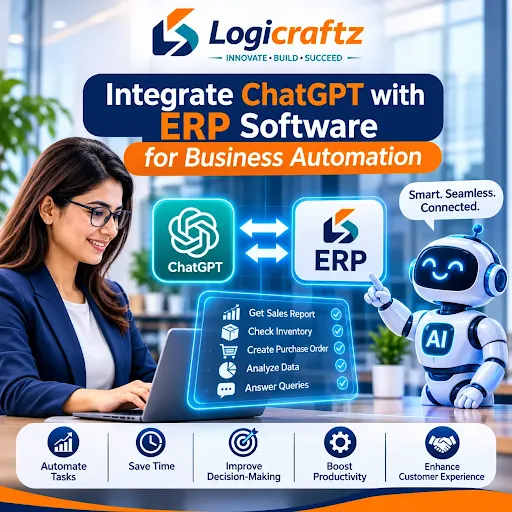
Businesses today are looking for smarter ways to manage operations, reduce manual work, and make faster decisions. Traditional ERP (Enterprise Resource Planning) systems help organizations manage important business activities such as finance, inventory, sales, procurement, production, and human resources. However, employees still spend considerable time searching for information, preparing reports, answering routine questions, and handling repetitive tasks. Integrate ChatGPT with ERP Software
This is where artificial intelligence (AI) can make a difference.
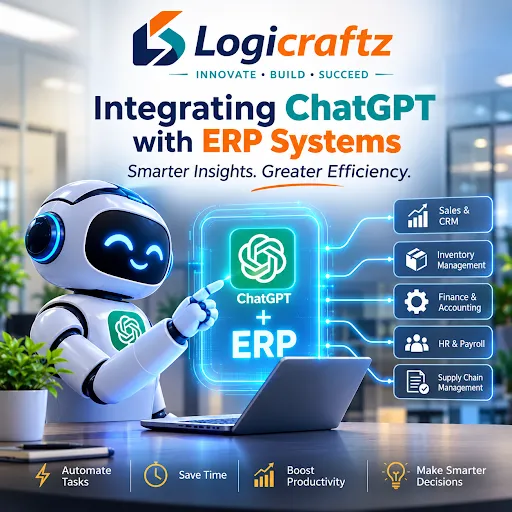
ChatGPT integration with ERP software allows businesses to combine conversational AI capabilities with their existing business management systems. With the right API connections and security controls, employees can interact with ERP data through natural language, automate selected workflows, generate reports, and access business information more efficiently.
For manufacturing companies, retailers, distributors, and growing enterprises, combining ChatGPT with ERP software can support a more connected and intelligent approach to business automation.
In this guide, we explain how ChatGPT works with ERP systems, the integration process, business applications, benefits, and important security considerations.
What Is ChatGPT and How Does It Work?
ChatGPT is an AI-powered conversational assistant developed by OpenAI. It understands natural language prompts and generates responses based on the information and context provided to it.
Businesses can use OpenAI's API to connect AI capabilities with their own applications, databases, and software platforms.
In an ERP environment, ChatGPT can help employees:
- Ask questions about business operations in natural language.
- Summarize sales and inventory reports.
- Generate structured business insights.
- Assist with customer and supplier communication.
- Explain operational information.
- Support selected automated workflows through connected tools.
For example, instead of manually searching through multiple ERP reports, an authorized employee could ask:
"Show me the products with low stock levels and summarize the pending purchase orders."
The integration layer can retrieve the permitted ERP information, provide relevant context to the AI model, and return an understandable response.
Importantly, ChatGPT does not automatically access an ERP database. Developers must establish secure connections, define permissions, and control which information and actions the AI application can access.
What Is ERP Software and Why Do Businesses Need It?
ERP software is a centralized business management solution that connects different departments and business processes through a common system.
Instead of maintaining separate systems for sales, inventory, accounting, production, and procurement, businesses can manage these operations through integrated ERP modules.
Common ERP modules include:
- Finance and accounting
- Inventory and warehouse management
- Sales and distribution
- Purchase and procurement
- Production planning
- Human resource management
- Customer relationship management
- Supply chain management
- Business reporting and analytics
ERP software improves information visibility and helps departments work with consistent business data.
However, traditional ERP interfaces may require employees to navigate multiple screens, apply filters, generate reports, and manually interpret information.
Integrating AI capabilities can make these interactions more convenient.
How Does ChatGPT Integration with ERP Software Work?
ChatGPT integration with ERP software generally works through APIs (Application Programming Interfaces), middleware, and secure data communication.
The ERP system continues to manage business transactions and records, while ChatGPT provides a conversational interface and AI-powered assistance.
A typical integration architecture includes five components:
1. ERP Software
The ERP system stores and manages business information, including sales orders, inventory records, purchase orders, invoices, and production data.
2. OpenAI API
The OpenAI API enables the application to send relevant information to an AI model and receive generated responses.
3. Middleware or Integration Layer
Middleware connects the ERP system with the AI application. It handles requests, validates inputs, retrieves information, and manages communication between systems.
4. Database and Business Logic
The integration layer accesses permitted ERP information through approved APIs or services. Business rules determine what information can be retrieved or modified.
5. User Interface
Employees interact with the AI assistant through an ERP dashboard, internal chatbot, website, or another approved application.
Example of ChatGPT and ERP Integration
Consider a manufacturing company using ERP software to manage its inventory.
An employee asks:
"Which raw materials need immediate replenishment?"
The workflow can operate as follows:
- The employee submits a question through the AI interface.
- The application identifies the required inventory information.
- The integration layer checks user permissions.
- The ERP API retrieves the relevant stock levels and reorder information.
- ChatGPT summarizes the retrieved data.
- The employee receives a clear response with relevant product details.
- If a purchase requisition is required, the system can prepare it for authorized human approval.
This approach combines AI-based interaction with ERP-controlled business processes.
Step-by-Step Process to Integrate ChatGPT with ERP Software
Successful ChatGPT API integration requires technical planning, security controls, and a clear understanding of business requirements.
Step 1: Identify Business Automation Requirements
Before starting development, identify the business activities that require automation.
For example:
- Employees frequently request inventory reports.
- Sales teams manually prepare order summaries.
- Managers spend time reviewing daily business reports.
- Customer support teams answer repetitive order-status questions.
- Procurement teams regularly check stock availability.
Select a few high-value processes for the initial implementation instead of trying to automate every ERP function at once.
Step 2: Evaluate Your Existing ERP System
Check whether your ERP software provides APIs, web services, database access through approved services, or integration capabilities.
Important factors include:
- ERP architecture and technology stack.
- API availability and documentation.
- Authentication methods.
- Database structure.
- Existing integrations.
- User roles and access permissions.
- Data quality and consistency.
This assessment helps determine the most appropriate integration approach.
Step 3: Set Up OpenAI API Integration
The OpenAI API allows developers to connect AI models with business applications.
Developers can create an application that sends relevant prompts and business context to the API and processes the model's response.
For more advanced ERP workflows, function calling allows an AI model to request specific application-defined functions.
For example, developers can define functions such as:
- Get inventory summary.
- Check sales order status.
- Retrieve outstanding invoices.
- Generate purchase order draft.
- Summarize production reports.
The application executes these functions according to its own validation and permission rules.
Step 4: Develop the Middleware Layer
Middleware acts as a communication bridge between the ERP system and ChatGPT.
It manages:
- API requests and responses.
- Data transformation.
- Authentication.
- Permission validation.
- Business rules.
- Error handling.
- Logging and monitoring.
A well-designed middleware layer prevents the AI model from directly controlling sensitive ERP operations.
Step 5: Implement Data Security and Access Controls
ERP systems often contain confidential business information, financial records, employee details, and customer data.
Therefore, security must be considered from the beginning.
Important measures include:
- Role-based access control.
- Secure API authentication.
- Encryption during data transmission.
- Protection of API keys and credentials.
- Data minimization.
- Audit logging.
- Input validation.
- Human approval for sensitive transactions.
Only the information required to answer a particular request should be shared with the AI model.
Step 6: Test the Integration
Before deployment, test the application with different user roles and business scenarios.
Verify that:
- Retrieved information matches ERP records.
- Unauthorized users cannot access restricted data.
- AI responses do not invent business figures.
- API failures are handled correctly.
- Transaction approvals work as expected.
- Sensitive operations require proper authorization.
Step 7: Deploy and Monitor Performance
After successful testing, deploy the integration in a controlled production environment.
Monitor API usage, response quality, system performance, security events, and user feedback.
Regular reviews help identify errors and improve the integration over time.
10 Practical Ways ChatGPT Can Automate ERP Business Operations
ChatGPT integration can support multiple ERP departments when connected to appropriate business data and application functions.
1. Sales and Order Management
Sales employees can ask questions about pending orders, customer requests, and order status.
ChatGPT can summarize order information and help prepare customer communication using approved ERP data.
2. Inventory Management
AI can help employees understand inventory reports, identify low-stock items, and summarize stock movement.
For example, employees can ask:
"Which products have crossed their minimum stock levels?"
The application can retrieve inventory data and generate an easy-to-understand summary.
3. Purchase and Procurement
Procurement teams can use AI to summarize supplier information, pending purchase requests, and procurement reports.
It can also help prepare purchase order drafts for review.
4. Finance and Accounting Support
ChatGPT can assist with explaining financial reports, summarizing outstanding payments, and organizing invoice-related information.
However, financial calculations, tax compliance, and accounting entries should remain governed by validated ERP rules and authorized personnel.
5. Customer Support
An AI-powered assistant connected to approved ERP information can answer routine questions about:
- Order status.
- Product availability.
- Delivery updates.
- Invoice details.
- Customer service requests.
This can help support teams respond more efficiently.
6. HR and Employee Queries
Employees can ask questions about company policies, leave procedures, and HR processes through an internal AI assistant.
Access to personal employee information must remain restricted according to HR permissions.
7. Manufacturing Operations
Manufacturing businesses can use ChatGPT to summarize production reports, explain material requirements, and help employees access operational information.
For example:
"Summarize today's production output and highlight pending work orders."
The AI application can retrieve the relevant ERP records and prepare a report.
8. Reporting and Data Analysis
Managers can ask natural-language questions about business performance instead of manually searching through multiple reports.
ChatGPT can summarize approved sales, inventory, production, and operational data.
9. Supply Chain Management
AI can help summarize supplier performance, pending deliveries, purchase requirements, and logistics updates.
This provides employees with a more accessible way to understand supply chain information.
10. Business Intelligence
ChatGPT can make business intelligence tools easier to interact with by converting natural-language questions into approved data queries or analytical requests.
Managers can use the results to understand business trends and investigate operational issues.
Key Benefits of Integrating ChatGPT with ERP Systems
Combining AI with ERP software can provide several operational advantages.
Improved Employee Productivity
Employees can retrieve information and prepare summaries through conversational interactions, reducing repetitive manual work.
Faster Business Reporting
AI can summarize large amounts of approved ERP information and present important details in a readable format.
Better Information Accessibility
Employees can ask questions using natural language instead of navigating multiple ERP screens.
Reduced Repetitive Work
Selected tasks such as report preparation, information retrieval, and communication drafting can be partially automated.
Improved Customer Experience
AI assistants connected to approved ERP data can help customer support teams respond to routine queries.
Better Operational Visibility
Managers can access summarized business information to support planning and decision-making.
Scalable Business Automation
Businesses can gradually extend AI integration to additional ERP modules as requirements evolve.
Actual results depend on the quality of ERP data, integration design, employee adoption, and business processes.
Industry-Wise Applications of ChatGPT and ERP Integration
Different industries can use AI-powered ERP automation to address their specific operational requirements.
| Industry | Potential AI and ERP Applications |
|---|---|
| Manufacturing | Production summaries, material planning, work order information |
| Retail | Stock inquiries, sales summaries, order management |
| Pharmaceuticals | Batch information retrieval, documentation assistance, inventory summaries |
| Food Processing | Raw material tracking, production reporting, procurement assistance |
| Logistics | Shipment information, delivery status, operational reporting |
| Distribution | Order tracking, warehouse summaries, supplier communication |
For example, a manufacturing company can use an AI assistant to retrieve production information, while a retail business may use it to answer inventory and sales-related questions.
The implementation should always follow industry-specific compliance, data protection, and operational requirements.
Challenges and Security Considerations
Although ChatGPT integration offers useful possibilities, businesses should understand the technical and operational challenges before implementation.
1. Data Privacy
ERP systems contain sensitive business information. Organizations must define what information can be shared with external AI services and review applicable contractual and data protection requirements.
2. Incorrect AI Responses
AI models can generate inaccurate or incomplete responses. Important business information should be validated against ERP records.
3. Integration Complexity
Legacy ERP systems may have limited API support or customized architectures. Additional middleware or custom development may be required.
4. Access Management
AI applications must follow the same access restrictions as the underlying ERP system. Users should never receive information beyond their authorized permissions.
5. Transaction Security
AI-generated recommendations should not automatically become financial or operational transactions without proper validation and approval.
6. Integration and API Costs
Businesses should evaluate API consumption, development expenses, infrastructure, maintenance, and ongoing monitoring costs.
A secure implementation should treat AI as an intelligent assistance layer, not as an unrestricted replacement for ERP controls.
Best Practices for Successful ChatGPT and ERP Integration
To achieve reliable business automation, consider the following practices:
- Start with clearly defined automation objectives.
- Choose high-value, low-risk workflows for initial implementation.
- Use documented ERP APIs wherever possible.
- Keep API credentials secure.
- Apply role-based permissions.
- Validate AI-generated information against source records.
- Require human approval for sensitive operations.
- Maintain audit logs for important activities.
- Monitor API usage and integration performance.
- Review security policies regularly.
- Train employees to use AI tools responsibly.
Businesses should also evaluate whether a ready-made integration, custom middleware, or a fully customized AI-powered ERP solution best matches their requirements.
How to Choose the Right ERP Integration Partner
Choosing the right technology partner is an important part of successful ERP and AI integration.
A capable ERP development partner should understand both business workflows and technical integration requirements.
Before selecting an integration partner, evaluate:
- Experience in ERP software development and integration.
- Knowledge of API-based application development.
- Understanding of business process automation.
- Database and middleware expertise.
- Data security and access management practices.
- Customization and scalability capabilities.
- Post-deployment technical support.
The right partner can help businesses identify suitable automation opportunities, plan the integration architecture, and implement solutions aligned with their operational needs.
Logicraftz Solutions LLP works in the ERP, CRM, and digital transformation space, helping businesses explore technology solutions for managing and improving business operations.
Make ERP Business Automation Smarter with ChatGPT
Integrating ChatGPT with ERP software creates opportunities for businesses to make their operations more accessible, connected, and efficient.
From inventory management and sales reporting to procurement assistance and manufacturing operations, AI can help employees interact with business information more naturally.
However, successful implementation requires more than connecting an AI model to an ERP system. It requires secure API integration, accurate business data, appropriate permissions, workflow validation, and continuous monitoring.
Businesses that approach AI integration strategically can build a stronger foundation for intelligent business automation.
Looking to Integrate ChatGPT with Your ERP Software?
Connect with Logicraftz Solutions LLP to explore ERP software, CRM solutions, custom software development, and business automation opportunities.
Let's discuss how the right technology approach can help streamline your business operations and support your digital transformation journey.
Contact Logicraftz Solutions LLP
Website: https://logicraftz.com/
Phone: +91 2231982472
Email: info@logicraftz.com
Build smarter business operations with the right technology partner.
Connect with Logicraftz
Stay connected with Logicraftz Solutions LLP for the latest updates, technology insights, ERP solutions, and digital transformation trends.
💼 Explore ERP Software Solutions
Follow us, like our posts, and share our updates to stay informed about smarter business technology and innovation!