
Call Logicraftz Professionals +912231982472 to improve marketing metrics, digital marketing KPIs, ROI tracking, analytics, and business growth.
Marketing Metrics: 11 Powerful KPIs to Track
A practical guide to digital marketing KPIs, ROI tracking, analytic, campaign performance, lead quality, and business growth.
Introduction
Marketing metrics help business owners understand whether their digital marketing efforts are actually producing results. Without tracking the right numbers, it becomes difficult to know which campaigns are working, where money is being wasted, and how marketing contributes to business growth.
Modern businesses need clear digital marketing KPIs to measure website performance, lead generation, campaign effectiveness, customer acquisition, and revenue impact. With proper analytic and ROI tracking, companies can make smarter decisions and improve marketing performance over time.
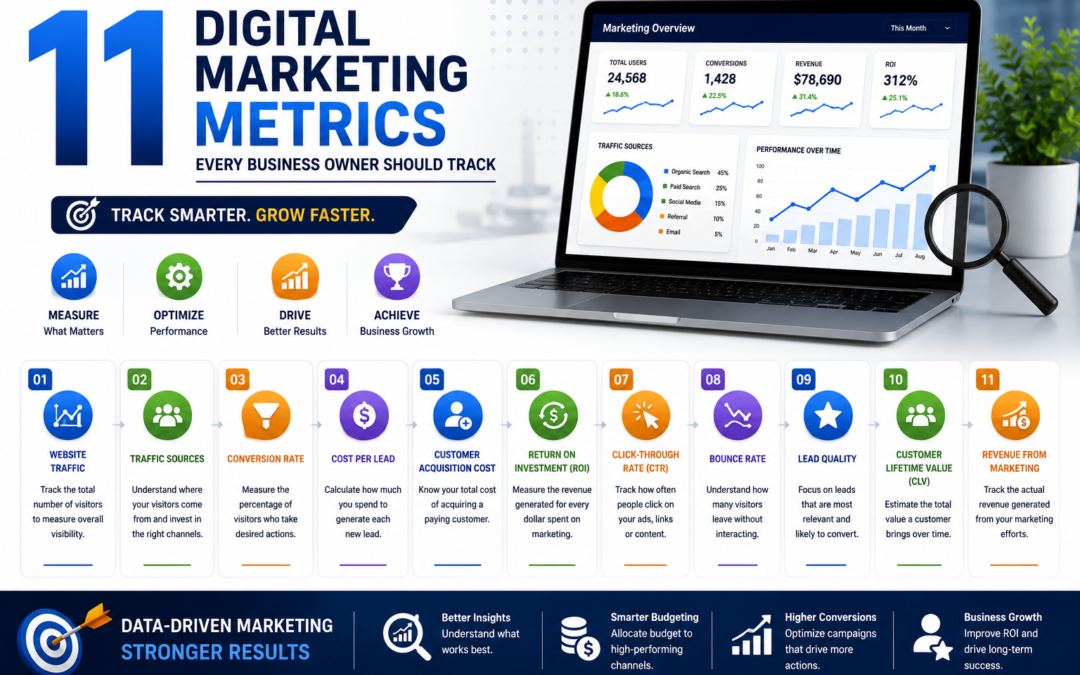
In this guide, we will explore 11 important KPIs every business owner should track to improve visibility, leads, conversions, and long-term growth.

Marketing dashboard for tracking traffic, leads, conversions, and ROI
Table of Contents
- Why Marketing Metrics Matter
- 1. Website Traffic
- 2. Traffic Sources
- 3. Conversion Rate
- 4. Cost Per Lead
- 5. Customer Acquisition Cost
- 6. Return on Investment
- 7. Click-Through Rate
- 8. Bounce Rate
- 9. Lead Quality
- 10. Customer Lifetime Value
- 11. Revenue From Marketing
- Vanity Metrics vs Growth Metrics
- Common Tracking Mistakes
- Frequently Asked Questions
Why Marketing Metrics Matter for Business Growth
Digital marketing should never be based on guesswork. Every campaign, website page, advertisement, landing page, email, and content strategy should be measured to understand real performance.
Tracking marketing metrics helps business owners identify what is generating leads, what needs improvement, and which channels deliver the highest return. When data is reviewed regularly, marketing becomes easier to manage and optimize.
Understand which campaigns are producing meaningful results.
Invest more in channels that generate better leads and revenue.
Measure whether enquiries are relevant and sales-ready.
Connect marketing activity with real revenue outcomes.
1. Website Traffic
Website traffic shows how many people visit your website within a specific period. It is one of the most basic but important marketing metrics because it shows whether your brand is attracting attention online.
Why It Matters
- Shows online visibility
- Measures content reach
- Tracks campaign impact
- Identifies growth trends
- Helps compare monthly performance
Traffic alone does not guarantee business success, but it helps you understand whether your online presence is growing.
2. Traffic Sources
Traffic sources show where your visitors are coming from. This helps business owners understand which channels deserve more attention and investment.
Common Traffic Sources
- Organic search
- Paid advertising
- Social media
- Email marketing
- Referral traffic
- Direct traffic
- Display or remarketing campaigns
For example, if organic search brings high-quality leads, SEO may deserve more investment. If paid campaigns bring traffic but no enquiries, the targeting or landing page may need improvement.

Website traffic and source tracking help identify the best-performing channels
3. Conversion Rate
Conversion rate measures the percentage of visitors who complete a desired action, such as submitting a form, calling your business, downloading a guide, booking a consultation, or making a purchase.
This is one of the most valuable digital marketing KPIs because it shows whether your website and campaign messaging are effective.
Conversions Can Include
- Form submissions
- Phone calls
- WhatsApp clicks
- Product purchases
- Demo requests
- Newsletter signups
4. Cost Per Lead
Cost per lead shows how much you spend to generate one enquiry or prospect. This metric is especially important for paid marketing and lead generation campaigns.
If your cost per lead is high, you may need to improve targeting, ad copy, landing pages, or campaign structure.
Cost Per Lead Helps Measure
- Paid campaign efficiency
- Budget usage
- Lead generation cost
- Landing page performance
- Audience targeting quality
5. Customer Acquisition Cost
Customer acquisition cost measures how much it costs to acquire one paying customer. This metric includes your marketing spend and, when possible, sales-related costs.
It helps business owners evaluate whether marketing and sales efforts are profitable. A campaign can generate many leads, but if the cost to convert those leads into customers is too high, the strategy needs improvement.

ROI dashboard for tracking lead cost, acquisition cost, and campaign returns
6. Return on Investment
ROI tracking helps measure the return generated from marketing investment. It shows whether your campaigns are helping the business earn more than it spends.
ROI Tracking Helps You Know
- Which campaigns are profitable
- Which channels waste budget
- Where to increase investment
- How marketing supports revenue
- Which offers generate better returns
Without ROI visibility, businesses may continue spending on campaigns that look active but do not produce real growth.
7. Click-Through Rate
Click-through rate measures how many users click on your ads, emails, search listings, or call-to-action buttons compared to how many people saw them.
A strong CTR usually means your message is relevant and compelling. A weak CTR may indicate poor headlines, weak ad copy, irrelevant audience targeting, or low offer appeal.
CTR Can Be Tracked For
- Google Ads
- Social media ads
- Email campaigns
- Search engine listings
- Website CTA buttons
- Banner campaigns
8. Bounce Rate
Bounce rate shows how many users leave after visiting only one page. A high bounce rate may indicate poor page experience, weak content, slow loading speed, irrelevant traffic, or unclear messaging.
Business owners should review bounce rate alongside time on page, conversion rate, and traffic source data. This gives a more complete view of page performance.

Analytic dashboard for tracking campaign engagement and website behavior
9. Lead Quality
Not all leads are equal. Lead quality measures how relevant and sales-ready your enquiries are. A campaign may generate many enquiries, but those leads may not be valuable if they do not match your ideal customer profile.
Lead Quality Signals
- Budget fit
- Service requirement
- Decision-making authority
- Location relevance
- Purchase intent
- Timeline to buy
- Business size or industry fit
Tracking quality helps marketing and sales teams focus on better enquiries instead of only chasing volume.
10. Customer Lifetime Value
Customer lifetime value measures the total revenue a customer may generate during their relationship with your business.
This helps businesses understand how much they can afford to spend on customer acquisition. If a customer brings long-term revenue through repeat purchases, renewals, or ongoing services, you can plan marketing budgets more confidently.
11. Revenue From Marketing
Revenue from marketing shows how much business revenue comes directly from digital marketing campaigns. This is one of the most important KPIs for understanding the real impact of marketing on business growth.
To track this properly, businesses should connect enquiry sources, sales follow-ups, CRM records, and closed deals. This helps reveal which campaigns truly generate revenue.
You can learn more about tracking performance from Google Analytics Help and Google Ads Resources.

Revenue tracking connects marketing performance with real business growth
Vanity Metrics vs Growth Metrics
| Area | Vanity Metrics | Growth Metrics |
|---|---|---|
| Website | Only tracking visits | Tracking leads, conversions, and source quality |
| Ads | Only tracking impressions | Tracking cost per lead and ROI |
| Social Media | Only tracking likes | Tracking enquiries, clicks, and conversions |
| Leads | Only counting lead volume | Measuring lead quality and sales readiness |
| Revenue | Not connected to campaigns | Mapped to marketing channels and campaigns |
Common Marketing Metrics Mistakes Businesses Should Avoid
Likes and impressions matter less if they do not support leads or revenue.
High lead volume is not useful if enquiries are not sales-ready.
Set up form, call, WhatsApp, and purchase tracking properly.
Incorrect analytics can lead to wrong business decisions.
Marketing should be connected to enquiries, customers, and revenue.
Compare Google, social, email, SEO, referrals, and paid ads regularly.
Continue Reading
Frequently Asked Questions
Q: What are marketing metrics?
Marketing metrics are measurable data points used to evaluate the performance of campaigns, websites, ads, content, and lead generation activities.
Q: What are digital marketing KPIs?
Digital marketing KPIs are key performance indicators that help businesses track goals such as traffic, leads, conversions, ROI, and revenue.
Q: Why is ROI tracking important?
ROI tracking helps businesses understand which marketing activities generate profit and which campaigns need improvement.
Q: How does analytics help business growth?
Analytics helps businesses make data-driven decisions, improve campaigns, reduce wasted budget, and focus on strategies that generate results.
Q: Which marketing metric is most important?
The most important metric depends on your goal, but conversion rate, cost per lead, customer acquisition cost, ROI, and revenue from marketing are highly valuable.
Want Better Marketing Insights?
Accurate tracking helps your business understand campaign performance, lead quality, ROI, website conversions, and revenue impact.
Logicraftz Solutions LLP helps businesses set up analytics, track digital marketing KPIs, measure ROI, and improve campaign performance.
Introduction
Modern businesses invest significant time and resources into digital marketing, but success cannot be measured by website traffic or social media likes alone. Organizations need reliable performance indicators that show whether marketing activities are generating qualified enquiries, increasing revenue, and strengthening customer relationships. Measuring the right metrics enables businesses to understand what works, identify areas for improvement, and make informed decisions based on data instead of assumptions.
Well-defined digital marketing KPIs help organizations evaluate campaign performance across multiple channels, including search engines, social media, email marketing, paid advertising, and content marketing. When combined with accurate ROI tracking, advanced analytics, and a clear focus on business growth, companies can optimize marketing investments while achieving measurable long-term results.
Whether serving local customers or operating internationally, organizations that monitor performance consistently are better positioned to improve efficiency, reduce wasted marketing spend, and increase profitability.
Why Performance Measurement Matters
Every marketing activity should contribute toward a measurable business objective. Without structured reporting, organizations often continue investing in channels or campaigns that deliver little value.
Performance measurement helps businesses:
- Understand customer behaviour
- Evaluate campaign effectiveness
- Improve budget allocation
- Increase operational efficiency
- Reduce unnecessary spending
- Identify high-performing channels
- Improve customer acquisition
- Support strategic planning
- Strengthen decision-making
- Maximize marketing performance
Reliable measurement creates confidence because every decision is supported by meaningful data.
Understanding Digital Marketing KPIs
Selecting the right digital marketing KPIs begins with identifying business objectives. Different organizations measure success differently depending on their industry, audience, and growth stage.
Common indicators include:
- Website traffic
- Conversion rate
- Qualified enquiries
- Customer acquisition cost
- Engagement rate
- Organic search visibility
- Email open rate
- Click-through rate
- Customer retention
- Revenue generated
Rather than monitoring dozens of unrelated metrics, businesses should focus on indicators that directly support strategic goals.
The Importance of ROI Tracking
Marketing budgets should generate measurable value. Effective ROI tracking enables organizations to compare investment against results, helping leadership understand which activities contribute most to profitability.
Organizations can evaluate:
- Advertising expenditure
- Revenue generated
- Campaign profitability
- Customer acquisition costs
- Cost per enquiry
- Conversion efficiency
- Channel performance
- Sales contribution
- Lifetime customer value
- Overall return on investment
These insights help businesses prioritize high-performing initiatives while reducing spending on underperforming activities.
Analytics Turns Data into Action
Raw data has little value unless it can support better decisions. Modern analytics platforms transform customer interactions, campaign performance, and website activity into meaningful insights that improve planning and execution.
Organizations can use reporting tools to identify:
- Visitor behaviour
- Traffic sources
- Content performance
- Landing page effectiveness
- Device usage
- Geographic distribution
- Audience demographics
- User engagement
- Conversion pathways
- Marketing trends
Understanding these patterns allows marketing teams to refine campaigns, improve customer experiences, and allocate resources more effectively.
Building a Foundation for Business Growth
Long-term business growth depends on continuous improvement rather than one-time success. Organizations should regularly review marketing performance, test new ideas, refine messaging, and optimize customer journeys based on measurable evidence.
Businesses that combine strong performance measurement with high-quality content, customer-focused communication, technical optimization, and ongoing analysis are better positioned to increase visibility, improve customer acquisition, and strengthen long-term profitability.
Establishing a culture of data-driven decision-making ensures marketing investments continue delivering value as customer expectations and digital technologies evolve.
Data-Driven Marketing Creates Better Results
Successful organizations no longer depend on assumptions when planning marketing activities. Every campaign should be supported by measurable data that helps identify strengths, weaknesses, and opportunities for improvement. By analyzing customer interactions across multiple channels, businesses gain valuable insights into how audiences discover, evaluate, and engage with their brand.
Monitoring performance regularly enables marketing teams to understand which content attracts the highest engagement, which channels generate qualified enquiries, and which campaigns contribute most effectively to revenue. These insights make it easier to refine messaging, improve audience targeting, and optimize future marketing investments.
Instead of making large changes based on opinion, organizations can implement small improvements supported by reliable data. Over time, these continuous optimizations produce significant improvements in overall marketing performance.
Customer Journey Analysis
Every customer follows a different path before making a purchasing decision. Some discover a business through search engines, while others engage through social media, referrals, email communication, or online advertising.
Understanding this journey helps organizations improve customer experiences at every stage. Businesses should evaluate how visitors interact with their website, which pages generate the most interest, where users leave the website, and what motivates customers to complete an enquiry or purchase.
Improving navigation, simplifying forms, creating informative content, and delivering faster page loading times can significantly improve user experience while increasing conversion opportunities.
Continuous Optimization Improves Long-Term Performance
Digital marketing is never a one-time activity. Customer behaviour, search algorithms, technology, and market competition continue to evolve, making continuous optimization essential for sustainable success.
Organizations should regularly review:
- Website performance
- Search visibility
- Content effectiveness
- Audience engagement
- Conversion rates
- Advertising efficiency
- Customer feedback
- Technical improvements
- Competitor activity
- Emerging industry trends
Regular performance reviews help businesses respond quickly to market changes while maintaining a competitive advantage.
Why Businesses Choose Logicraftz
Logicraftz helps organizations transform marketing investments into measurable business outcomes through strategic planning, advanced technology, and data-driven optimization. Every engagement begins with understanding the client's objectives, industry landscape, target audience, and competitive environment before developing a customized growth strategy.
The company provides comprehensive services including search engine optimization, website development, AI-powered automation, paid advertising management, content creation, social media marketing, conversion optimization, performance reporting, and CRM integration. Rather than relying on generic marketing approaches, Logicraftz develops tailored solutions that align with each organization's unique business goals.
Continuous monitoring, transparent reporting, and ongoing optimization ensure marketing efforts remain effective as customer expectations and digital platforms continue to evolve. By combining technical expertise, creative thinking, and measurable performance analysis, Logicraftz enables businesses to improve online visibility, strengthen customer engagement, generate qualified opportunities, and achieve sustainable long-term growth in an increasingly competitive digital marketplace.