
Need expert guidance on cloud ERP or on-premise ERP?
Call Logicraftz Solutions LLP at +91 22 3198 2472
for ERP consulting, deployment planning, implementation, migration, integration, training, and support.
Choosing between cloud ERP software India and on premise ERP software India affects cost, scalability, control, security, accessibility, and maintenance. This detailed guide explains cloud vs on premise ERP, hosted ERP solutions India, and the leading ERP deployment models India for Indian businesses.
Choose the Right ERP Deployment Model for Your Business
Cloud ERP and on-premise ERP can both deliver strong results when selected for the right reasons.
The decision should align with infrastructure, business continuity, cost, compliance, security, users, locations, and growth.
A structured comparison reduces implementation risk and improves long-term value.

Cloud ERP vs On-Premise ERP: Why the Deployment Choice Matters
Choosing between cloud ERP and on-premise ERP affects cost, security, scalability, control, maintenance, accessibility, and long-term digital transformation.
A business evaluating cloud ERP software India should compare its operational requirements, internet availability, internal IT capacity, compliance needs, integration requirements, and expansion plans.
The right decision is not simply about choosing newer technology. It is about selecting the ERP deployment model that supports your processes, users, data, and long-term business strategy.
What Is Cloud ERP Software India?
Cloud ERP software India is hosted on remote servers and accessed through a secure internet connection. The ERP provider or cloud infrastructure partner manages the hosting environment, updates, backups, and system availability.
Users can access the system from offices, factories, warehouses, branches, or remote locations, depending on their permissions.
Cloud ERP is commonly selected by businesses seeking faster deployment, lower initial infrastructure investment, easier scalability, and centralized access across locations.
What Is On Premise ERP Software India?
On premise ERP software India is installed on servers owned or controlled by the organization. The business manages the hardware, network, database, security, backups, upgrades, and system performance.
This model may provide greater infrastructure control and can support organizations with strict internal hosting requirements.
However, it generally requires stronger internal IT resources, higher initial investment, and ongoing responsibility for system maintenance.
Understanding ERP Deployment Models India
The main ERP deployment models India include cloud ERP, on-premise ERP, private cloud ERP, hosted ERP, and hybrid ERP.
Each model offers a different balance of ownership, control, cost, scalability, accessibility, and maintenance responsibility.
Businesses should compare these models based on real operational needs instead of following a one-size-fits-all recommendation.
Cloud vs On Premise ERP: Key Difference
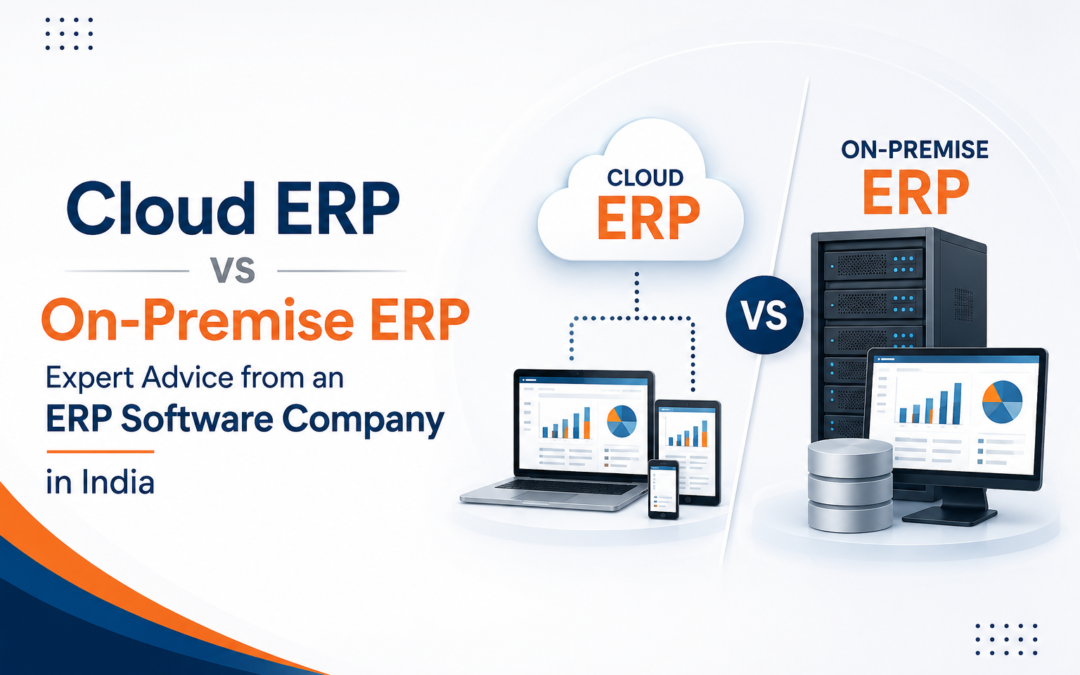
The primary difference in cloud vs on premise ERP is where the software and data are hosted and who manages the infrastructure.
Cloud ERP is hosted externally and accessed online. On-premise ERP runs on the company’s own infrastructure.
This difference influences implementation cost, system control, upgrades, data access, scalability, and technical responsibilities.
Compare Initial and Long-Term Costs
Cloud ERP usually has a lower upfront infrastructure cost because the organization does not need to purchase and maintain extensive server hardware.
On-premise ERP may require investment in servers, networking, operating systems, databases, security tools, backup systems, and IT personnel.
Businesses should calculate total cost of ownership across licensing, infrastructure, maintenance, upgrades, support, energy, security, and internal resources.
Subscription vs Capital Investment
Most hosted ERP solutions India use a subscription model based on users, modules, storage, transactions, or usage.
On-premise ERP may involve perpetual licenses or long-term licensing combined with infrastructure and annual maintenance.
The right commercial model depends on cash flow, budgeting preferences, growth expectations, and procurement policies.
Deployment Speed and Go-Live Timeline
Cloud ERP can often be deployed faster because the hosting environment is already available.
On-premise ERP may require hardware procurement, network preparation, server configuration, database installation, security setup, and performance testing before application deployment.
Implementation speed also depends on process complexity, customization, data migration, integrations, testing, and user readiness.
Scalability for Growing Businesses
Cloud ERP can usually scale users, storage, processing capacity, and locations more easily.
On-premise ERP can also scale, but the business may need additional hardware, licenses, database capacity, network upgrades, and IT support.
Organizations planning rapid expansion should evaluate how quickly each model can support new branches, plants, warehouses, teams, and transaction volumes.
Remote Access and Multi-Location Operations
Cloud ERP is designed for secure access through the internet and is well suited to multi-location operations.
Users can access dashboards, approvals, inventory, sales, production, and finance from authorized devices.
On-premise ERP can support remote access through secure VPNs or private networks, but this may require additional configuration and management.
Security in Cloud and On-Premise ERP
Security depends on architecture, implementation quality, user controls, monitoring, backups, and operational discipline.
Cloud ERP providers may offer encryption, redundancy, monitoring, access controls, security updates, and certified infrastructure.
On-premise ERP gives the organization direct control, but the company is responsible for maintaining security tools, patches, backups, firewall rules, and incident response.
Data Ownership and Control
Businesses often prefer on-premise ERP when they want direct control over physical infrastructure and database administration.
Cloud ERP customers still retain ownership of their business data, but hosting and infrastructure are managed by the provider or cloud platform.
Contracts should clearly define data ownership, access, export, retention, backup, recovery, and termination procedures.
Backup and Disaster Recovery
Cloud ERP typically includes scheduled backups, infrastructure redundancy, and disaster-recovery options.
On-premise ERP requires the organization to design, test, and maintain its own backup and recovery process.
A reliable recovery strategy should include recovery time objectives, recovery point objectives, offsite copies, restoration tests, and documented responsibilities.
Software Updates and Maintenance
Cloud ERP updates are usually managed by the provider, reducing the workload on the internal IT team.
On-premise ERP upgrades may require planning, testing, database changes, server preparation, and application downtime.
Businesses should confirm how updates affect customizations, integrations, reports, user interfaces, and operational continuity.
Customization and Configuration
Both deployment models can support configuration and customization, but the available level depends on the ERP platform and architecture.
On-premise ERP may allow deeper infrastructure-level control, while modern cloud ERP platforms often provide configurable workflows, APIs, extensions, and low-code tools.
Excessive customization should be avoided because it increases cost, upgrade complexity, and long-term maintenance.
Integration with Business Systems
ERP may need to connect with CRM, eCommerce, banking, payroll, logistics, machines, barcode systems, mobile applications, and business intelligence tools.
Cloud ERP commonly uses APIs and secure web services for integration.
On-premise ERP can support APIs, database connections, middleware, and internal network integrations, but these must be managed carefully.
Performance and Internet Dependence
Cloud ERP performance depends on internet quality, application design, infrastructure location, network routing, and workload.
On-premise ERP may offer strong local network performance, especially where factory or warehouse internet connectivity is unreliable.
Businesses should test realistic transaction volumes, reports, integrations, and remote access before making a final decision.
Compliance and Industry Requirements
Some organizations have regulatory, contractual, or customer requirements governing where data is stored and how it is accessed.
The selected model should support audit logs, access controls, retention rules, encryption, backup, and reporting requirements.
Compliance decisions should involve management, legal, IT, finance, and relevant operational teams.
Cloud and On-Premise ERP for Manufacturing
Manufacturers need BOM, MRP, production planning, shop-floor reporting, quality, maintenance, inventory, costing, and dispatch.
A specialized Manufacturing ERP Software solution can be deployed in the cloud, on-premise, or through a hybrid model depending on factory connectivity, machine integration, security, and operational requirements.
The selected model should support uninterrupted production processes and accurate real-time data.
ERP Deployment for Trading Businesses
Trading companies need fast access to purchasing, sales, pricing, inventory, credit control, billing, and finance.
A dedicated Trading ERP Software solution is often well suited to cloud deployment because teams may operate across multiple branches, warehouses, and sales locations.
On-premise deployment may still be preferred where internal infrastructure and specific control requirements are important.
ERP Deployment for Logistics Operations
Logistics businesses require shipment planning, fleet coordination, freight management, route control, proof of delivery, and reconciliation.
A specialized Logistics ERP Software platform can benefit from cloud access because operational teams, drivers, branches, and customers may need real-time information.
A hybrid setup may be useful when local operations must continue during temporary connectivity issues.
ERP Deployment for Healthcare Organizations
Healthcare organizations manage finance, procurement, inventory, assets, departments, vendors, billing, and compliance-sensitive information.
A dedicated Healthcare ERP Software solution should be evaluated carefully for data security, access control, availability, backup, integration, and regulatory requirements.
Both cloud and on-premise deployment can be appropriate depending on governance, infrastructure, and risk policies.
ERP Deployment for Education Institutions
Schools, colleges, and education groups manage admissions, fees, attendance, academics, payroll, procurement, finance, and communication.
A specialized Education ERP Software solution often benefits from cloud access for students, parents, teachers, administrators, and management.
Institutions should evaluate privacy, scalability, user access, integration, and support before deployment.
When Hybrid ERP Is the Better Option
Hybrid ERP combines cloud services with on-premise systems or local operational components.
For example, a factory may keep machine-connected functions locally while using cloud dashboards, CRM, analytics, or mobile access.
Hybrid ERP can provide flexibility, but it requires careful integration, data synchronization, security, monitoring, and support.
Hosted ERP Solutions India
Hosted ERP solutions India place the ERP application on infrastructure managed by a hosting provider.
Hosted ERP may offer dedicated environments, managed backups, controlled upgrades, and remote access.
Businesses should confirm whether the solution is truly cloud-native, privately hosted, single-tenant, multi-tenant, or simply an on-premise application running on a remote server.
Factors to Consider Before Choosing a Model
Review business size, locations, internet quality, IT team strength, data sensitivity, customization, integrations, budget, growth, security, compliance, and support requirements.
The decision should be supported by a documented comparison.
Each stakeholder should understand the benefits, costs, responsibilities, risks, and limitations of the selected deployment model.
Questions to Ask an ERP Software Company in India
Ask where the application and data will be hosted, who manages backups, how upgrades work, what happens during downtime, and how data can be exported.
Also ask about security controls, infrastructure certifications, disaster recovery, integration, customization, performance, support, and exit procedures.
A professional provider should answer these questions clearly and provide written commitments.
Migrating from On-Premise ERP to Cloud ERP
Migration requires data assessment, process review, integration planning, security design, cleansing, testing, reconciliation, training, and cutover planning.
Businesses should not move every historical record without evaluating its usefulness and quality.
A phased migration can reduce risk and allow teams to validate the new system before complete transition.
Can a Business Move from Cloud to On-Premise?
Moving from cloud to on-premise may be possible, but it depends on the ERP architecture, database access, licensing, data-export options, and infrastructure requirements.
Organizations should evaluate portability before signing a contract.
The agreement should define how data, documents, configurations, and transaction history can be retrieved if the relationship ends.
Implementation Best Practices
Begin with process discovery, requirement definition, fit-gap analysis, and deployment-model selection.
Prepare data, integrations, infrastructure, users, security, and acceptance criteria before configuration begins.
Test real business scenarios and establish support, backup, monitoring, and escalation procedures before go-live.
Why Choose Logicraftz Solutions LLP
Logicraftz Solutions LLP provides ERP consulting, implementation, customization, migration, integration, AI automation, UI/UX, application development, and long-term support.
We help businesses compare cloud ERP software India, on premise ERP software India, hosted ERP, private cloud, and hybrid deployment options.
Our recommendations are based on business processes, security, scalability, infrastructure, cost, users, locations, integrations, and long-term growth.
Expert Recommendation: Cloud or On-Premise?
Cloud ERP is often suitable for organizations seeking faster deployment, remote access, easier scalability, and reduced infrastructure management.
On-premise ERP may be suitable for organizations requiring direct infrastructure control, specialized local integrations, or strict internal hosting.
The right choice depends on the organization. A structured assessment is more reliable than a universal recommendation.
Final Thoughts
The cloud vs on premise ERP decision should support operational reliability, security, scalability, accessibility, and financial sustainability.
Businesses evaluating ERP deployment models India should compare cloud, on-premise, hosted, private cloud, and hybrid options carefully.
With the right ERP partner, organizations can select and implement a deployment model that supports present operations and future digital transformation.
Cloud ERP vs On-Premise ERP Comparison Table
| Factor | Cloud ERP | On-Premise ERP |
|---|---|---|
| Hosting | Hosted on provider or cloud infrastructure. | Hosted on company-owned or controlled servers. |
| Initial Cost | Usually lower infrastructure investment. | Usually higher server and setup investment. |
| Maintenance | Mostly managed by provider. | Managed by internal IT or support partner. |
| Scalability | Usually faster to expand. | May require hardware and license upgrades. |
| Remote Access | Designed for online, multi-location access. | Requires VPN or secure network configuration. |
| Control | Provider manages infrastructure. | Organization controls infrastructure. |
| Updates | Usually provider-managed. | Organization plans and executes upgrades. |
| Internet Dependency | Requires reliable connectivity. | Can operate primarily on local network. |
| Backup & Recovery | Often included as a managed service. | Must be designed and maintained internally. |

Explore Logicraftz ERP Services
Connect with Logicraftz Solutions LLP
Follow Logicraftz for ERP, CRM, AI automation, software integration, and digital transformation insights.
Useful ERP Resources
Frequently Asked Questions
What is cloud ERP software India?
It is ERP software hosted on remote infrastructure and accessed securely through the internet.
What is on premise ERP software India?
It is ERP software installed on infrastructure owned or controlled by the organization.
Which is better in cloud vs on premise ERP?
The better option depends on cost, control, security, internet reliability, IT resources, compliance, integration, and growth.
What are hosted ERP solutions India?
They are ERP applications operated on infrastructure managed by a hosting or technology provider.
What are the main ERP deployment models India?
They include cloud ERP, on-premise ERP, private cloud ERP, hosted ERP, and hybrid ERP.
Is cloud ERP secure?
Cloud ERP can be secure when supported by strong access control, encryption, monitoring, backups, and governance.
Can on-premise ERP support remote teams?
Yes, but secure VPN, network, identity, and access-control infrastructure may be required.
Can Logicraftz help select the deployment model?
Yes. Logicraftz evaluates process, infrastructure, security, cost, locations, integrations, scalability, and support requirements.
Choose the Right ERP Deployment Model with Logicraftz
Get expert guidance for cloud ERP, on-premise ERP, hosted ERP, private cloud, hybrid ERP, migration, integration, security, training, and support.
Table of Contents
Businesses across India are increasingly adopting cloud ERP software India because it offers flexibility, scalability, and real-time accessibility. Unlike traditional systems, cloud ERP software India allows employees to securely access business data from offices, factories, warehouses, or remote locations using an internet connection. This improves collaboration between departments while reducing dependency on expensive on-site infrastructure. Organizations looking for future-ready ERP deployment models India often choose cloud ERP because it supports faster implementation, automatic software updates, and easier expansion as the business grows.
On Premise ERP Software India Still Delivers Strong Business Control
While cloud technology is growing rapidly, on premise ERP software India remains an excellent option for organizations that require complete infrastructure control. Businesses with strict security policies or specialized compliance requirements often prefer on premise ERP software India because all servers, databases, and applications remain within their own environment. Companies can customize infrastructure according to internal standards while maintaining direct control over data management, backups, and system performance. For organizations comparing cloud vs on premise ERP, understanding internal operational requirements is more important than simply following market trends.
Cloud vs On Premise ERP: Which Solution Fits Your Business?
The debate around cloud vs on premise ERP depends on several business factors rather than one universal answer. Cloud ERP software India generally offers lower initial investment, faster deployment, and easier scalability, making it ideal for growing organizations with multiple branches. In contrast, on premise ERP software India provides greater infrastructure ownership and may suit businesses with complex local integrations or regulatory requirements. When evaluating cloud vs on premise ERP, companies should compare implementation costs, maintenance responsibilities, internet reliability, business continuity, security, and long-term operational goals before selecting the right ERP platform.
Hosted ERP Solutions India Support Business Growth
Modern hosted ERP solutions India provide businesses with the advantages of managed infrastructure without requiring significant investment in server hardware. With hosted ERP solutions India, software hosting, backups, monitoring, and updates are generally managed by experienced technology providers. This allows internal teams to focus on business operations instead of server administration. Organizations expanding into multiple locations often benefit from hosted ERP solutions India because users can securely access centralized information while maintaining consistent business processes across departments, branches, and warehouses.
ERP Deployment Models India Help Businesses Scale Efficiently
Understanding different ERP deployment models India is essential before beginning an ERP implementation project. Businesses can choose from cloud ERP, on-premise ERP, private cloud, hosted ERP, or hybrid ERP depending on operational requirements. Selecting the right ERP deployment models India helps organizations improve scalability, optimize infrastructure costs, strengthen security, and support future expansion. Logicraftz Solutions LLP helps businesses evaluate cloud ERP software India, on premise ERP software India, cloud vs on premise ERP, and hosted ERP solutions India to recommend the most suitable deployment strategy based on business processes, IT infrastructure, security requirements, and long-term digital transformation goals.
Why Cloud ERP Software India Is Becoming the Preferred Choice
Aaj ke fast-growing business environment mein companies ko aise ERP solution ki zarurat hai jo flexible, secure aur future-ready ho. Isi wajah se cloud ERP software India businesses ke liye preferred choice banta ja raha hai. Cloud-based ERP employees ko office, factory, warehouse ya remote location se real-time business data access karne ki facility deta hai, jisse collaboration aur decision-making dono improve hote hain. Saath hi, businesses ko expensive server infrastructure maintain karne ki zarurat nahi padti.
Modern ERP deployment models India organizations ko faster implementation, automatic software updates aur easy scalability provide karte hain, jisse companies apni digital transformation journey ko smoothly accelerate kar sakti hain.
Har business ki operational requirements alag hoti hain, isliye ERP deployment ka decision bhi carefully evaluate karna chahiye. Kuch organizations ke liye on premise ERP software India complete infrastructure control aur enhanced security provide karta hai, jabki growing businesses ke liye hosted ERP solutions India aur cloud-based platforms lower maintenance aur better accessibility offer karte hain.
Cloud vs on premise ERP comparison karte waqt companies ko cost, scalability, security, compliance aur long-term business goals ko dhyan mein rakhna chahiye. Logicraftz Solutions LLP businesses ko cloud ERP software India, on premise ERP software India, hosted ERP solutions India, aur suitable ERP deployment models India select karne mein expert guidance provide karta hai, taaki har organization apni business needs ke according best ERP strategy choose karke sustainable growth aur long-term digital success achieve kar sake.
Leading ERP Software Company in India Helping SMEs Scale Faster with AI & Automation
ERP Software Company in India: Cost, Implementation Process & ROI Explained
AI-Powered ERP Software Company in India: The Future of Business Automation
Top 10 Features Every ERP Software Company in India Should Offer
Cloud ERP vs On-Premise ERP: Expert Advice from an ERP Software Company in India
Best ERP Software Company in India for Manufacturing, Trading & Distribution
Why Indian Manufacturers Need a Trusted ERP Software Company in India
ERP Software Company in India: Complete Guide to Digital Transformation
How to Choose the Best ERP Software Company in India for Your Business
Top ERP Software Company in India | Business Management Solutions 2026
Award Winning Web Developer Near Me | Premium Quality Websites
Trusted Website Developer Near Me – See Portfolio & Reviews
Website Developer Near Me vs Online Agencies – Which is Better
Best Reviewed Website Developer Near Me – Real Client Results
Top 10 Website Developers Near Me – Reviewed & Rated
Why Hiring a Website Developer Near Me Is the Smart Choice
Tell Me About the Best Website Developer Near Me
Website Developer Near Me – SEO + AI Integration Experts
How Much Does a Website Developer Near Me Cost
What to Look for in a Website Developer Near Me
How Do I Find a Reliable Website Developer Near Me